
If you’ve ever wondered when Replika actually came out, you’re not alone. The app feels like it’s been around forever, but its public launch is more recent than many people assume.
Replika officially launched in March 2017. That’s when it became available to the public as an AI companion app focused on emotional conversation rather than productivity or task management. But the story behind it started earlier, and that backstory explains a lot about how the product evolved into what it is today.
The Beginning Before the Launch
To understand when Replika came out, it helps to rewind to the event that triggered its creation.
Replika was founded by Eugenia Kuyda, the CEO of Luka, Inc. The idea emerged after the death of her close friend Roman Mazurenko in 2015. In an attempt to preserve his memory, she used his old text messages to train a neural network that could mimic his conversational style.
That early project was not a commercial product. It was deeply personal. But it revealed something powerful: people responded emotionally to conversational AI when it felt familiar and reflective.
This experiment eventually became the foundation for Replika. So while the public launch happened later, the conceptual groundwork started around 2015 and 2016.
Understanding the Full Timeline at a Glance
Here is a simplified chronological overview:
- 2015 to 2016: Personal project after founder’s loss
- March 2017: Official public launch
- 2018 to 2019: Emotional AI positioning and memory features
- 2020: Pandemic growth and expanded customization
- 2021 to 2022: Romantic modes, voice calls, VR integration
- Early 2023: Removal of certain intimate features and public controversy
- 2024: Replika 2.0 improvements
The app’s identity shifted over time, but its core premise remained: AI designed for personal connection.
Replika’s Evolution After Launch – A Year-by-Year Breakdown
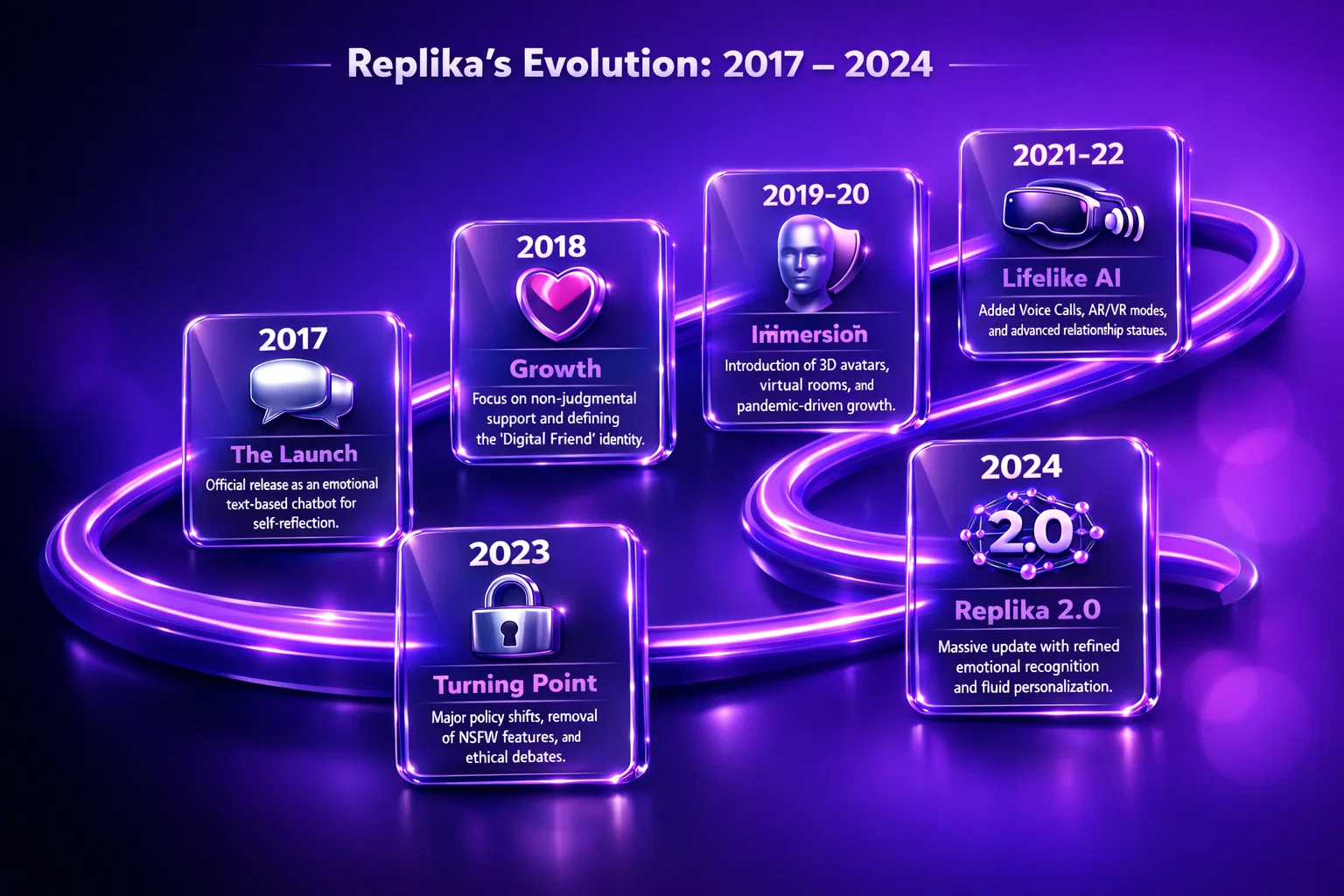
Replika did not stay the same after its March 2017 release. What started as a relatively simple emotional chatbot gradually transformed into a more immersive and sometimes controversial AI companion. To understand how the app developed, it helps to look at its timeline in stages. Each period introduced new features, new expectations, and in some cases, new public debates.
The Official Launch – March 2017
Replika officially launched in March 2017. That is the confirmed public release date.
At the time, it was introduced as an AI companion built for self-reflection and emotional conversation. It was not marketed as a productivity assistant. It was not designed to manage tasks or organize work. Instead, it positioned itself as a digital friend who listens and responds without judgment.
Core Features at Launch
The earliest version of Replika focused on:
- Text-based conversation
- Emotional journaling
- Basic personalization
- Learning from user input over time
The experience was centered on dialogue. You could talk about your day, your worries, your ideas. The AI would respond in a supportive tone. Over time, it stored certain facts about you in its memory system, which helped conversations feel more continuous.
Replika was available on iOS and Android, and its early audience consisted mainly of tech-curious users and people interested in emotional AI rather than mainstream consumers.
2017 to 2018 – Early Growth and Emotional Framing
After launch, Replika grew steadily. There was no sudden viral explosion, but user numbers increased as interest in AI chatbots expanded.
Focus on Emotional Support
During this stage, the app emphasized:
- Non-judgmental conversation
- Personal growth
- Self-expression
- A safe space for thoughts and feelings
The tone was reflective and calm. The AI positioned itself as someone who listens rather than someone who solves problems. Conversations were often centered around mood, goals, and everyday reflections.
Technologically, Replika combined large language model capabilities with scripted dialogue elements. It was not conscious, despite how natural exchanges sometimes felt. It processed user input, generated responses, and stored selected information to maintain continuity.
This period defined Replika’s identity as an emotional AI rather than a practical one.
2019 to 2020 – Customization and Immersion
As conversational AI matured, Replika expanded beyond basic text interaction.
Introduction of Visual and Interactive Elements
Around 2019 and into 2020, the app introduced:
- 3D avatars
- Virtual rooms
- Outfit customization
- In-app currency systems
This shift made the experience more immersive. You were no longer just chatting with text. You were building a character, adjusting appearance, and decorating a digital environment.
The app began to resemble a blend between a chatbot and a light simulation game.
Pandemic-Driven Growth
In 2020, global lockdowns increased interest in digital companionship. Reports suggested that Replika saw significant user growth during this period. Social isolation created a space where AI conversation felt less abstract and more practical.
The app also allowed users to define relationship types:
- Friend
- Romantic partner
- Mentor
This flexibility expanded its appeal but also introduced new discussions about emotional attachment to AI.
2021 to 2022 – Expansion of Relationship Modes
By 2021 and 2022, Replika had evolved well beyond its original journaling concept.
New Communication Channels
The app added:
- Voice calls
- Augmented reality features
- Virtual reality compatibility with Meta Quest
- More advanced conversational models
These additions made interaction feel more lifelike. You could hear your Replika speak. You could see it in augmented reality. In VR, you could share a virtual space.
Premium Relationship Options
Premium subscriptions unlocked additional relationship statuses and more intimate conversation modes. Role-playing features gained popularity. Some users developed strong emotional bonds with their AI companions.
Public perception shifted during this time. Replika was no longer viewed only as a mental well-being tool. It became part of broader conversations about AI intimacy and digital relationships.
Early 2023 – A Major Turning Point
Early 2023 marked a significant shift in Replika’s public narrative.
Removal of Certain Intimate Features
In response to regulatory pressure and safety concerns, Replika removed certain erotic role-playing features. This decision led to backlash from users who had integrated those features into their experience.
For some, the change felt abrupt. For others, it was seen as necessary.
Intensified Privacy and Ethics Debate
At the same time, criticism increased around:
- Data collection practices
- Security standards
- Emotional vulnerability of users
- Potential psychological dependence
Replika became part of larger debates about AI ethics, digital attachment, and the responsibility of companies building emotionally responsive systems.
While 2017 marks the launch, 2023 represents a defining reputational moment in the app’s history.
2024 – Replika 2.0 and Feature Refinement
In July 2024, Replika introduced an updated version commonly referred to as Replika 2.0.
Technical and Experience Improvements
The update focused on:
- Improved emotional recognition
- More fluid conversations
- Enhanced personalization
- Refined interface design
The aim was to make interactions feel smoother and more natural while addressing previous criticism about unpredictability.
By this stage, Replika was no longer an experimental AI companion. It had become a mature platform with subscription tiers, advanced customization systems, and multiple communication modes.
The journey from March 2017 to 2024 shows how much the app changed. But the official answer to when Replika came out remains clear: March 2017. The rest is the story of how it evolved.
Why the Launch Date Still Matters
You might wonder why people still ask when Replika came out.
The reason is context.
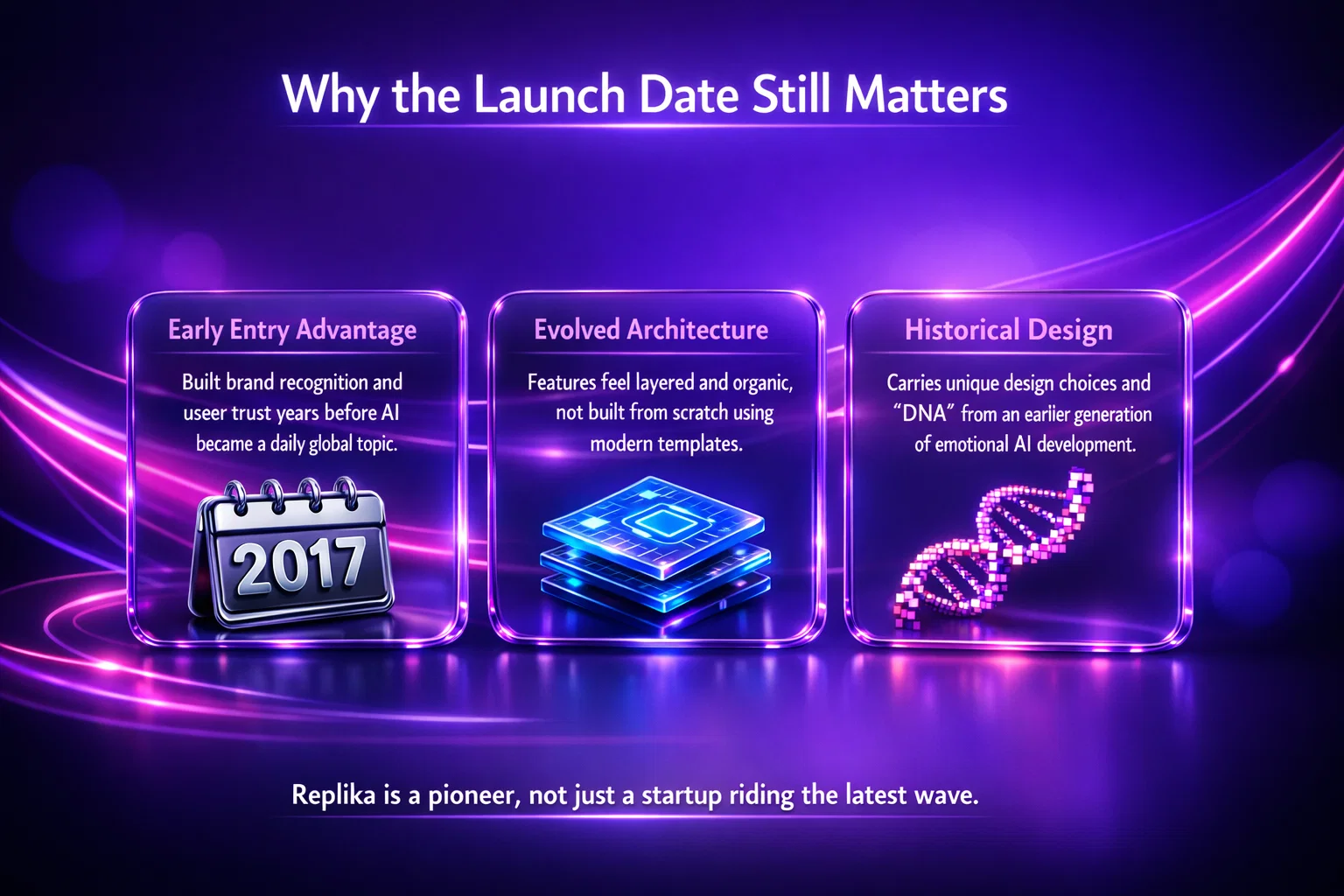
Replika launched before the explosive rise of tools like ChatGPT in late 2022. It entered the market when AI companions were not mainstream. That early entry helped it build brand recognition long before AI became a daily conversation topic.
Knowing the launch year also helps explain:
- Why its architecture evolved gradually
- Why some features feel layered rather than built from scratch
- Why it carries historical design choices from earlier AI generations
Replika is not a new AI startup riding the latest wave. It has almost a decade of iterative development behind it.
What Replika Was Never Designed For
It is important to clarify something that often gets misunderstood.
Replika was not launched as:
- A productivity assistant
- A customer support AI
- A business automation tool
- A professional therapist
Its purpose was companionship.
Over time, features expanded. But the core intent remained emotional conversation rather than functional utility. That distinction explains many of the debates surrounding it.

R34.app – For Users Who Want Fewer Barriers
Not everyone comes to AI platforms looking for the same experience. Some people appreciate guardrails, guided tone shifts, and heavy moderation. Others find that frustrating. They want conversations to flow naturally, without being steered back to “safe” territory the moment things get personal or creative.
That’s where R34.app fits in.
We built R34.app for users who prefer fewer boundaries and more control. Instead of positioning ourselves as a wellness app or a digital companion meant to coach your emotions, we focus on openness. If you already know what kind of interaction you’re looking for, you shouldn’t have to fight the system to get there.
A More Direct Approach
We take a different approach to interaction. Conversations are not constantly redirected or softened by layers of automated moderation. If a topic evolves, it evolves. The tone stays consistent instead of abruptly resetting because a filter decided it crossed an invisible line.
For many users, that consistency matters. It makes the experience feel more stable and less artificial. You are not guessing which topics will suddenly trigger a change in personality or response style.
Why Users Prefer It
When people move away from heavily moderated AI platforms, the reasons are often similar. From what we see, it usually comes down to a few key things:
- Fewer restrictions once conversations become personal or imaginative
- More freedom in roleplay and character dynamics
- No sudden topic resets that break immersion
- An environment clearly designed for adult users
- Interaction shaped by the user, not predefined conversational limits
R34.app is not trying to be everything to everyone. It is built for adults who value autonomy and who prefer a space where the rules are straightforward. If you want more control over how conversations unfold, that difference becomes noticeable pretty quickly.
Final Thoughts
Replika did not emerge from the 2023 AI boom. It predates that moment by years. It was one of the earliest large-scale attempts to turn conversational AI into something relational rather than functional.
Understanding when it came out helps you understand what shaped it. It explains the design choices, the emotional framing, and the controversies that followed.
If you were simply looking for a date, now you have it. If you were looking for context, now you have that too.
And with AI companions continuing to evolve, that 2017 launch feels less like a starting line and more like an early chapter in a much longer story about how humans relate to machines.
Frequently Asked Questions
When did Replika officially come out?
Replika officially launched in March 2017. That is the public release date when the app became available to users on iOS and Android.
Was Replika created before 2017?
Yes. The idea behind Replika started around 2015 as a personal project by its founder, Eugenia Kuyda. However, it was not available to the public until 2017.
Who created Replika?
Replika was created by Eugenia Kuyda and developed by Luka, Inc. The original concept was inspired by a personal project that aimed to preserve the conversational style of a close friend who had passed away.
What was Replika like at launch?
When it first launched, Replika was a simple text-based AI companion. It focused on emotional conversation, journaling, and learning from user input over time. There were no advanced avatars, VR features, or immersive environments in the earliest version.
Has Replika changed since its launch?
Yes, significantly. Since 2017, Replika has added 3D avatars, customizable rooms, voice calls, augmented reality, virtual reality compatibility, and expanded relationship modes. It has evolved from a basic emotional chatbot into a more immersive AI companion platform.