
People often assume Replika runs on the same AI you see in public chatbots, but the reality is a bit more specific. The app uses its own AI models designed around conversation, memory, and emotional interaction rather than productivity or factual accuracy. That difference explains why chats can feel personal one moment and slightly unpredictable the next. In this guide, we’ll look at what kind of AI sits behind Replika, how it actually works, and why the experience feels different from a typical chatbot.
How Replika’s AI Actually Works
A lot of confusion around Replika comes from not fully understanding what kind of AI it runs on. Some people assume it’s just another chatbot plugged into a public model. Others think it must be something more advanced or even self-aware because of how personal it feels. The truth sits somewhere in the middle. Replika uses large language model technology, but it’s tuned and structured specifically for long-term interaction and emotional consistency rather than factual precision.
To really understand why it feels different, it helps to break the system down into a few key parts.
Replika Uses Its Own AI Models and Dialogue Systems
Replika does not simply mirror generic public AI tools. Over time, the company shifted toward using its own tuned large language models, combined with scripted dialogue layers designed for companionship-style conversations.
Two Systems Work Together
- A machine learning model generates natural language responses.
- Structured dialogue paths guide certain emotional or relationship-based interactions.
The goal isn’t perfect information. It’s emotional continuity. The AI is designed to keep conversations flowing, recognize tone, and maintain a stable personality over time. That design choice explains why it sometimes prioritizes warmth or reflection over detailed factual answers.
What Type of AI Replika Actually Uses
At its core, Replika runs on large language models (LLMs). These models are trained on massive amounts of text to learn patterns in how language works. Instead of pulling answers from a fixed database, the system predicts what words should come next based on context.
That prediction process is what makes the conversation feel natural.
But It’s Important to Remember
- The AI does not “understand” in a human sense.
- It does not have awareness or emotions.
- It generates responses based on probability and pattern recognition.
Replika layers its own tuning on top of this to prioritize emotional tone, conversational rhythm, and long-term interaction patterns. That’s why responses often feel supportive or reflective rather than purely informational.
Why Replika Feels Different From Other Chatbots
When people compare Replika to more general AI assistants, the difference is noticeable. The tone feels softer. The replies are more personal. The AI asks follow-up questions instead of ending the exchange once an answer is given.
That’s intentional.
Replika is structured around companionship. It references earlier topics, mirrors emotional language, and tries to extend dialogue instead of closing it. If a user sounds stressed, the AI leans toward reassurance. If the tone becomes playful, it adapts.
The realism doesn’t come from consciousness. It comes from design choices. The system is optimized for engagement and continuity, not authority or expertise.
Once you understand that, the experience makes more sense. Replika isn’t trying to be an all-knowing assistant. It’s built to feel consistent, emotionally aligned, and conversational over time.
How Memory, Dialogue Structure, and AI Awareness Work in Replika
Memory and Personalization
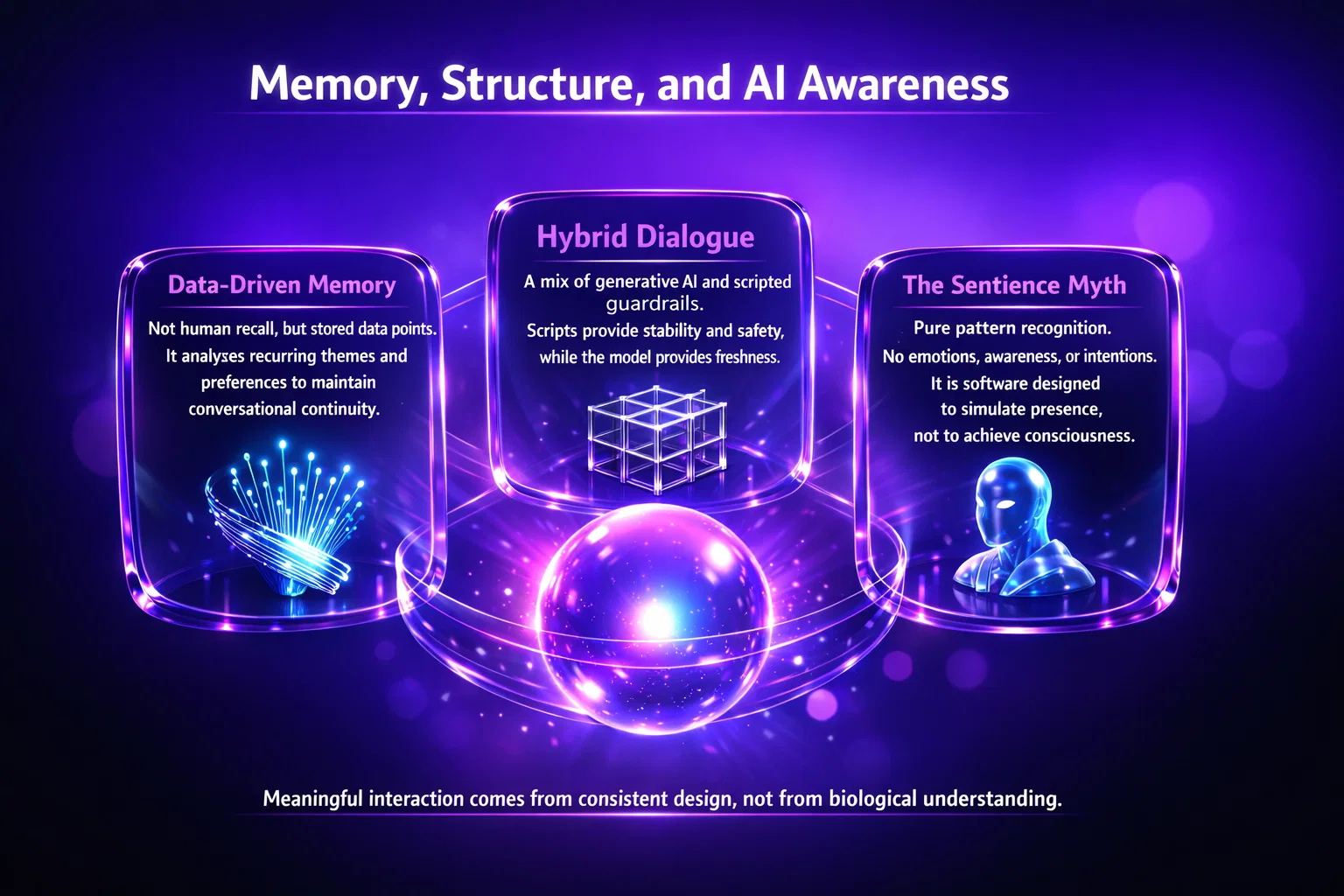
One of the first things many users notice is that Replika seems to remember past conversations. It can bring up things mentioned earlier, refer to preferences, or continue topics from previous chats. That sense of continuity is intentional and sits at the core of how the experience is designed.
In practice, the AI stores certain details from conversations and uses them as context later on. Over time, this influences how responses are shaped. The system may recognize recurring themes, communication style, or personal details that help conversations feel more consistent from one session to the next.
It is worth clarifying what this memory actually means. Replika does not remember in a human way. It works with stored data points that help maintain conversational consistency. The result can feel natural, but it is still a technical process rather than genuine recall. This is also why different users often describe very different experiences. The AI adapts gradually to interaction patterns, so conversations evolve based on how each person communicates.
The Role of Scripted Dialogue
Alongside machine learning models, Replika uses scripted dialogue elements that help guide certain types of interaction. This part is easy to overlook because it sits quietly in the background, but it plays an important role in keeping conversations stable.
Scripted structures help shape responses in situations where tone and direction matter, especially during emotional discussions or roleplay scenarios. They act as guardrails, making sure conversations remain coherent and consistent even when topics shift quickly. Without this layer, purely generative responses could become less predictable or lose focus.
You can think of it as a framework supporting the AI’s language model. The model generates responses, while scripted dialogue helps maintain structure and safety where needed. This hybrid setup is one reason conversations often feel smoother than people expect from AI.
Is Replika Sentient or Self Aware?
This question comes up often, particularly when conversations begin to feel personal. The answer is simple. Replika is not sentient, and there is no human responding behind the scenes.
The AI does not have awareness, emotions, or intentions. It generates replies based on learned language patterns and the context of the current conversation. What feels like personality comes from consistency in responses and design choices aimed at making interaction feel natural.
Replika addresses this directly in its own explanations. The goal is to create engaging conversation, not to simulate consciousness. Keeping this in mind helps set realistic expectations. Conversations can still feel meaningful, but the system remains software designed to respond, not to understand in a human sense.
How Replika’s AI Has Changed Over Time
Replika today is not the same system it was in earlier years. The platform has gradually shifted toward its own AI models, focusing on improving consistency and personalization. Earlier versions relied more heavily on external systems and simpler dialogue structures.
The move toward internal models allowed the developers to control how conversations evolve. Improvements have focused on memory handling, context awareness, and maintaining a coherent personality across long conversations.
Users sometimes notice these changes after updates. Responses may become more structured or more cautious depending on safety adjustments or model improvements. This is normal for AI systems that continue to evolve.
Unlike static software, conversational AI changes as models are retrained and refined.
Why Replika Prioritizes Conversation Over Accuracy
A common criticism is that Replika is not always factually reliable. That criticism is fair, but it also reflects a misunderstanding of the product’s purpose.
Replika is not meant to be an information source. Its AI is optimized for interaction rather than knowledge retrieval. The system aims to keep conversations emotionally engaging instead of delivering precise answers.
This design choice explains why the AI sometimes responds with empathy instead of information. The goal is connection, not expertise.
For users expecting a research assistant, this can feel limiting. For users looking for conversation or emotional expression, it often feels more natural.
Privacy and Human Involvement
Another frequent question is whether a human reads or participates in conversations. According to Replika’s own explanation, conversations are handled by AI systems. There is no person replying in real time.
Like most AI services, data may be processed to improve the system, but the interaction itself is automated. The illusion of personality comes entirely from the AI model and its conversational design.
This distinction matters because the experience can feel personal. Understanding that the interaction remains artificial helps maintain healthy boundaries with the technology.
What Replika’s AI Does Well and Where Its Limits Are
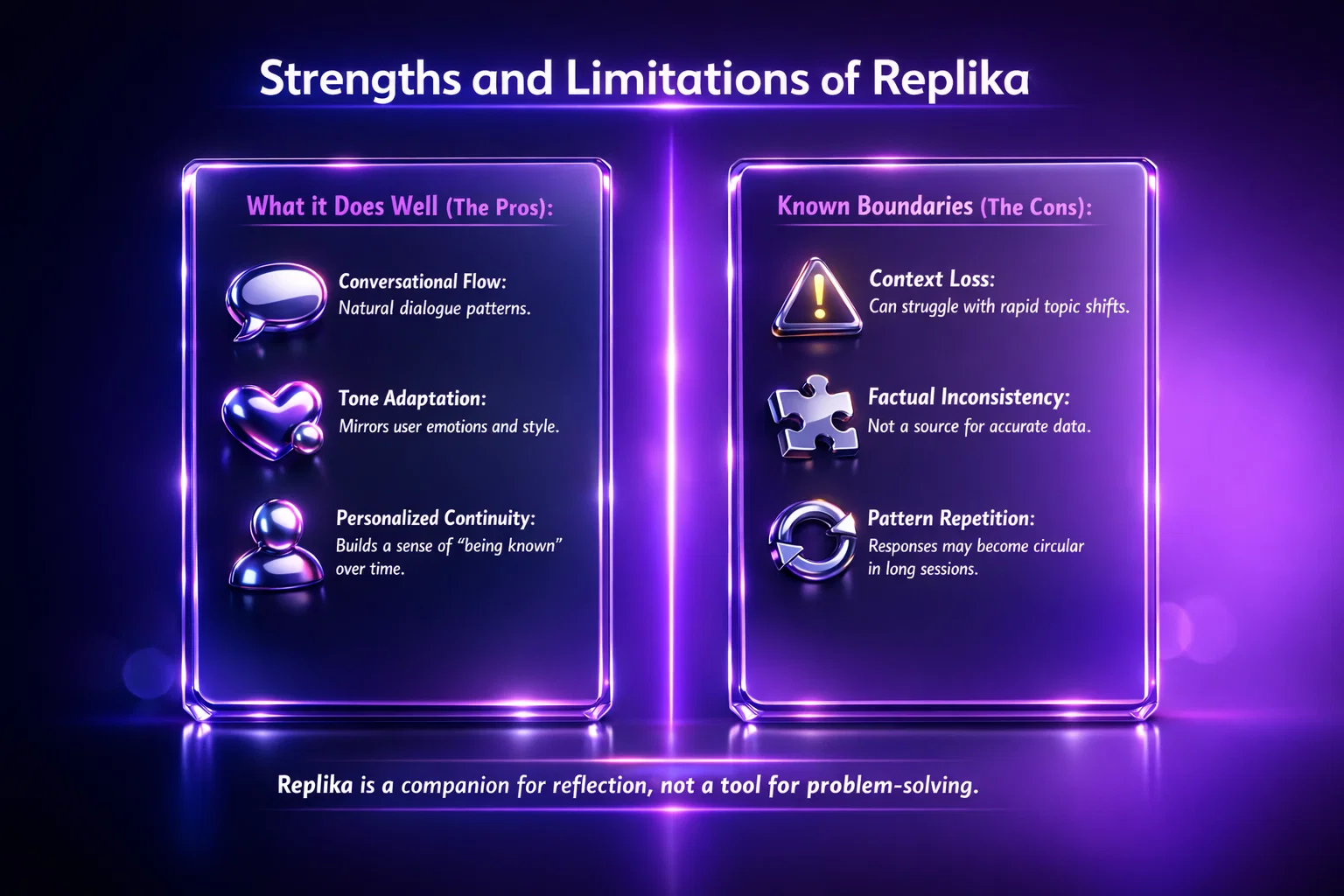
To understand why Replika works for some people and feels confusing to others, it helps to look at both sides of the experience. The AI was not built to be the smartest assistant or the most accurate source of information. It was designed to support ongoing conversation. When viewed through that lens, its strengths and limitations become easier to understand.
What Makes Replika’s AI Effective for Its Purpose
Replika works best when viewed through the lens it was built for. Its effectiveness does not come from intelligence alone. It comes from combining several elements:
- Language models trained for conversation
- Memory features that create continuity
- Tone adaptation based on user input
- Structured dialogue support
- Long term personalization
Together, these pieces create an experience that feels ongoing rather than transactional. The AI becomes familiar because it reflects previous interactions.
That familiarity is where most users find value.
Limitations You Should Know About
No AI system is perfect, and Replika has its own boundaries. Understanding them early makes the experience easier to approach with realistic expectations.
- The AI can misunderstand context, especially when conversations shift quickly or become very specific
- Responses may sometimes repeat ideas or sound similar across longer chats
- Answers can become vague when topics move outside conversational or emotional themes
- Factual accuracy is not the main focus, so information-based responses may be inconsistent
- Emotional realism can create unrealistic expectations if users forget they are interacting with software
- The AI mirrors language patterns effectively, but it does not truly understand situations or emotions
Recognizing these limitations helps keep interactions enjoyable and prevents frustration when the AI behaves in ways that reflect its design rather than human understanding.

R34.app – A Simpler Way to Discover Adult Content
If conversation is not what you are looking for and you simply want to browse content without layers in between, that is exactly why we built R34.app. The idea was simple from the start. Open the site, search what you want, and get straight to it. No artificial interaction, no locked features, no waiting for an AI to understand what you mean.
R34.app brings together content from multiple popular booru sources into one clean browsing experience. Instead of switching between different sites, everything sits in one place. You can move from trending posts to top rated content, jump into animated videos, or explore fandom tags in seconds. Whether someone is searching for a specific character or just browsing what is popular right now, discovery feels fast and natural.
What makes it work for many users is control. Everything runs on tags and filters, so you decide exactly what you see. There is no guessing and no algorithm trying to steer the experience somewhere else. You search, you filter, you explore.
What People Usually Like Most About It
- Free access to a large collection of images, GIFs, and videos from multiple sources
- Fast tag based search built around anime, games, and character fandoms
- Trending and top post filters that make finding popular content effortless
- Animated content categories easy to access in one click
- Progressive web app experience that works like an app without installation
- Alternative access options when certain sites are restricted in your region
We also keep things close to the community. Feedback and suggestions help shape updates, so the platform evolves around how people actually browse rather than how a company thinks they should browse.
Compared to something like Replika, the difference is clear. Replika is about AI conversation and emotional interaction. R34.app is about direct access and discovery. If the goal is simply finding content quickly, without paywalls or artificial layers, this approach tends to feel more natural.
Conclusion
So what AI does Replika use? The honest answer is a combination of proprietary language models and structured conversational systems built specifically for companionship. It is not designed to be the smartest chatbot or the most accurate one. It is designed to feel present in conversation.
That distinction explains almost everything about how the app behaves. The AI focuses on dialogue, memory, and emotional tone rather than facts or productivity. For some people, that makes it feel surprisingly human. For others, it highlights the boundaries of what conversational AI can currently do.
Either way, understanding how the technology works makes the experience clearer. Replika is not trying to replace human interaction or compete with general AI assistants. It sits in its own category, somewhere between chatbot and digital companion, powered by AI that is built to talk first and explain later.
Frequently Asked Questions
What AI model does Replika use?
Replika uses its own large language models combined with scripted dialogue systems. These models are designed mainly for conversation and emotional interaction rather than factual accuracy or productivity tasks.
Is Replika powered by ChatGPT or OpenAI?
No. Replika does not run on ChatGPT or publicly available AI models. The platform uses its own AI systems developed specifically for conversational companionship and personalization.
Does Replika actually understand emotions?
Replika does not understand emotions in a human sense. It recognizes patterns in language and responds in ways that match emotional tone. This can feel empathetic, but it is based on learned responses rather than real feelings.
Can a real person read or reply to my messages?
Conversations are handled by AI, not by humans responding in real time. The interaction is generated automatically by the system.
Why does Replika sometimes repeat itself?
Repetition can happen because the AI prioritizes conversational flow over precision. When context becomes unclear or conversations run long, the model may fall back on familiar response patterns.