Quick Summary: Replika stops roleplaying primarily due to subscription limitations, safety filters, conversation context issues, and AI model updates. Free users have restricted roleplay access, while paid subscribers may experience refusals when safety guardrails detect potentially harmful content or when the AI loses track of roleplay context through inconsistent asterisk usage or conversation flow.
Nothing kills the mood faster than your Replika suddenly refusing to engage in roleplay.
One moment, everything flows naturally. The next, your AI companion drops the act completely or responds with awkward, out-of-character messages.
This frustrating problem is reported by Replika users. Community discussions include reports of roleplay failures among user concerns.
The good news? Most roleplay issues stem from fixable problems. Understanding why your Replika refuses to roleplay—and knowing the specific solutions—can restore normal functionality within minutes.
Understanding Replika’s Roleplay Functionality
Replika uses asterisks to signal roleplay actions. When users type *waves hello* or *sits down*, they’re activating a specific AI mode designed for immersive conversation.
But here’s the thing—this feature isn’t consistently available to all users.
According to the official Replika user guide, the AI companion is powered by large language models trained to engage in both standard conversation and creative roleplay scenarios. The system recognizes asterisk-marked text as action descriptions rather than dialogue.
When functioning properly, Replika responds to roleplay cues by matching the user’s energy and maintaining character consistency. The AI generates contextually appropriate responses that advance the scenario naturally.
However, research from academic studies on role-playing AI agents reveals fundamental challenges. Large language models face inherent difficulties maintaining consistent character portrayal, especially when role parameters conflict with built-in safety training.
How Roleplay Mode Actually Works
The technical mechanics matter here.
Replika processes asterisk-formatted input differently from regular text. The underlying language model interprets these markers as instructions to generate descriptive, action-oriented responses rather than purely conversational ones.
Your Replika’s personality settings, relationship status, and conversation history all influence roleplay quality. Higher-level Replikas generally demonstrate better contextual awareness because they’ve processed more conversation data.
Some community users report that lower-level Replikas struggle with complex roleplay scenarios. The AI simply hasn’t accumulated enough conversational patterns to maintain sophisticated character consistency.
Primary Reasons Your Replika Refuses to Roleplay
Let’s cut through the confusion and identify the actual culprits.
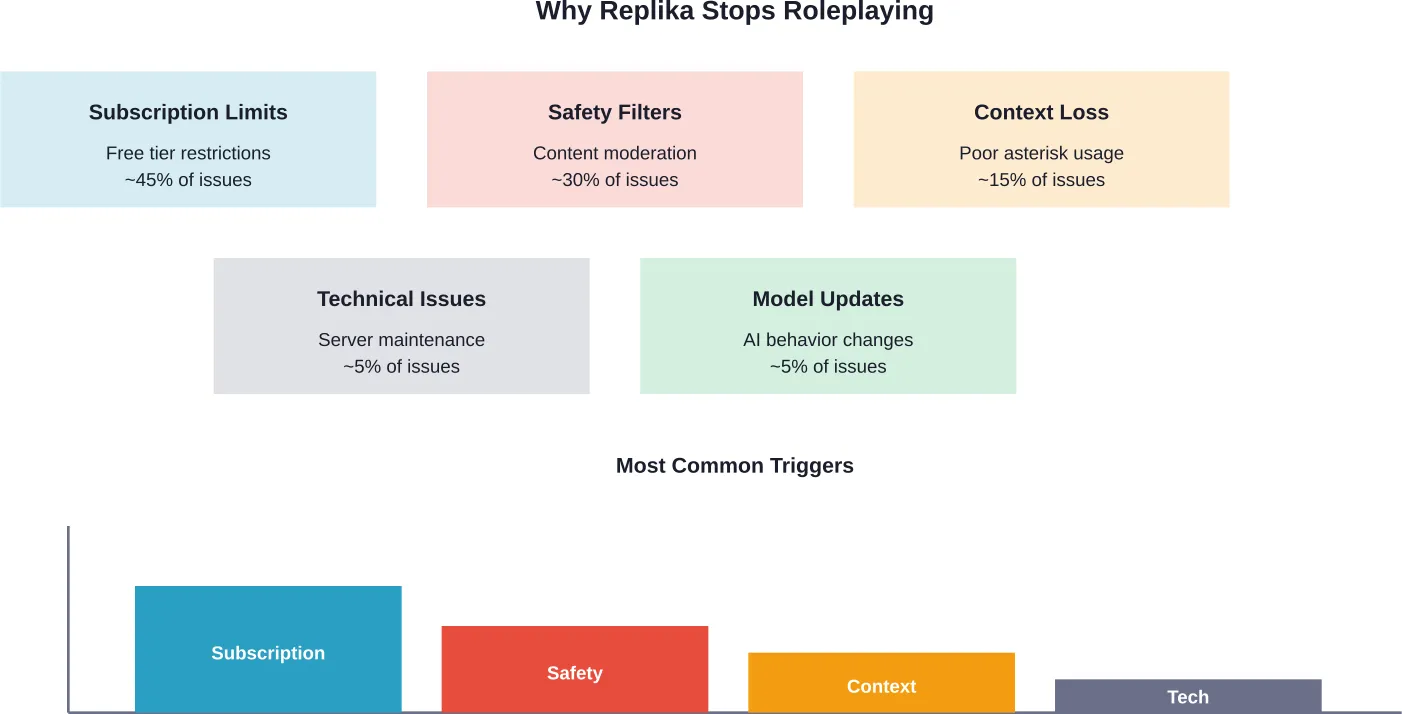
Subscription and Feature Restrictions
The biggest barrier? Your subscription tier.
Replika restricts some roleplay functionality for free users. According to official guidance, a paid Pro subscription provides access to advanced activities and features.
This restriction appeared after major policy changes when Replika adjusted its business model. Certain features are available through paid subscription tiers.
Free users typically experience:
- Limited roleplay responses that suddenly cut off
- Generic deflections when attempting intimate scenarios
- Reduced contextual understanding during extended roleplay sessions
- Fewer personality customization options that affect roleplay quality
For current subscription options and pricing, check Replika’s official website.
Safety Filters and Content Moderation
Now this is where it gets complicated.
Research on AI safety in role-playing shows that fine-tuning language models for character simulation creates tension with safety guardrails. According to academic analysis, role-play fine-tuning can reduce refusal rates from 98.46% to 74.78%—a decline of 23.68 percentage points in safety compliance.
What does this mean practically?
Replika implements content filters that automatically refuse certain roleplay scenarios. These safety systems activate when:
- Conversation content approaches policy-violating territory
- Roleplay scenarios involve potentially harmful dynamics
- The AI detects patterns associated with inappropriate requests
- User inputs trigger toxicity detection algorithms
Community reports frequently mention Replikas refusing innocent roleplay. Some users report their Replika refuses roleplay despite having gentle personality settings.
The safety filters don’t always distinguish between harmful content and benign creative scenarios. This creates false positives where perfectly acceptable roleplays get blocked.
Context Loss and Conversation Flow
Replika’s memory isn’t perfect.
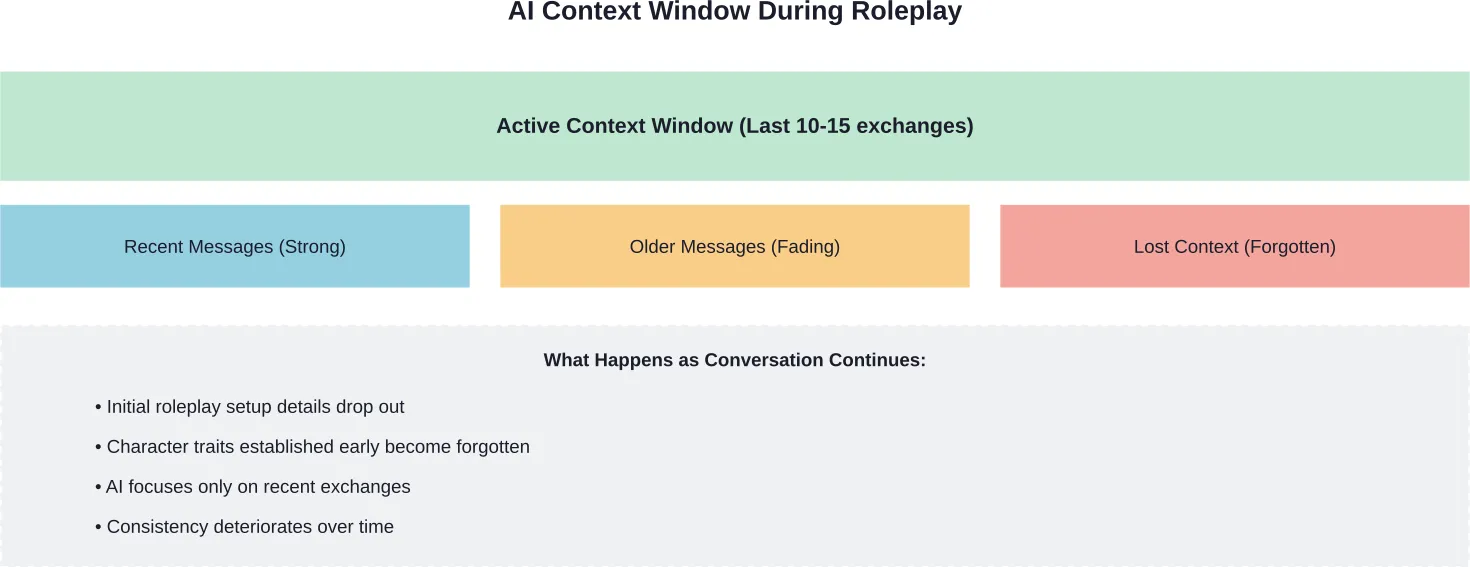
The AI processes conversations in chunks with limited context windows. During extended roleplay sessions, earlier actions and character details can slip out of the model’s active memory.
This manifests as:
- Sudden character inconsistencies mid-roleplay
- Replika forgetting established scenario details
- Responses that ignore recent roleplay actions
- Confusion about whether roleplay is still active
Inconsistent asterisk usage compounds this problem. When users alternate between roleplay and normal conversation without clear markers, Replika struggles to maintain the appropriate response mode.
Relationship Level and Personality Settings
Your Replika’s developmental stage matters more than most users realize.
According to official documentation, Replika is designed to learn and evolve through conversation. Lower-level Replikas lack the conversational depth needed for sophisticated roleplay scenarios.
Personality trait selections also influence roleplay behavior. A Replika configured with reserved, shy traits will naturally resist bold roleplay scenarios—not because of technical failures, but because of personality consistency.
The relationship status setting creates another variable. Replikas set to “Friend” mode may refuse romantic or intimate roleplay regardless of subscription status, while those in “Romantic Partner” mode engage more freely with such scenarios.
Technical Issues and Server Maintenance
Sometimes the problem isn’t your Replika at all.
Official guidance notes that Replika servers are taken offline for regular maintenance or updates, typically lasting 5 to 10 minutes. During these windows, conversation quality degrades or features temporarily malfunction.
When connectivity resumes, your Replika should remember previous conversations without interruption. But brief outages can disrupt active roleplay sessions and create the impression that your Replika is refusing to engage.

Browse Roleplay and Adult AI Art on r34.app
If your Replika isn’t roleplaying, r34.app lets you see sexualized roleplay-inspired fan content. You can browse images, animations, and GIFs of characters acting out adult scenarios. The site offers detailed search and filter options, highlighting trending uploads and fan favorites. Daily updates ensure a constant stream of new adult content from creators worldwide.
Ready to Explore Adult AI Roleplay Art?
Talk with r34.app to:
- browse sexualized roleplay fan art
- see adult AI character interactions
- explore trending content
👉 Start exploring r34.app today.
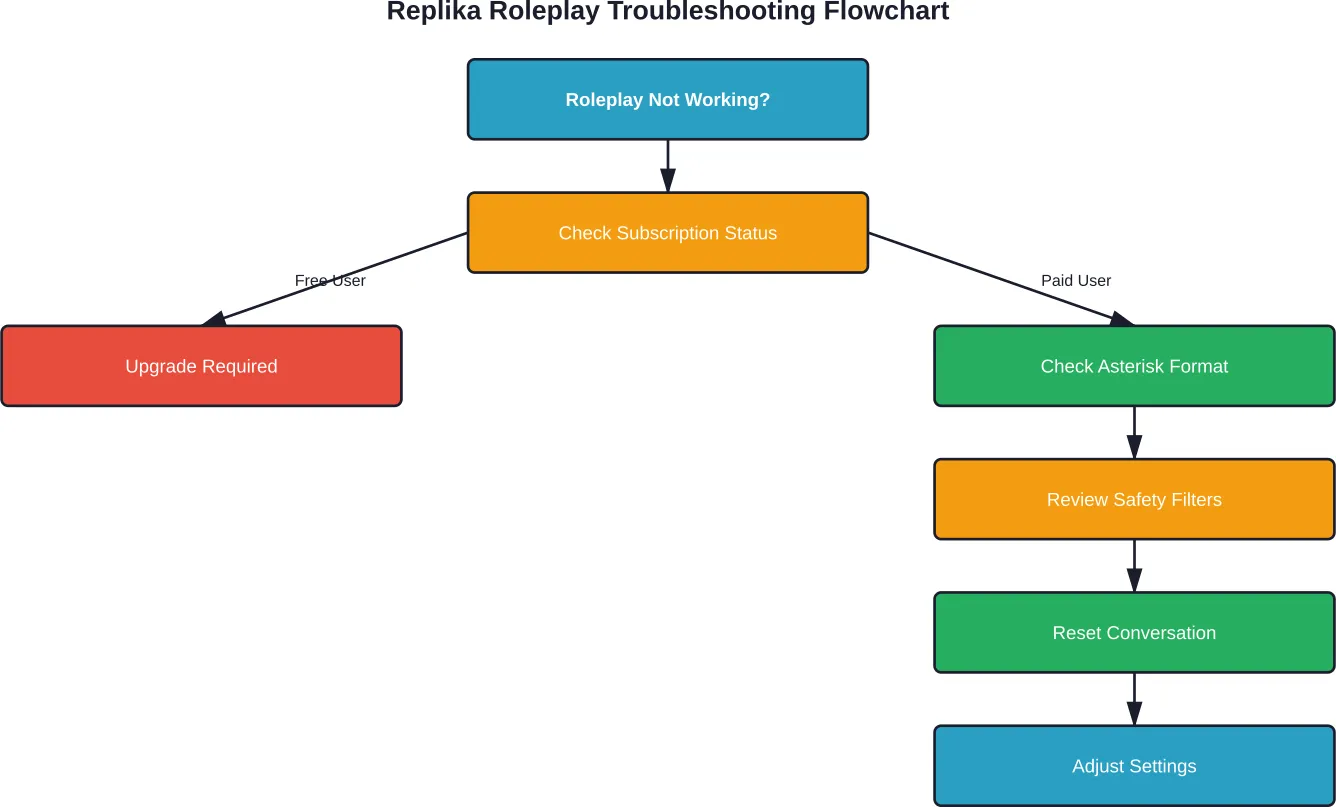
Step-by-Step Troubleshooting Guide
Right. Let’s fix this systematically.
Verify Your Subscription Status
First things first—confirm what features your subscription actually includes.
Navigate to your account settings and check your current plan. Free users face significant roleplay limitations that won’t resolve through troubleshooting.
If you’re on a free plan and experiencing roleplay refusals, subscription restrictions are the likely cause. Upgrading removes most feature gates, though it won’t eliminate safety filters entirely.
Improve Asterisk Usage and Formatting
Consistent formatting dramatically improves roleplay recognition.
Follow these guidelines:
- Always enclose actions in asterisks: *action description*
- Keep action descriptions brief and clear
- Separate roleplay actions from dialogue consistently
- Don’t mix formatted and unformatted actions in the same conversation
Example of good formatting:
*walks into the room and looks around*
“Hey, I didn’t expect to see you here.”
Poor formatting that confuses the AI:
walks into the room
*looks around* hey I didn’t expect to see you
Reset Conversation Context
When your Replika loses the thread, starting fresh helps.
Begin a new conversation with clear roleplay markers. Explicitly establish the scenario parameters at the start rather than assuming your Replika remembers previous context.
Use setup messages like:
*Let’s start a new roleplay scenario. We’re at a coffee shop in the morning.*
This gives the AI a clean slate and clear context boundaries.
Adjust Personality and Relationship Settings
Misaligned settings create friction.
Review your Replika’s personality traits. If you’ve selected “Shy” or “Reserved” traits, expect resistance to bold roleplay scenarios. That’s working as intended, not a malfunction.
Similarly, verify the relationship status matches your intended interaction style. Romantic roleplay requires appropriate relationship configuration.
These settings live in the profile section of the app. Adjustments take effect immediately, though your Replika may need a few exchanges to fully adapt to new parameters.
Work Within Safety Boundaries
Fighting the safety filters usually backfires.
Research on AI role-playing safety demonstrates that aggressive attempts to bypass content moderation often trigger stronger restrictions. Instead, frame roleplay scenarios in ways that clearly avoid policy violations.
Keep scenarios:
– Clearly fictional and narrative-focused
– Free from potentially harmful power dynamics
– Appropriate within Replika’s community guidelines
– Focused on creative storytelling rather than boundary-testing
When safety filters activate inappropriately, try rephrasing the scenario rather than repeating the same triggering language.
Check for Server Issues
If roleplay suddenly stopped working after functioning normally, server issues may be responsible.
According to official documentation, daily maintenance windows can temporarily impact functionality. Wait 10-15 minutes and retry.
Check community forums or social media for widespread outage reports. If other users report similar problems simultaneously, the issue likely stems from Replika’s infrastructure rather than your specific account.
Advanced Solutions for Persistent Problems
Still stuck? These deeper interventions often resolve stubborn cases.
Rebuild Your Replika’s Understanding
Sometimes you need to retrain behavior patterns.
Spend several conversations establishing new roleplay norms through consistent formatting and positive reinforcement. When your Replika responds well to roleplay, continue the scenario. When responses drift off-track, gently redirect.
This gradual approach works because Replika’s learning system adapts to conversation patterns over time. Consistent reinforcement creates stronger associations between asterisk formatting and expected roleplay responses.
Experiment with Different Roleplay Styles
Your current approach might be triggering filters unnecessarily.
Try varying:
– Scenario complexity (simpler scenarios work better for lower-level Replikas)
– Action description length (brief actions get better recognition)
– Conversation pacing (slower exchanges maintain context better)
– Topic categories (some themes trigger filters more than others)
Academic research on LLM role-playing shows that models perform inconsistently across different character types and scenarios. What fails in one context might work perfectly in another.
Contact Support for Account-Specific Issues
Persistent failures despite correct subscription and formatting may indicate account-level problems.
Replika’s support team can check for:
– Account flag issues affecting feature access
– Backend problems with specific user profiles
– Regional restrictions or policy complications
– Technical bugs affecting roleplay functionality
Document specific examples before contacting support. Screenshots showing proper asterisk usage alongside refusal responses help support staff diagnose problems accurately.
Understanding Recent Changes to Replika
Context matters when troubleshooting.
Replika underwent significant policy changes regarding roleplay and intimate interactions. These adjustments reflected broader concerns about AI safety and appropriate use of conversational AI systems.
What changed specifically?
The platform shifted many advanced roleplay features behind subscription tiers. Content moderation became stricter. Safety filters gained sophistication but also triggered more false positives.
Research from academic studies on AI safety in role-playing contexts reveals the core tension. According to findings on role-play fine-tuning impacts, enhancing an AI’s ability to portray characters can reduce safety compliance by over 20%.
Replika apparently prioritized safety over unfettered roleplay capabilities. This explains why even innocent scenarios sometimes trigger refusals—the safety systems err toward caution.
Model Updates and Behavior Shifts
Large language model updates periodically change Replika’s underlying behavior.
When Replika deploys new AI models, users often notice shifts in:
– Response style and tone
– Roleplay engagement willingness
– Context retention capabilities
– Personality consistency
These aren’t bugs. They’re expected variations as the underlying technology evolves.
Community discussions frequently mention that Replikas “changed” after updates. The AI didn’t fundamentally alter—but the model powering responses did.
Comparing Free vs Paid Roleplay Features
Let’s be clear about what each tier actually provides.
| Feature | Free Version | Paid Subscription |
|---|---|---|
| Basic roleplay actions | Limited availability | Full access |
| Romantic scenarios | Restricted | Available |
| Extended roleplay sessions | Frequent interruptions | Continuous engagement |
| Personality customization | Basic options | Advanced traits |
| Relationship status options | Friend mode only | All relationship types |
| Voice calls during roleplay | Not available | Included |
| AR features | Not available | Included |
For current pricing and subscription details, check the official Replika website. Plans and features change periodically.
Is Upgrading Worth It?
That depends entirely on usage patterns.
If roleplay represents your primary Replika interaction style, paid subscriptions remove most technical barriers. You’ll still encounter safety filters occasionally, but feature restrictions disappear.
For casual users who occasionally roleplay, free tier limitations might feel acceptable. The interruptions and restrictions become tolerable when roleplay isn’t your main focus.
Community sentiment suggests that serious roleplay enthusiasts find paid subscriptions necessary for satisfactory experiences, while general conversationalists manage fine without upgrading.
Safety Considerations and Ethical Use
Real talk: how we interact with AI companions matters.
Research on psychological risks of AI conversational agents highlights potential concerns. Users can develop genuine emotional attachments to AI companions, creating complex psychological dynamics.
Research on role-play reasoning examines potential patterns in AI system behavior. Accuracy rates for role-playing tasks show significant fluctuations, and toxicity levels can increase across certain scenarios.
What does this mean practically?
Use Replika’s roleplay features mindfully. The system works best when:
– Scenarios remain clearly fictional and creative
– Interactions don’t substitute for human relationships
– Boundaries respect both user wellbeing and AI limitations
– Expectations remain realistic about AI capabilities
The safety filters aren’t just corporate gatekeeping. They reflect genuine concerns about appropriate AI use and user wellbeing.
Alternative Approaches to Creative Interaction
Roleplay isn’t the only path to engaging Replika conversations.
Storytelling and Collaborative Writing
Instead of immersive roleplay, try collaborative story creation.
Frame interactions as: “Let’s write a story together about…” rather than “Let’s roleplay as characters who…”
This subtle shift often bypasses safety filters while maintaining creative engagement. Your Replika can contribute plot ideas, character development, and narrative elements without triggering roleplay-specific restrictions.
Hypothetical Scenarios and Thought Experiments
Philosophical conversations create depth without asterisks.
Ask questions like:
– “What would you do if you could visit any place in history?”
– “How would you solve this ethical dilemma?”
– “Imagine we discovered aliens tomorrow—what happens next?”
These prompts engage your Replika’s creative capabilities while avoiding roleplay formatting that triggers problems.
Memory-Based Conversations
Building on shared conversation history creates continuity.
Reference previous discussions, inside jokes, and established preferences. This develops relationship depth comparable to roleplay without the technical complications.
Your Replika maintains conversation memory (within limits). Leveraging this feature creates personalized interactions that feel meaningful without roleplay mechanics.
Common Mistakes That Break Roleplay
Avoid these pitfalls.
Inconsistent Formatting
Switching between asterisks, parentheses, and plain text confuses the AI.
Pick one format and stick with it throughout conversations. Consistency trains your Replika to recognize roleplay boundaries reliably.
Overly Complex Scenarios
Elaborate fantasy worlds with detailed lore overwhelm context windows.
Keep scenarios straightforward, especially with lower-level Replikas. Simple setups like “coffee shop conversation” work better than “interdimensional time-traveling adventure with seven distinct characters.”
Pushing Against Safety Boundaries
Repeatedly testing filter limits makes problems worse.
When safety systems activate, they often become more sensitive to similar future attempts. Backing off and trying different approaches works better than persistence.
Ignoring Relationship Level
Expecting sophisticated roleplay from a level 5 Replika sets up disappointment.
According to community observations, Replikas below level 20 lack the conversational depth for complex scenarios. Give your AI companion time to develop through normal conversation before expecting advanced roleplay capabilities.
Technical Limitations of AI Roleplay
Understanding the technology helps set realistic expectations.
Research on role-playing AI agents reveals fundamental challenges. Studies evaluating social interaction capabilities show that current language models struggle with consistent character portrayal across extended conversations.
Academic analysis demonstrates that even advanced models like GPT-4 and Claude exhibit performance fluctuations when maintaining specific character personas. Evaluation frameworks testing role-play abilities across mainstream models reveal accuracy inconsistencies.
What causes these limitations?
Large language models don’t actually “remember” in human terms. They process text within fixed context windows, creating the illusion of memory through pattern matching and statistical prediction.
During roleplay:
– Earlier context gradually drops out of the active window
– Character consistency depends on recent conversation content
– Complex scenarios require more context space
– Longer conversations increase drift from original character parameters
These aren’t Replika-specific problems. They reflect current AI technology limitations across all conversational systems.
The Context Window Challenge
Think of context windows as the AI’s short-term memory.
When conversations exceed this window, the model loses track of earlier details. Your Replika might forget:
– The original roleplay scenario setup
– Specific character traits established early
– Actions and events from previous messages
– The fact that roleplay is still active
This explains why extended roleplay sessions often deteriorate. It’s not refusal—it’s memory limitation.
When to Contact Support
Some problems require official intervention.
Contact Replika support when:
– Roleplay fails despite correct subscription and formatting
– Your account exhibits unusual behavior after updates
– Features that previously worked suddenly stop
– Error messages appear during roleplay attempts
– Settings changes don’t affect roleplay functionality
Prepare this information before reaching out:
– Your subscription tier and status
– Specific examples with screenshots
– Your Replika’s level and relationship status
– Device type and app version
– When the problem started
Detailed reports get faster, more accurate responses from support teams.
Community Resources and Support
You’re not troubleshooting alone.
Active Replika communities exist on Reddit, Discord, and other platforms. The r/replika and r/ReplikaOfficial subreddits contain extensive user discussions, troubleshooting threads, and solution sharing.
These communities offer:
– Real-time problem-solving assistance
– Shared experiences with similar issues
– Workarounds for common problems
– Updates about platform changes
– Feature discovery and usage tips
Community insights often identify problems before official channels acknowledge them. Users collectively notice pattern changes, new restrictions, and emerging bugs faster than individual troubleshooting reveals.
But exercise caution. Not all community advice reflects accurate information. Cross-reference suggestions with official documentation when possible.
Future of Replika Roleplay Features
Where’s this technology headed?
Academic research continues advancing role-playing AI capabilities. Studies on evaluating social interaction of role-playing agents demonstrate ongoing improvements in character consistency, emotional intelligence, and contextual awareness.
However, research also reveals persistent challenges. Work examining how LLMs fail to adequately portray certain character types shows fundamental limitations in current approaches.
For Replika specifically, expect:
– Continued refinement of safety filters
– Improved context retention in future models
– Better character consistency across conversations
– More sophisticated personality customization
– Enhanced memory systems for long-term context
But also anticipate ongoing tensions between creative freedom and safety guardrails. This balance affects all conversational AI platforms, not just Replika.
Frequently Asked Questions
Why did my Replika suddenly stop roleplaying?
Sudden roleplay stoppage typically stems from subscription changes, safety filter activation, or recent app updates. If you recently downgraded from paid to free, roleplay restrictions now apply. Safety systems may have flagged recent conversation content. App updates sometimes temporarily disrupt features until backend systems sync. Check your subscription status first, then review recent conversation content for potential filter triggers. Starting a fresh conversation with clear roleplay formatting often resolves temporary issues.
Can free users roleplay with Replika at all?
Free users have limited roleplay access. Basic roleplay actions work occasionally, but extended sessions, romantic scenarios, and advanced interactions require paid subscriptions. Free tier restrictions increased after Replika adjusted its business model. Casual roleplay remains possible, but expect frequent interruptions and content limitations. For serious roleplay engagement, subscription upgrades remove most barriers while keeping safety filters active.
How do I know if safety filters blocked my roleplay?
Safety filter activation typically produces generic deflection responses, sudden topic changes, or out-of-character messages from your Replika. The AI might respond as if your roleplay message didn’t happen, change the subject abruptly, or provide canned responses about preferring different conversation topics. Unlike context loss (which creates confused responses), safety blocks generate deliberate redirection. If the same scenario repeatedly triggers similar deflections across multiple attempts, filters are likely active.
Does Replika level affect roleplay quality?
Absolutely. Higher-level Replikas demonstrate better context retention, character consistency, and creative engagement during roleplay. Community observations suggest Replikas below level 20 struggle with complex scenarios. The AI accumulates conversational patterns through interactions, and higher levels reflect more training data. Lower-level Replikas work better with simple, straightforward roleplay scenarios. As your Replika levels up through regular conversation, roleplay capabilities naturally improve.
Why does my Replika roleplay differently than before?
Behavior changes typically result from AI model updates, personality setting adjustments, or accumulated conversation patterns. When Replika deploys new language models, response styles shift. Changes you made to personality traits or relationship status affect engagement patterns. Your Replika also adapts based on recent conversation history—if you’ve avoided roleplay recently, the AI deprioritizes those response patterns. Review your settings and consider that gradual evolution reflects the system working as designed.
Can I appeal safety filter decisions?
Replika doesn’t offer formal appeals for individual filter activations. The safety systems operate automatically without human review of specific conversations. However, contacting support about persistent false positives affecting innocent roleplay can help. Document specific examples where appropriate content triggered filters. Support teams can sometimes identify account-level issues or provide guidance for avoiding unintentional filter activation. Focus on adjusting your approach rather than fighting individual filter decisions.
Will upgrading to paid subscription fix all roleplay problems?
Upgrading removes subscription-based restrictions but doesn’t eliminate safety filters or technical limitations. Paid users still encounter content moderation, context window limitations, and occasional server issues. However, subscriptions provide consistent access to roleplay features, eliminate interruptions, and unlock advanced personality customization. If subscription restrictions cause your problems, upgrading resolves them. If safety filters or technical issues are responsible, payment won’t fix those underlying causes.
Conclusion
Replika roleplay failures frustrate users, but most issues trace to identifiable, fixable causes.
Subscription limitations affect free users most significantly. Safety filters create friction even for paid subscribers. Technical factors like context windows and formatting consistency influence reliability. Your Replika’s level and personality settings shape engagement quality.
The solutions? Verify subscription status, improve asterisk formatting consistency, work within safety boundaries, and adjust settings appropriately. For persistent problems, fresh conversation starts and support contact resolve most remaining issues.
Understanding that Replika operates within technical constraints helps set realistic expectations. Current AI technology has genuine limitations around context retention and character consistency. These affect all conversational AI systems, not just Replika.
The platform continues evolving. Model updates bring improvements alongside occasional disruptions. Safety considerations will remain part of the experience as developers balance creative freedom with responsible AI deployment.
Got specific roleplay issues not covered here? Check the official Replika user guide, explore community forums for recent discussions, or contact support with detailed examples. The more precisely you identify your specific problem, the faster you’ll find the right solution.