
Quick Summary: The word ‘hentai’ does mean pervert or perverted in Japanese, but its usage differs significantly between Japan and the West. In Japanese, ‘hentai’ (変態) translates to ‘abnormal,’ ‘perverted,’ or ‘metamorphosis,’ and is commonly used as an insult to describe someone with deviant behavior. In Western contexts, however, ‘hentai’ specifically refers to sexually explicit anime and manga, a usage that doesn’t align with how the term is actually applied in Japan.
Walk up to someone in Tokyo and call them ‘hentai,’ and you’ve just insulted them. Pull up the same word in a Western online search, and you’ll find something entirely different. This linguistic split has created one of the most interesting cultural misunderstandings between Japanese and English speakers.
The question ‘does hentai mean pervert’ isn’t as simple as yes or no. The answer depends entirely on where you’re asking and who you’re talking to. What started as a clinical psychological term in early 20th-century Japan evolved into a slang insult, then somehow became the Western label for adult anime content.
Here’s the thing though—most Japanese people would be genuinely confused if you used ‘hentai’ to describe pornographic anime. They’d understand you’re calling someone a pervert, but they wouldn’t make the connection to adult content that Westerners automatically assume.
The Original Japanese Meaning of Hentai
In Japanese, ‘hentai’ (変態) literally translates to ‘transformation’ or ‘metamorphosis.’ The kanji characters break down as ‘hen’ (変) meaning ‘strange’ or ‘change,’ and ‘tai’ (態) meaning ‘condition’ or ‘appearance.’
The word has multiple legitimate uses in Japanese. In biology, it describes metamorphosis—like a caterpillar transforming into a butterfly. In psychology and general conversation, however, it carries a much more negative connotation.
When Japanese people use ‘hentai’ to describe a person, they’re calling them a pervert, weirdo, or someone with abnormal sexual desires. It’s an insult, plain and simple. The term suggests deviant behavior or perverted tendencies that fall outside social norms.
According to Wikipedia’s table on the development of the term, during the Meiji period (1868–1912), it referred to hysteria. By 1917, it meant abnormal sexual desire. Throughout the 1920s–1930s, it described perverted sexuality. The 1940s and beyond are documented with ‘Pervert (insult/slang)’ as the meaning.
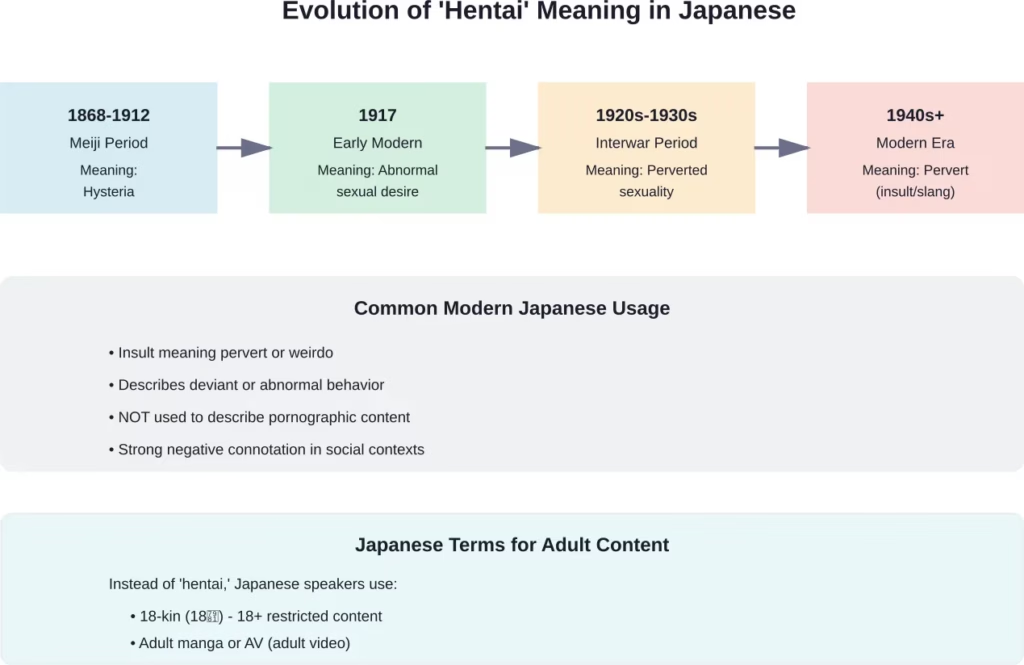
In slang usage today, ‘hentai’ functions as an insult. Call someone ‘hentai’ on the streets of Japan, and you’re not making a neutral observation—you’re actively insulting them by suggesting they have perverted or abnormal sexual interests.
How Western Usage Completely Diverged
So how did English speakers end up using ‘hentai’ to describe pornographic anime and manga? This represents one of the most significant linguistic shifts in modern pop culture terminology.
In Western contexts, ‘hentai’ specifically refers to sexually explicit Japanese animation and comics. According to Kotaku’s 2019 article by Brian Ashcraft, the Oxford Dictionary defines ‘hentai’ as ‘a subgenre of the Japanese genres of manga and anime, characterized by overtly sexualized characters and sexually explicit imagery.’
That definition would sound strange to most Japanese people. The disconnect is massive.
Here’s what happened: Western anime fans in the 1980s and 1990s encountered Japanese adult content and needed terminology to describe it. They borrowed ‘hentai,’ likely from partial translations or misunderstandings of Japanese discussions about such content. The term stuck in English-speaking anime communities and spread.
But wait. In Japan, people don’t use ‘hentai’ to describe pornographic anime at all. Instead, they use terms like ’18-kin’ (18禁, meaning 18+ restricted), ‘adult manga,’ or ‘AV’ (adult video). According to Urban Dictionary’s community-sourced definitions, ‘hentai has a negative connotation to the Japanese and is commonly used to mean sexually perverted. In slang, it’s an insult meaning pervert or weirdo and isn’t applied to pornography in Japan.’
The Western appropriation of ‘hentai’ created a false friend—a word that looks the same but means completely different things across languages. English speakers think they’re using a Japanese word correctly when they’re actually using it in a way no Japanese speaker would recognize.
What Japanese People Actually Call Adult Anime
Real talk: if Japanese people don’t use ‘hentai’ for adult content, what do they say instead?
The most common term is ’18-kin’ (18禁), which literally means ’18 forbidden’ or ’18+ restricted.’ This designation appears on adult content across Japan, from manga to video games to films. It’s the equivalent of an NC-17 or X rating in Western media classification systems.
‘Adult manga’ is another straightforward descriptor. Japanese speakers simply prefix ‘adult’ (アダルト, adaruto) to specify mature content. The same applies to ‘AV’ or ‘adult video’ for filmed pornographic content.
For manga and anime that have sexual content but aren’t explicitly pornographic, Japanese speakers often use ‘etchi’ (エッチ, ecchi). This term comes from the letter ‘H,’ which stands for ‘hentai,’ but it’s softened to mean ‘naughty’ or ‘perverted’ in a less severe way. Ecchi content includes sexual themes, suggestive imagery, and fan service, but typically stops short of explicit sex scenes.
| Japanese Term | Meaning | Usage Context |
|---|---|---|
| Hentai (変態) | Pervert, abnormal, deviant | Insult; describes a perverted person |
| 18-kin (18禁) | 18+ restricted | Rating for adult content |
| Adult manga/AV | Adult comics/video | Direct description of pornographic content |
| Etchi (エッチ) | Naughty, perverted (mild) | Suggestive content, not explicit |
| Seijin-muke (成人向け) | For adults | Adult-oriented content designation |
Another term you’ll encounter is ‘seijin-muke’ (成人向け), meaning ‘for adults’ or ‘adult-oriented.’ This appears on packaging and promotional materials to indicate mature content.
The terminology distinction matters because it reveals how cultural contexts shape language. Western fans created their own vocabulary system around Japanese media, borrowing words but reshaping their meanings to fit different cultural frameworks.
The Etymology and Historical Development
The word ‘hentai’ has roots that stretch back over a century. Understanding its etymology reveals how medical and psychological terminology evolved into everyday slang.
During the Meiji period (1868–1912), Japan underwent rapid modernization and adopted Western scientific concepts. ‘Hentai’ emerged as a clinical term related to psychological conditions, initially describing hysteria and abnormal mental states.
By 1917, the meaning had shifted toward sexuality. Medical and psychological texts began using ‘hentai’ specifically to describe abnormal sexual desire or deviation from normative sexual behavior. This wasn’t slang yet—it was formal terminology used by doctors and researchers.
The 1920s and 1930s saw ‘hentai’ expand into broader cultural discussions. It appeared in discourse about perverted sexuality, often in contexts that pathologized non-heteronormative behavior. This period reflects how ‘hentai’ became associated with sexual deviance as defined by contemporary social norms.
Now, this is where it gets interesting. By the 1940s and beyond, ‘hentai’ had transitioned from clinical terminology into everyday slang. People started using it as an insult or descriptor for individuals they considered sexually abnormal or perverted. The word shed its scientific neutrality and picked up strong negative connotations.
According to community discussions on platforms like Reddit, the term maintained this insulting character throughout the post-war period and into contemporary usage. Japanese speakers recognize ‘hentai’ primarily as a put-down, not as a genre label.
The Western adoption of ‘hentai’ to describe adult anime likely occurred during the 1980s and 1990s, when Japanese animation began reaching international audiences through fan distribution networks and early commercial releases. English-speaking fans needed vocabulary to categorize different types of anime, and ‘hentai’ became the catch-all term for sexually explicit content.
Cultural Misunderstandings and Their Impact
The divergence between Japanese and Western usage of ‘hentai’ creates awkward situations and genuine communication barriers.
Picture this scenario: a Western anime fan visits Japan and casually mentions ‘hentai’ while discussing anime with a Japanese acquaintance. The Japanese person hears someone talking about perverts, while the Westerner thinks they’re discussing a content genre. Confusion ensues.
These misunderstandings aren’t just amusing anecdotes—they reflect deeper issues in cross-cultural communication. When English speakers borrow foreign words but alter their meanings, they create linguistic false friends that can cause embarrassment or offense.
The term has also affected how Japanese media is perceived internationally. Western categorization systems impose labels that don’t align with Japanese industry classifications. What Western distributors market as ‘hentai’ might fall under multiple different Japanese categories, from ’18-kin’ adult manga to softcore ‘etchi’ content.
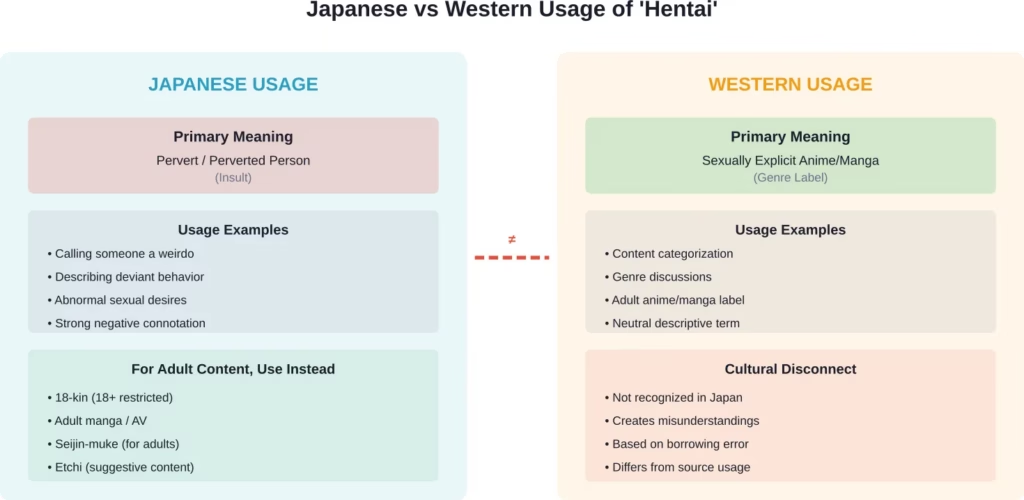
Community discussions on platforms like Reddit frequently highlight these cultural gaps. Japanese language learners often express surprise when they discover that ‘hentai’ doesn’t actually refer to adult anime in Japanese contexts. The revelation prompts questions about what other anime terminology might be similarly misunderstood.
Some Japanese creators and cultural commentators have noted the Western usage with bemusement or confusion. The fact that international audiences use an insulting term to categorize an entire media genre strikes many Japanese observers as odd.
Common Misconceptions About the Term
Several persistent myths surround the word ‘hentai’ and its usage. Let’s address the most common ones:
- Misconception 1: ‘Hentai’ is the official Japanese term for adult anime. False. Japanese industry and consumers use ’18-kin,’ ‘adult manga,’ or specific publisher-designated categories. ‘Hentai’ doesn’t appear on packaging, in store categories, or in industry discussions about adult content.
- Misconception 2: Japanese people understand what Westerners mean by ‘hentai.’ Not necessarily. While younger Japanese people with international exposure might recognize the Western usage, most Japanese speakers would interpret ‘hentai’ as its original meaning—pervert. Context clues might help, but the initial understanding would be the insult, not the genre.
- Misconception 3: ‘Etchi’ and ‘hentai’ are the same thing. Wrong. ‘Etchi’ refers to suggestive or mildly sexual content that stops short of explicit pornography. Think fan service, partial nudity, or sexual innuendo. Western ‘hentai’ implies explicit sexual content. The distinction matters in Japanese content classification.
- Misconception 4: The word ‘hentai’ only has sexual connotations. Not quite. Remember, ‘hentai’ originally meant transformation or metamorphosis. In biological contexts, it still carries this meaning. A biology textbook might discuss the ‘hentai’ of insects without any sexual implication whatsoever.
- Misconception 5: Using ‘hentai’ in Japan is just slightly awkward. It’s more than awkward—it’s insulting. Calling someone ‘hentai’ in Japanese is a direct insult suggesting they’re a sexual deviant or pervert. Using the term casually can cause genuine offense.
Explore What Hentai Really Includes

You won’t get a clear picture from labels alone. R34.app gives you one place to search hentai by tags, open results instantly, and move through different styles and themes without switching between sites.
Type What You Want and Get Results
With R34.app, you get a simpler way to find and control what you see:
- More variety in one place without extra steps
- Results that match what you actually type
- No need to switch between multiple sites
- A simple way to control what you see
Go to R34.app, enter a tag, and see how different it really is.
How to Properly Discuss Adult Anime Content
So what’s the right way to discuss adult anime and manga content, especially in cross-cultural contexts?
When speaking with Japanese audiences or in Japanese language contexts, avoid ‘hentai’ entirely for content descriptions. Instead, use the appropriate Japanese classifications: ’18-kin’ for age-restricted content, ‘adult manga’ for pornographic comics, or ‘AV’ for adult video content.
For discussions with fellow Western anime fans, ‘hentai’ remains understood and widely used. The term has become standard English anime community vocabulary, even if it doesn’t reflect Japanese usage. Just recognize that this is English slang, not proper Japanese terminology.
When writing about Japanese media for international audiences, consider explaining the terminology disconnect. Acknowledging that ‘hentai’ means something different in Japanese adds educational value and prevents readers from embarrassing themselves in cross-cultural situations.
| Context | Appropriate Term | Avoid |
|---|---|---|
| Speaking in Japanese | 18-kin, adult manga, seijin-muke | Hentai (unless calling someone a pervert) |
| English anime communities | Hentai (understood, though technically incorrect) | Japanese terms (may confuse English speakers) |
| Cross-cultural discussions | Explain both usages; use neutral terms like adult anime | Assuming universal understanding |
| Academic or formal writing | Sexually explicit anime/manga, adult anime, with cultural context | Using ‘hentai’ without explanation |
In formal or academic contexts, terms like ‘sexually explicit anime,’ ‘pornographic manga,’ or ‘adult anime’ work better than ‘hentai.’ These descriptive phrases communicate clearly without cultural baggage.
The broader lesson here applies beyond just this one word. When borrowing terms from other languages, especially for specialized subcultures, verifying actual native usage prevents confusion and shows respect for the source culture.
The Linguistic Journey of Borrowed Words
‘Hentai’ isn’t the only Japanese word that changed meaning when English speakers adopted it. This phenomenon affects multiple anime and manga terms.
‘Anime’ itself has a different scope in Japanese versus English. In Japanese, ‘anime’ (アニメ) simply means animation—any animation, including Disney films or Western cartoons. English speakers specifically use ‘anime’ to mean Japanese animation, creating a narrower definition than the source language.
‘Manga’ has remained more consistent, though Western manga readers sometimes apply it to non-Japanese comics that mimic manga styles, which Japanese speakers wouldn’t typically do.
‘Otaku’ represents another interesting shift. In Japanese, ‘otaku’ (おたく) means an obsessive fan of something, often with negative connotations of social awkwardness. Western anime fans adopted ‘otaku’ as a badge of honor, draining it of its negative associations and making it a neutral or even positive identifier.
These linguistic evolutions reveal how language adapts across cultural boundaries. Words get borrowed, reshaped, and recontextualized to serve the needs of different communities. The original meaning doesn’t disappear—it coexists with new interpretations.
But that coexistence creates communication challenges. Japanese exchange students studying in the West sometimes experience culture shock when they hear English speakers casually using words like ‘hentai’ or ‘otaku’ with completely different connotations than they learned at home.
Academic and Media Perspectives
Scholars studying Japanese media and cross-cultural communication have examined the ‘hentai’ terminology split extensively.
According to Kotaku’s 2019 article by Brian Ashcraft, Western media outlets and dictionaries have codified the English usage of ‘hentai’ to mean sexually explicit anime and manga. This institutionalization in reference works like the Oxford Dictionary gives the Western definition legitimacy within English language contexts, even though it deviates from Japanese usage.
Academic papers examining Japanese popular culture often address this terminology gap. Researchers note that Western fan communities created their own classification systems for Japanese media, borrowing Japanese words but assigning them meanings that made sense within Western cultural frameworks.
The development reflects broader patterns in how fan communities construct specialized vocabularies. When official terminology doesn’t exist or doesn’t meet community needs, fans create their own lexicon, drawing from source material but adapting it pragmatically.
Media coverage of Japanese animation in Western outlets consistently uses ‘hentai’ as the standard term for adult anime content. Entertainment journalists, reviewers, and industry analysts employ it without typically acknowledging the Japanese usage difference. This reinforces the term’s entrenchment in English anime discourse.
Some cultural commentators argue that Western anime fans should adopt more accurate terminology to better respect Japanese language and culture. Others contend that language naturally evolves through cultural exchange, and attempting to ‘correct’ established English usage fights against normal linguistic processes.
Why the Distinction Actually Matters
Does it really matter that English speakers use ‘hentai’ differently than Japanese speakers? Can’t we just acknowledge the difference and move on?
The distinction matters for several practical reasons.
First, travelers and cultural exchange participants can avoid genuine embarrassment. Imagine walking into a Japanese bookstore and asking where the ‘hentai’ section is. The staff would either think you’re being extremely rude or assume you’re looking for content about perverts—not the adult manga section you intended to find.
Second, language learners need accurate information. Students studying Japanese should understand that textbook translations and actual usage can differ from borrowed slang in English. Recognizing these gaps produces more effective communication skills.
Third, respecting source cultures matters. When Western audiences borrow Japanese terms but fundamentally change their meanings, it can feel appropriate or dismissive to Japanese people. Understanding the original meaning shows cultural awareness and respect.
Fourth, accurate terminology improves cross-cultural discussions about media. When Japanese creators and Western fans try to communicate about content, using aligned terminology prevents misunderstandings and facilitates more productive conversations.
The ‘hentai’ terminology split also serves as a useful case study in linguistic evolution and cultural exchange. It demonstrates how words transform when they cross cultural boundaries, how communities shape language to meet their needs, and how those changes can create communication barriers.
Practical Guidelines for Usage
Here’s the straightforward guide for when and how to use ‘hentai’ appropriately:
- In English-language anime fan communities: Using ‘hentai’ to describe sexually explicit anime and manga is standard and understood. The term has become established English slang within this context. Most community members won’t question or misunderstand its usage.
- When speaking Japanese or with Japanese speakers: Don’t use ‘hentai’ to describe content genres. If you need to discuss adult anime or manga, use ’18-kin,’ ‘adult manga,’ or ‘seijin-muke.’ Reserve ‘hentai’ only if you specifically mean to call someone a pervert—and recognize that’s an insult.
- In cross-cultural settings: Explain both meanings if the term comes up. Acknowledge that Western anime fans use ‘hentai’ for adult content, but that’s not how Japanese speakers use it. This demonstrates cultural awareness and prevents confusion.
- In formal or professional writing: Consider using descriptive English terms like ‘sexually explicit anime,’ ‘adult animation,’ or ‘pornographic manga’ instead of ‘hentai.’ These communicate clearly to all audiences without requiring cultural knowledge.
- When teaching or explaining Japanese culture: Address the terminology difference directly. It’s an excellent teaching point about language evolution and cultural borrowing. Students appreciate understanding why the disconnect exists.
- When encountering the term in the media: Understanding the context determines meaning. In Western entertainment journalism, ‘hentai’ refers to adult anime. In Japanese media or translations, it likely means pervert or abnormal.
- If someone corrects your usage: Accept the correction graciously. Language learning includes understanding cultural contexts and actual native usage. Adjust your vocabulary accordingly for future situations.
The Future of the Term
Will the dual meanings of ‘hentai’ continue indefinitely, or might usage converge over time?
Generally speaking, as global communication increases, more English speakers are becoming aware of the Japanese meaning of ‘hentai.’ Online language learning resources, cultural exchange programs, and social media interactions expose Western anime fans to actual Japanese usage.
Some younger Western fans now use more accurate terminology like ’18+’ or ‘adult anime’ instead of ‘hentai,’ recognizing the cultural disconnect. This shift isn’t universal, but it’s noticeable in certain online communities that prioritize cultural accuracy.
Conversely, some younger Japanese people with international exposure recognize the Western usage of ‘hentai.’ They might understand that English speakers use it as a genre label, even if they wouldn’t use it that way themselves. This creates a generation with bilingual awareness of the term’s dual meanings.
The anime industry itself shows mixed usage. Western distributors and streaming platforms continue using ‘hentai’ in their classification systems. Meanwhile, Japanese publishers and studios stick with their traditional terminology when marketing to domestic audiences.
Translation and localization teams navigate this terminology gap regularly. When translating Japanese discussions about content ratings or genres, they must decide whether to use literal translations or adapt to Western fan terminology expectations.
The term’s future likely involves continued coexistence of both meanings. English ‘hentai’ has become too entrenched in Western anime vocabulary to disappear. Simultaneously, Japanese ‘hentai’ retains its original meaning domestically. Both usages will probably persist with gradually increasing awareness of the distinction.
Frequently Asked Questions
Does hentai literally mean pervert in Japanese?
Yes, ‘hentai’ (変態) literally means pervert, perverted, abnormal, or deviant in Japanese. It’s commonly used as an insult to describe someone with perverted behavior or abnormal sexual interests. The word can also mean metamorphosis or transformation in biological contexts, but when applied to people, it carries strong negative connotations about being sexually abnormal or perverted.
Why do English speakers use hentai to mean adult anime if that’s not what it means in Japanese?
Western anime fans in the 1980s and 1990s borrowed the term ‘hentai’ from Japanese contexts, likely through partial translations or misunderstandings, and applied it specifically to sexually explicit anime and manga. The usage stuck within English-speaking anime communities and became standardized, even though it doesn’t reflect actual Japanese usage. Japanese speakers use terms like ’18-kin’ (18+ restricted) or ‘adult manga’ instead.
What should I call adult anime content when speaking in Japanese?
When speaking Japanese, use ’18-kin’ (18禁) for 18+ restricted content, ‘adult manga’ (アダルトまんが) for pornographic comics, ‘AV’ for adult video, or ‘seijin-muke’ (成人向け) meaning for adults. Don’t use ‘hentai’ to describe content genres—Japanese speakers would interpret that as you talking about perverts, not adult entertainment content.
Is ecchi the same as hentai?
No, ‘ecchi’ (エッチ) and ‘hentai’ serve different purposes in both Japanese and Western contexts. ‘Ecchi’ refers to suggestive or mildly sexual content with fan service, partial nudity, or sexual innuendo that stops short of explicit sex scenes. Western ‘hentai’ specifically means sexually explicit pornographic content. In Japanese, ‘ecchi’ means naughty or perverted in a softer sense, while ‘hentai’ is a harsher insult meaning pervert.
Will Japanese people understand if I use hentai to mean adult anime?
Most Japanese people won’t immediately understand the Western usage. They’ll interpret ‘hentai’ according to its Japanese meaning—pervert or perverted. Younger Japanese people with international exposure might recognize the Western usage, but the default understanding remains the insulting Japanese meaning. When communicating with Japanese speakers, it’s better to use the proper Japanese terms for adult content.
Did hentai always mean pervert in Japanese?
No, the meaning evolved over time. During the Meiji period (1868–1912), ‘hentai’ referred to hysteria and psychological conditions. By 1917, it shifted to mean abnormal sexual desire in medical contexts. Throughout the 1920s-1930s, it expanded to describe perverted sexuality more broadly. By the 1940s onward, it had become everyday slang used as an insult meaning pervert or weirdo, which remains its primary usage in modern Japanese.
Is it offensive to use the word hentai in Japan?
Using ‘hentai’ to describe a person in Japanese is insulting—it’s calling them a pervert or sexual deviant. Using it casually in conversations about media with Japanese people can create awkward misunderstandings or make you sound inappropriate, since they’ll interpret it as the insult rather than the Western genre label. When discussing content, stick to appropriate Japanese terms like ’18-kin’ to avoid offense or confusion.
Conclusion: Understanding Cultural Context
The answer to ‘does hentai mean pervert’ is definitively yes in Japanese—but with the crucial caveat that English anime communities use the same word completely differently. This linguistic split perfectly illustrates how borrowed words transform across cultures.
In Japanese, ‘hentai’ remains an insult describing perverted or abnormal people. It carries negative connotations and isn’t used to categorize media content. Japanese speakers use specific terms like ’18-kin,’ ‘adult manga,’ and ‘seijin-muke’ for age-restricted content instead.
Western anime fans created their own usage, applying ‘hentai’ as a genre label for sexually explicit anime and manga. This English slang has become standardized in Western contexts, appearing in dictionaries and media coverage, despite not reflecting actual Japanese usage.
The distinction matters for anyone engaging in cross-cultural communication, language learning, or cultural exchange with Japan. Using terminology accurately demonstrates respect and prevents embarrassing misunderstandings. Understanding both meanings allows navigating between Western anime communities and Japanese cultural contexts appropriately.
Language evolves through cultural contact, borrowing, and adaptation. The ‘hentai’ terminology split isn’t a mistake to correct—it’s a natural linguistic phenomenon reflecting how different communities shape words to serve their needs. Recognizing these differences enhances cultural understanding and communication effectiveness.
Whether discussing anime with fellow Western fans or communicating with Japanese speakers, choosing appropriate terminology for each context shows linguistic awareness and cultural sensitivity. The word ‘hentai’ will likely continue carrying both meanings—separated by language, culture, and context—for the foreseeable future.
Ready to explore more about Japanese language nuances and cultural terminology? Understanding these distinctions enriches appreciation for both Japanese culture and the global anime community that celebrates it.