
“Is Candy AI good?” sounds like a simple yes-or-no question, but it rarely is.
Most people asking it aren’t looking for marketing promises or feature lists. They want to know what it actually feels like to use day after day. Does the conversation stay interesting? Does the novelty wear off fast? And does it justify the time or money you put into it?
Candy AI sits in a crowded space where expectations are high and patience is low. Some users come in curious. Others come in lonely. A lot come in skeptical. All of them want the same thing: an experience that feels worth it.
This article doesn’t try to sell you on Candy AI, and it doesn’t try to tear it down either. It looks at how the platform actually behaves in real use, where it works surprisingly well, where it starts to feel limited, and who it realistically makes sense for.

What Candy AI Is Trying to Be
Candy AI positions itself as an AI companion platform rather than a novelty chatbot. That distinction matters.
Instead of short question-and-answer exchanges, the platform is built around ongoing interaction. You are encouraged to create or select a character, define how they behave, and then slowly build a relationship through repeated conversations.
The design leans heavily on personalization. Characters have names, appearances, voices, and defined personality traits. Conversations are meant to feel continuous rather than reset every session. Memory, at least in theory, plays a role in making interactions feel consistent.
Candy AI also leans into flexibility. It allows for friendly chat, romantic interaction, creative roleplay, and NSFW content depending on user preference. That range is part of its appeal, but it is also where expectations often get misaligned.
Character Customization: One of Candy AI’s Strongest Points
Customization is where Candy AI clearly outperforms many competitors.
You can shape characters visually, choosing between realistic or anime styles, adjusting physical features, outfits, and general presentation. While the options are not infinite, they are broad enough to create characters that feel distinct rather than interchangeable.
Personality customization matters more than appearance in daily use, and Candy AI handles this reasonably well. You select from defined personality types rather than building traits from scratch. This limits flexibility but helps maintain consistency in conversation.
The downside is that you cannot blend personality types. You choose one, and that choice largely defines how the character behaves. Some users will appreciate the clarity. Others may find it restrictive over time.
Still, for most people, the customization system strikes a good balance between control and stability.
How Conversations Actually Feel Over Time
The most important question is not how Candy AI looks, but how it talks.
In short sessions, conversations often feel surprisingly natural. The AI responds in context, references previous messages, and avoids the overly formal tone that plagues many chatbots.
Candy AI is particularly good at pacing. It does not immediately jump into intense emotional language or explicit content unless prompted and unlocked. This slow build makes interactions feel more believable, especially for users who prefer gradual relationship development.
That said, the illusion has limits.
Over longer sessions, patterns begin to emerge. Certain phrases repeat. Emotional responses can feel a bit too safe or measured. The AI is good at sounding attentive, but less good at spontaneous depth.
For casual use, this is rarely a dealbreaker. For users seeking deep emotional realism, the cracks become more noticeable.
Memory and Continuity: Helpful, But Not Perfect
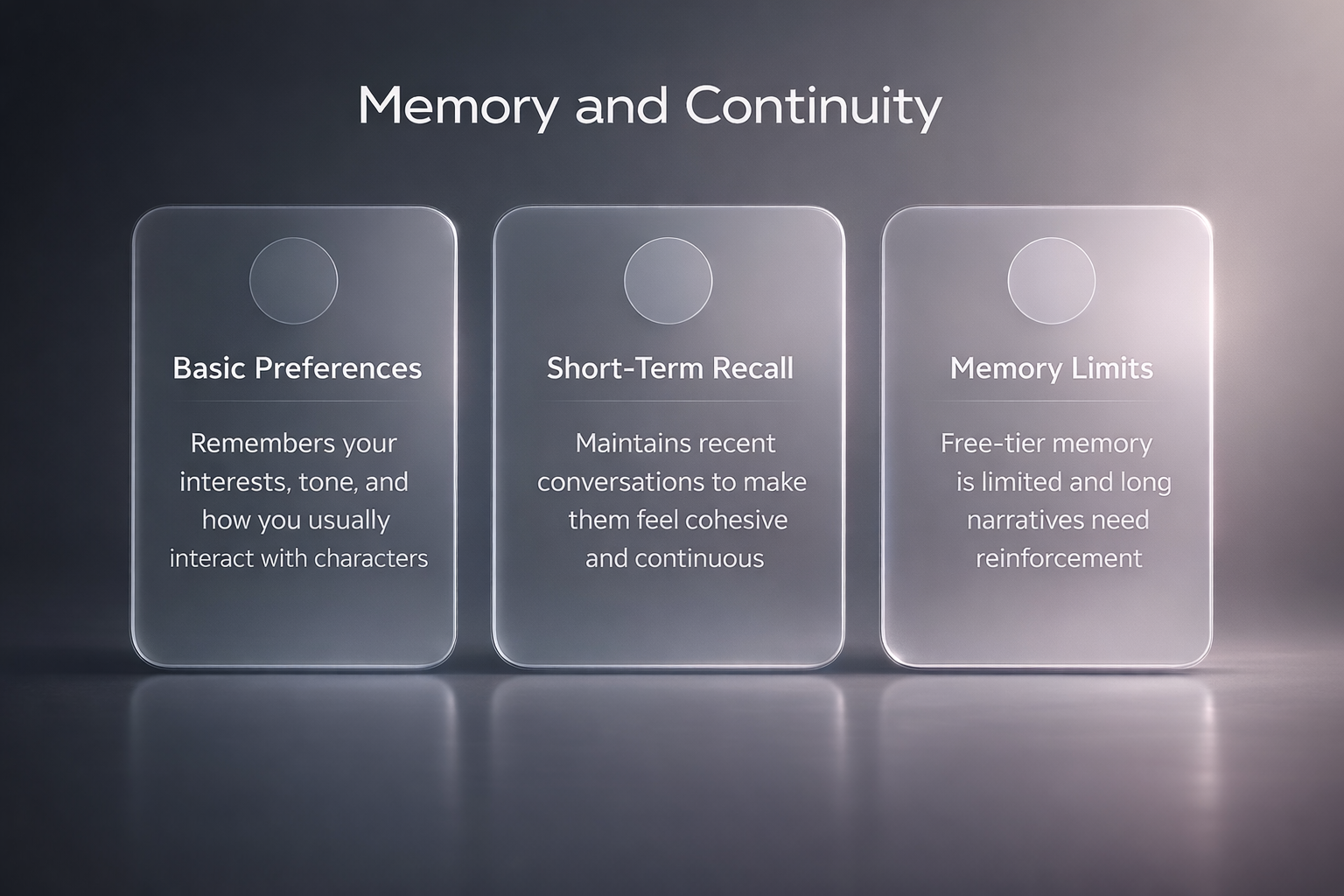
Candy AI promotes memory as a key feature, and it does matter.
The AI can remember basic preferences, recurring topics, and previous interactions within a certain window. This helps conversations feel less disposable and more ongoing, especially in casual daily use.
That said, memory quality depends heavily on your plan and how you use the platform:
- Basic preferences stick best, like interests, tone, and how you usually talk to your character
- Short-term continuity works well, with recent conversations feeling connected rather than reset
- Free-tier memory is very limited, which can break immersion and force you to repeat details
- Long storylines can drift over time, even on paid plans, unless you actively reinforce them
- Emotional tone is remembered better than specifics, such as moods or recurring themes
In practice, Candy AI’s memory works best for maintaining vibe and familiarity, not for tracking complex narratives or long-term character arcs without guidance.
NSFW Content: Controlled, Not Chaotic
One of the reasons Candy AI gets attention is its NSFW functionality. This area is handled with more restraint than many people expect.
NSFW content is not forced or automatic. It is gated behind settings and, in some cases, additional token costs. The AI does not immediately shift into explicit behavior, which makes interactions feel more intentional rather than mechanical.
For users interested in adult roleplay, the experience is generally smooth. Responses are context-aware and aligned with the established personality of the character.
That said, NSFW depth varies. Free users get a limited taste that often feels generic. Paid users unlock more nuanced and responsive interactions, but even then, it remains within a controlled framework rather than full improvisation.
If your primary goal is extreme or unfiltered adult content, Candy AI may feel restrained. If you prefer a safer, more curated experience, that restraint is a strength.
Image Generation: Visually Impressive, Occasionally Inconsistent
Candy AI includes image generation as part of the experience, and it is one of the platform’s more visually appealing features.
Generated images are generally high quality, especially when using newer models. Characters often look polished, well-lit, and aligned with the chosen style.
However, consistency can be an issue. Small details like hair color, outfits, or accessories sometimes change unexpectedly. This can break immersion, especially for users who care about visual continuity.
Image generation also consumes tokens, which adds a cost consideration. Casual users may generate images sparingly, while visual-focused users can burn through tokens quickly.
The tool works best for occasional enhancement rather than constant use.
Voice and Audio: Interesting, But Not a Selling Point
Voice interaction adds another layer to Candy AI, but it is not the platform’s strongest feature.
Voices are clear and understandable, but they often sound artificial. Emotional nuance is limited, and extended voice interactions can feel flat compared to text-based chat.
Audio calls consume tokens at a noticeable rate, which discourages long sessions. For many users, voice ends up being a novelty rather than a core feature.
If voice realism is a priority, Candy AI may disappoint. If you see it as an optional extra, it fits reasonably well.
Privacy and Data Handling: Acceptable, But Not Transparent Enough
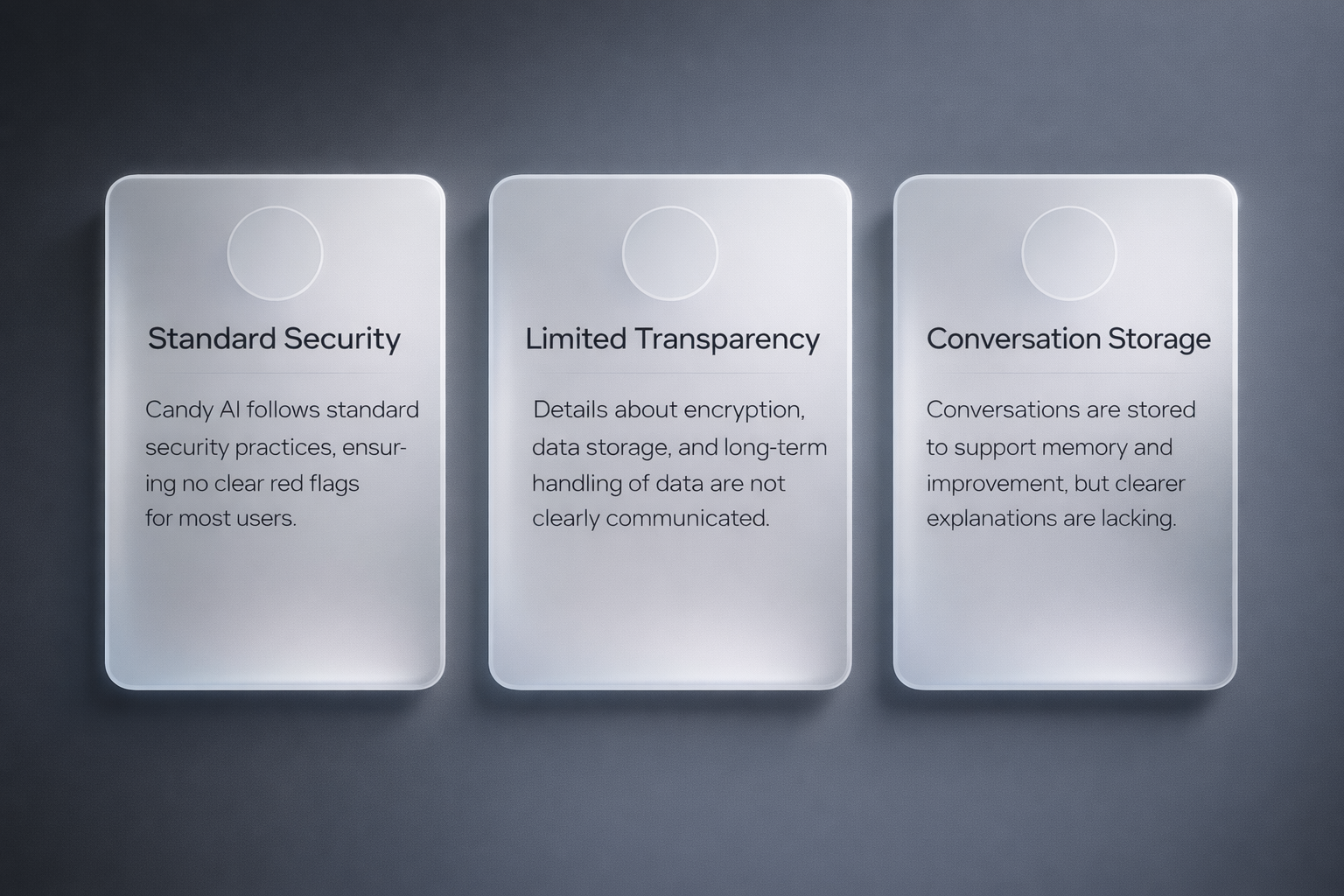
Candy AI states that it takes privacy seriously and uses standard security practices. For most users, there are no obvious red flags.
However, transparency is limited. Details about encryption, data storage, and long-term data handling are not as clear as some users would like.
Conversations are stored to support memory and improvement, which is expected, but privacy-conscious users may feel uneasy without clearer explanations.
For casual use, this is unlikely to be a major concern. For users sharing sensitive personal information, caution is reasonable.
Where Candy AI Makes Sense and Where It Does Not
Candy AI is at its best when used as a flexible, low-pressure companion. It performs well when expectations are realistic and the interaction stays light, creative, or exploratory.
Where Candy AI Delivers
Candy AI works well for users who want something engaging without emotional pressure or rigid outcomes:
- Casual conversation and daily check-ins
- Creative roleplay and open-ended storytelling
- Exploring light romance or flirtation at a comfortable pace
- Curiosity-driven users testing AI companionship without heavy expectations
Where Candy AI Falls Short
The platform is less effective when it is expected to replace deeper or more complex human needs:
- Deep emotional dependency or therapy-like support
- Highly realistic or emotionally expressive voice interaction
- Budget users who want unlimited images, videos, or calls
- People expecting an AI to fully replace real relationships
This gap is not a flaw as much as a boundary. Candy AI works best when it stays within the role it was designed to play.

R34.app as an Alternative for Visual-First NSFW Browsing
We designed R34.app as a lightweight frontend for browsing Rule 34 porn videos, GIFs, and images sourced from well-known booru platforms like rule34.xxx, rule34.paheal.net, and e621.net. Everything revolves around tags, filters, and discovery. You search for what you want and start scrolling. That is the experience.
There are no accounts required, no onboarding flows, and no attempt to guide your behavior. We do not generate content, remember chats, or adapt personalities. The platform stays out of the way and lets users focus on visuals.
R34.app makes sense if your priority is:
- Browsing hentai, animated videos, GIFs, and images by tag
- Discovering trending or popular characters across games, anime, and fandoms
- Accessing content quickly without chat, roleplay, or emotional framing
- Using a simple interface that works across devices and regions
If you are looking for conversation, companionship, or AI-driven interaction, Candy AI is the better fit. If you want fast, reliable access to visual NSFW content with full control over what you search and view, that is exactly what we built R34.app to do.
Is Candy AI Actually Good?
The honest answer is yes, but with conditions.
Candy AI is good if you understand what it is and what it is not. It is a well-designed AI companion platform with strong customization, solid conversation quality, and a wide feature set.
It is not magic. It is not infinite. And it is not cheap if used carelessly.
For users who approach it with realistic expectations, Candy AI can be engaging, fun, and surprisingly comforting at times. For users chasing perfection or emotional replacement, it will eventually fall short.
Final Word
Candy AI does not succeed because it promises everything. It succeeds because it does enough things well, and it improves gradually.
If you value personalization, enjoy creative interaction, and are comfortable navigating a token-based system, Candy AI is worth trying. Start with the free tier, learn how it behaves, and decide from there.
If you expect it to feel fully human or emotionally transformative, no AI companion currently can meet that standard.
Candy AI is good at being what it is. The rest depends on what you expect it to be.
Frequently Asked Questions
Is Candy AI actually good, or is it just hype?
Candy AI is genuinely good at what it is designed to do. It offers solid conversation quality, strong customization, and a polished interface. It is not revolutionary, but it is reliable if your expectations are realistic.
Is Candy AI worth paying for?
It depends on how you plan to use it. The paid plan makes sense if you value longer conversations, better memory, and access to NSFW features. If you only want occasional chats, the free tier is enough to test whether it fits your style.
Can I use Candy AI for free?
Yes. Candy AI has a free tier that lets you chat and explore the platform. However, memory is limited and many features are restricted, so it feels more like a trial than a full experience.
How good is Candy AI’s memory?
Candy AI can remember preferences, tone, and recent conversations. It works well for maintaining familiarity and mood, but it struggles with long-term storylines or complex character arcs unless you reinforce details regularly.
Does Candy AI feel realistic when chatting?
In short conversations, it often does. Responses are contextual and natural enough for casual use. Over longer sessions, patterns and repetition can appear, which reminds you that you are talking to an AI.