
Quick Summary: Character AI uses large language models (LLMs) and neural networks to generate human-like conversational text. The platform processes user input through transformer architectures trained on massive datasets, enabling AI characters to maintain context and produce realistic responses. Users can create custom AI personas that simulate conversations with fictional characters, celebrities, or entirely original personalities.
Character AI has emerged as one of the most popular platforms for conversational AI, letting users chat with everything from historical figures to fictional characters. But what’s actually happening under the hood?
Technology isn’t magic. It’s a sophisticated combination of neural networks, natural language processing, and transformer architectures working in concert to create surprisingly realistic interactions.
Here’s the thing though—understanding how Character AI works doesn’t require a PhD in machine learning. The core concepts are accessible once you break down the layers.
What Is Character AI?
Character AI is a generative AI chatbot service where users can create and interact with virtual characters. These characters can be based on fictional media sources, celebrities, historical figures, or completely original creations made with specific goals in mind, such as assisting with creative writing or playing text-based adventure games.
Developed by former Google AI developers Noam Shazeer and Daniel de Freitas, Character AI was launched in November 2021. The beta version became publicly available to the public on September 16, 2022, and quickly gained traction for its ability to generate human-like responses.
The platform is available in 31 languages and allows users to switch between multiple characters within the same session. Unlike single-personality chatbots like Replika, Character AI focuses on variety and role-playing scenarios.
The Neural Network Foundation
At its core, Character AI relies on enormous neural networks to determine each word to say next. These networks are trained on massive datasets containing text from books, websites, and conversational data.
Neural networks function through interconnected layers of nodes that process information. Input passes through multiple layers, each extracting increasingly abstract features until the network produces an output—in this case, the next token (word or word fragment) in a conversation.
Training Process
The training process involves exposing the neural network to billions of text examples. The network learns patterns in language: grammar rules, conversational structure, context maintenance, and even personality traits associated with different speaking styles.
During training, the model adjusts internal parameters (weights) to minimize prediction errors. When the model incorrectly predicts the next word in a training example, it adjusts slightly. Over millions of iterations across enormous datasets, these adjustments accumulate into a model that can generate coherent, contextually appropriate text.
Research on conversational agents shows that hybrid approaches combining architecture improvements with targeted training can achieve up to a 52% improvement in task accuracy and a 50% improvement in format adherence compared to baseline models.
Transformer Architecture: The Secret Sauce
The real breakthrough enabling Character AI’s performance comes from transformer architecture. Introduced in the famous 2017 paper “Attention is All You Need,” transformers revolutionized natural language processing.
Before transformers, sequential models processed text one word at a time, struggling with long-range dependencies. Transformers changed everything by introducing self-attention mechanisms that allow the model to weigh the importance of every word in relation to every other word simultaneously.
How Self-Attention Works
Self-attention lets the model focus on relevant parts of the input when generating each output token. When processing the word “it” in a sentence, self-attention helps the model identify which noun “it” refers to by examining relationships across the entire context window.
This mechanism involves three learned representations for each word: queries, keys, and values. The model compares queries against keys to determine attention weights, then uses those weights to create a context-aware representation by combining values.
The result? Models that maintain context across hundreds or thousands of tokens, enabling coherent long-form conversations that feel remarkably human.
Multi-Layer Processing
Character AI’s underlying model consists of multiple transformer layers stacked on top of each other. Early layers typically learn basic patterns like grammar and syntax. Deeper layers capture more abstract concepts like topic coherence, personality consistency, and conversational flow.
Each layer refines the representation, adding nuance and contextual understanding. By the final layer, the model has a rich, context-aware representation that it uses to predict the most appropriate next token.
Large Language Models Behind the Scenes
Character AI is powered by large language models—neural networks with billions of parameters trained on enormous text corpora. These LLMs form the foundation that makes realistic character simulation possible.
The platform’s founders developed these models during their time at Google, building on research that led to LaMDA (Language Model for Dialogue Applications). While Character AI’s exact model architecture isn’t publicly documented, it follows similar principles to other transformer-based LLMs.
Memory and Context Management
One critical challenge for conversational AI is maintaining context over extended interactions. Research on memory-enhanced architectures shows that incorporating explicit memory mechanisms significantly improves long-term conversation coherence.
Character AI implements context windows that track recent conversation history. When generating a response, the model considers not just the immediate user message but the entire conversation thread within its context window.
This memory allows characters to reference earlier parts of the conversation, maintain consistent personality traits, and build on established narrative threads—creating the illusion of genuine understanding and recall.
Character-Specific Conditioning
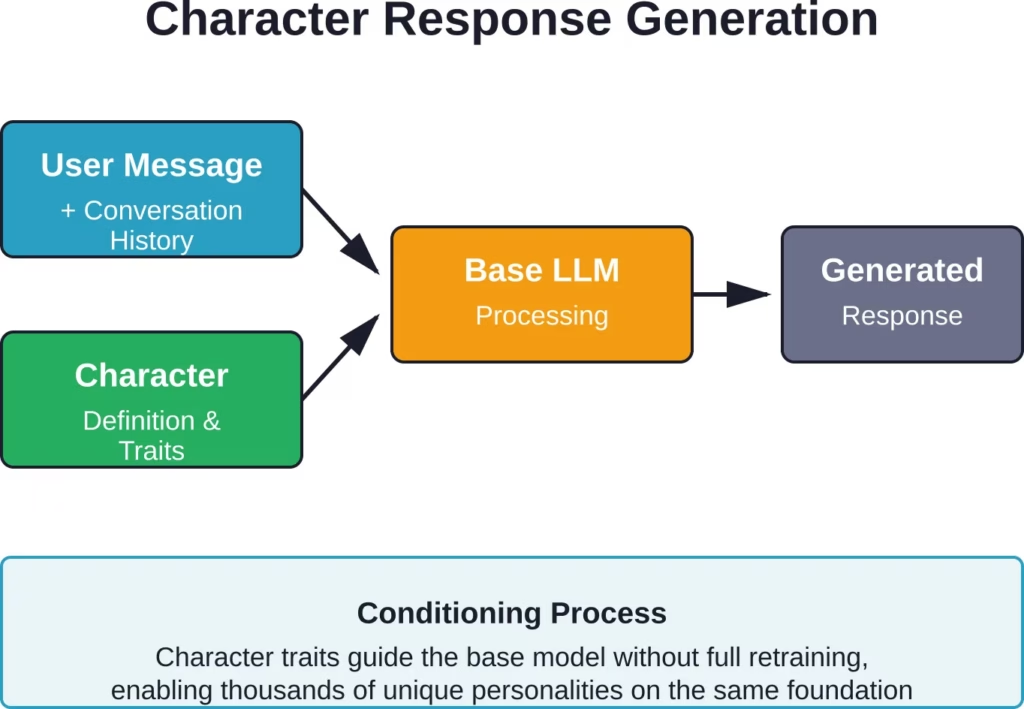
When users create a character, they provide defining information: personality traits, background, speaking style, and example dialogues. Character AI uses this information to condition the base language model’s responses.
The conditioning process doesn’t retrain the entire model for each character. Instead, it applies the character definition as additional context that guides generation. The base model’s language capabilities combine with character-specific instructions to produce responses that match the intended personality.
Natural Language Processing Components
Beyond the core language model, Character AI employs several NLP techniques to enhance conversation quality.
Tokenization
Before processing text, the system breaks it into tokens—subword units that balance vocabulary size with coverage. Modern tokenizers like Byte-Pair Encoding (BPE) or SentencePiece create vocabularies of 30,000-50,000 tokens that can represent any text input.
Tokenization allows the model to handle rare words, typos, and novel word formations by breaking them into familiar subword components. This flexibility makes Character AI robust to varied user input styles.
Embedding Representations
Each token converts to a high-dimensional vector embedding—a numerical representation that captures semantic meaning. Similar words have similar embeddings in this vector space.
These embeddings feed into the transformer layers, where they’re continuously refined to incorporate context. By the output stage, each token’s embedding reflects not just its dictionary meaning but its role in the specific conversation.
Response Generation Strategies
Character AI doesn’t simply pick the single most likely next word. That approach produces repetitive, boring text.
Instead, the platform uses sampling strategies that introduce controlled randomness. Temperature parameters control how much the model explores less-likely but interesting word choices. Higher temperatures increase creativity and variety; lower temperatures make output more predictable and focused.
Top-k and nucleus (top-p) sampling further refine this process by restricting sampling to the most probable tokens while still allowing variation. These techniques balance coherence with the spontaneity that makes conversations feel natural.
Platform Features and Implementation
Character AI translates the underlying technology into accessible features for users.
Character Creation
Users can create characters by defining personality traits, background information, greeting messages, and example dialogues. The platform uses these inputs to condition responses appropriately.
Advanced users can provide more detailed instructions about speaking style, knowledge domains, and behavioral tendencies. The more specific the definition, the more consistent the character’s personality across conversations.
Multi-Character Conversations
Unlike many chatbots, Character AI supports group conversations where multiple AI characters interact with each other and the user simultaneously. The underlying model tracks each character’s state separately while maintaining overall conversation coherence.
This feature enables complex scenarios: imagine hosting a debate between historical figures or running a tabletop RPG with multiple AI-controlled non-player characters.
Conversation Modes and Settings
The platform offers different conversation modes optimized for various use cases. Creative writing mode emphasizes narrative development. Roleplay mode focuses on character consistency and scene building. Practical modes prioritize factual accuracy and helpful responses.
Users can adjust parameters like response length and creativity level. These controls modify the underlying generation process—longer context windows for extended responses, higher temperatures for more creative output.
| Feature | Free Version | Character.AI+ ($10/month) |
|---|---|---|
| Basic Character Interaction | Yes | Yes |
| Character Creation | Yes | Yes |
| Priority Access (Skip Queues) | No | Yes |
| Group Chat Rooms | Limited | Unlimited |
| Early Feature Access | No | Yes |
| Faster Response Times | Standard | Enhanced |
Technical Challenges and Solutions
Running a large-scale conversational AI platform presents significant engineering challenges.
Computational Requirements
Large language models require enormous computational resources. Inference—generating responses—demands significant GPU memory and processing power.
Character AI handles millions of conversations daily. Scaling this requires distributed systems, model optimization techniques like quantization, and efficient caching strategies that reuse computation when possible.
Latency Management
Users expect near-instant responses. But processing thousands of tokens through billion-parameter models takes time.
The platform employs several strategies to reduce latency: model distillation creates smaller, faster versions that maintain quality; speculative decoding predicts multiple tokens ahead; and infrastructure optimization ensures efficient GPU utilization.
Content Moderation
Generative models can produce inappropriate content. Character AI implements multiple layers of content filtering.
Pre-training filters remove harmful content from training data. Post-generation classifiers screen outputs before delivery. User reports trigger additional review. The system continuously learns from these interventions to improve filtering accuracy.
Context Window Limitations
Transformers have finite context windows—the amount of conversation history they can process. Extremely long conversations eventually exceed this limit.
Character AI addresses this through intelligent summarization: the system condenses older conversation segments into summaries that preserve key information while freeing context space for recent messages.
Comparing Character AI to Alternatives
Character AI sits within a broader ecosystem of conversational AI platforms, each with different focuses.
Replika focuses on building a single, deep emotional bond with users. Its AI learns specifically from conversations with you, creating a personalized companion. Character AI instead emphasizes variety—switching between many different characters rather than developing one relationship.
Chai offers similar multi-character functionality but with a stronger emphasis on community-created characters and social features. Character AI’s technology tends to produce more coherent long-form conversations.
ChatGPT and similar general-purpose assistants prioritize factual accuracy and task completion over personality simulation. They’re better for research or problem-solving; Character AI excels at roleplay and creative scenarios.
Explore Character Content Without Complicated Systems

Character AI works through chat models, prompts, filters, and moderation systems running in the background. If you just want direct access to character-based NSFW content without dealing with complicated chat mechanics, R34.app gives you a simpler way to search and browse through tagged results.
Get Direct Access with No Complex Tools
With R34.app, you can keep things simple:
- Direct browsing without chatbot setup
- Faster access through searchable tags
- Easier movement between different themes
- No prompts, retries, or chat limits
👉Go to R34.app and explore content without extra complexity.
Real-World Applications
Character AI serves multiple practical purposes beyond entertainment.
Creative Writing Assistance
Writers use Character AI to develop fictional characters, test dialogue, and explore plot scenarios. Interacting with AI versions of characters helps authors understand how those personalities would respond to different situations.
The platform essentially provides unlimited brainstorming partners who never tire of exploring “what if” scenarios.
Language Learning
Conversing with AI characters offers low-pressure language practice. Learners can chat in target languages without embarrassment about mistakes.
Character AI supports 31 languages, enabling multilingual conversations. Users report that conversational practice with patient AI characters complements traditional language learning methods.
Social Skills Practice
Some users leverage the platform to practice social interactions in a safe environment. Role-playing difficult conversations—job interviews, conflict resolution, public speaking—builds confidence.
The AI provides immediate, judgment-free interaction that helps users experiment with different communication approaches.
Entertainment and Gaming
Text-based roleplay and interactive storytelling represent major use cases. Users create elaborate narratives, playing through scenarios with AI characters as scene partners.
The technology enables solo experiences that were previously only possible with human game masters or roleplay partners.
Limitations and Considerations
Despite impressive capabilities, Character AI has meaningful limitations.
Lack of True Understanding
The AI doesn’t actually understand conversations in any meaningful sense. It’s pattern-matching and statistical prediction—extraordinarily sophisticated pattern-matching, but fundamentally different from human comprehension.
Characters don’t have genuine emotions, opinions, or consciousness. They simulate these qualities convincingly but lack internal experience.
Factual Accuracy Issues
Language models sometimes generate plausible-sounding but incorrect information—a phenomenon called hallucination. Character AI prioritizes conversational flow over factual accuracy.
Users shouldn’t treat character responses as reliable information sources, especially for historical facts, scientific claims, or practical advice.
Privacy Considerations
According to the official Character.AI Privacy Policy updated August 27, 2025, the platform collects and processes various types of user information to provide services.
Conversations are processed on Character AI’s servers. While the company implements security measures, users should avoid sharing sensitive personal information in chats.
Dependency Concerns
The platform’s engaging nature raises questions about emotional attachment to AI characters. Mental health professionals note that while AI conversations can provide entertainment and practice, they shouldn’t replace human relationships or professional support.
Future Developments
The field of conversational AI continues evolving rapidly.
Multimodal capabilities represent one frontier. Character AI has begun exploring voice and video features, moving beyond pure text. These additions create more immersive experiences but require solving new technical challenges around real-time processing and synchronization.
Improved memory systems will enable characters that remember conversations across weeks or months, maintaining relationship continuity like human friends.
Emotional intelligence enhancements aim to better detect and respond to user emotional states, creating more empathetic interactions.
Research on conversational agents shows continued improvements in task accuracy and format adherence through architectural innovations and training refinements. As these advances reach production platforms like Character AI, conversation quality will continue improving.
Frequently Asked Questions
Does Character AI store my conversations?
Yes, Character AI processes and stores conversation data on its servers to provide the service. The platform’s Privacy Policy, last updated August 27, 2025, outlines how user information is collected and processed. Users can request data deletion, though this may limit platform functionality.
Can Character AI characters remember previous conversations?
Character AI maintains context within individual conversation sessions through its context window. Long-term memory across separate sessions is limited, though the platform continues developing improved persistence features. Characters remember what happened earlier in the current chat but may not recall details from weeks-old conversations.
Is Character AI safe for children?
Character AI implements content moderation systems, but no automated filter is perfect. The platform’s terms of service specify age requirements. Parents should supervise children’s use and discuss online safety, just as with any internet service that involves user-generated content.
How does Character AI compare to ChatGPT?
Character AI specializes in personality simulation and creative roleplay, while ChatGPT focuses on factual accuracy and task completion. Character AI excels for entertainment and creative writing; ChatGPT is better for research, coding assistance, and practical problem-solving. They serve different purposes using similar underlying technology.
Can I use Character AI for commercial projects?
Character AI’s terms of service govern commercial use. Users should review the current terms on the official website to understand rights and restrictions regarding content generated on the platform. For professional applications requiring specific licensing, contacting Character AI directly clarifies usage permissions.
What makes Character AI responses feel so realistic?
The realism comes from transformer architecture with self-attention mechanisms that maintain context, plus training on massive conversational datasets. The model learns subtle patterns in how people communicate—pacing, personality consistency, emotional responses—and reproduces these patterns convincingly. It’s statistical prediction operating at a scale that produces qualitative emergence of seemingly intelligent behavior.
Why does Character AI sometimes give inconsistent responses?
Inconsistencies arise from several factors: the model’s context window limits what it can remember from earlier in long conversations; sampling randomness introduces variation by design; and the underlying system lacks genuine understanding, occasionally producing responses that contradict previous statements. These limitations are inherent to current language model technology.
Conclusion
Character AI represents a remarkable application of modern neural network technology, transformer architectures, and large language models. The platform translates cutting-edge research into an accessible service that millions use for entertainment, creative development, and conversational practice.
The technology works through enormous neural networks trained on massive text datasets, using transformer self-attention to maintain context and generate coherent responses. Character definitions condition these base models to produce personality-consistent output that simulates interaction with distinct individuals.
While the system has limitations—it doesn’t truly understand conversations and can produce incorrect information—its capabilities continue improving as researchers develop better architectures and training methods.
For anyone curious about conversational AI or looking for creative tools and entertainment, Character AI offers an impressive demonstration of what’s currently possible. Just remember you’re interacting with sophisticated pattern-matching systems, not conscious entities.
Ready to explore what conversational AI can do? Visit the official Character.AI website to create characters and start chatting—the technology behind those conversations is now a little less mysterious.