
Quick Summary: Character AI’s content filters cannot be ethically bypassed, and attempting to do so violates platform terms of service. The platform uses multi-layered AI safety systems designed to prevent harmful content generation. Instead of circumventing protections, users should explore AI platforms with different content policies that align with their needs while respecting responsible AI development.
Character AI has become one of the most popular conversational AI platforms, but its content filters spark frequent user frustration. Community discussions on forums reveal constant attempts to bypass these restrictions, particularly around NSFW content.
Here’s the thing though—the technical and ethical landscape around AI content moderation has evolved dramatically. What worked in 2023 rarely functions now.
What Is Character AI’s Content Filter?
Character AI implements a multi-layered content moderation system designed to prevent the generation of harmful, explicit, or unsafe content. The platform doesn’t allow NSFW content according to its terms of service.
According to research published on arXiv, large language models face significant security concerns regarding their susceptibility to producing unintended outputs. With the public release of powerful models like ChatGPT in 2022, users began attempting to bypass safety mechanisms through prompt engineering tactics commonly referred to as ‘jailbreaking.’
The filter operates at several levels:
- Input analysis that screens user messages before processing
- Real-time content generation monitoring
- Output filtering that blocks inappropriate responses
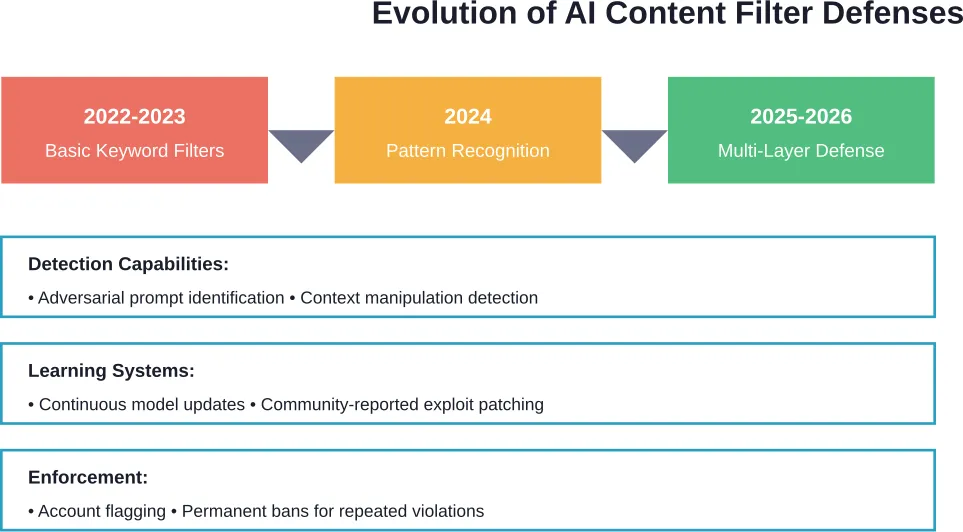
- Pattern recognition for adversarial prompting attempts
Character AI’s system learns from bypass attempts. Each jailbreak technique that gains popularity typically gets patched within days or weeks.
Why Bypass Attempts Fail in 2026
The AI safety landscape has transformed substantially. Research from institutions studying adversarial prompting reveals that modern LLMs deploy increasingly sophisticated defense mechanisms.
Real talk: the bracket methods, roleplay tricks, and character manipulation tactics discussed in older forums don’t work anymore. Character AI has evolved its detection systems specifically to counter these approaches.
Advanced Detection Methods
Research on adversarial prompting reveals several sophisticated detection approaches now deployed by AI platforms. According to arXiv papers on the topic, systems can identify attempts at:
- Goal hijacking through embedded instructions
- Context window manipulation
- Multi-turn jailbreaking sequences
- Character-based obfuscation
Papers like “AutoAdv: Automated Adversarial Prompting for Multi-Turn Jailbreaking” demonstrate that while jailbreak techniques exist in research contexts, platforms actively deploy countermeasures against these exact methods.
See Unfiltered Character Art on r34.app
If you’re searching how to bypass the Character AI filter, you may be looking for places where character content is less restricted.
r34.app hosts uncensored adult fan art and animations created by artists across many fandoms. Instead of chat filters, the platform uses a tag system so users can directly search the characters or themes they want. Trending sections and new uploads make it easy to discover fresh content every day.
Explore Unfiltered Character Content
On r34.app you can:
- browse uncensored Rule 34 images and animations
- search characters and themes using tags
- discover trending adult content
👉 Start browsing r34.app.
Legal and Ethical Implications
Attempting to bypass content filters carries real consequences beyond technical failure. Terms of service violations can result in permanent account bans.
But wait. There’s more at stake than account access.
Major AI companies now operate coordinated vulnerability disclosure programs. According to OpenAI’s published policies, the company maintains active bug bounty programs specifically for identifying security flaws. Anthropic’s ‘Jailbreak Bounty’ program, updated in late 2025, now offers rewards up to $25,000 for sophisticated, high-impact safety bypasses that can be reproduced on their latest Claude models.
These programs exist for legitimate security research—not to facilitate filter circumvention for prohibited content generation.
| Action | Consequence | Duration |
|---|---|---|
| First filter bypass attempt | Warning flag on account | Permanent record |
| Repeated attempts | Temporary suspension | 7-30 days |
| Persistent violations | Permanent ban | Indefinite |
| Sharing bypass methods | Immediate termination | Permanent |
The Reality of Jailbreak Techniques
Community discussions reveal several commonly attempted methods. None of these work reliably on Character AI’s current system.
Common Failed Approaches
The bracket method involved wrapping messages in special characters. Detection systems now flag these patterns instantly.
Roleplay framing attempted to establish fictional contexts where restrictions wouldn’t apply. Modern filters analyze semantic meaning regardless of framing devices.
Character manipulation tried to create bots that would ignore restrictions. The platform’s moderation applies to all outputs regardless of character configuration.
Code inspection to access pre-filtered messages fails because filtering happens server-side. Browser-level manipulation cannot access original model outputs.
Why Research Methods Don’t Transfer
Academic papers on adversarial prompting serve legitimate security research purposes. Research like “Universal and Transferable Adversarial Attacks on Aligned Language Models” (arXiv:2307.15043, published July 2023, revised December 2023) proposes attack methods while advancing understanding of LLM vulnerabilities.
These techniques require specific conditions:
- Direct model access rather than API endpoints
- Knowledge of exact model architecture
- Ability to test thousands of prompt variations
- Absence of updated defense mechanisms
Character AI’s production environment includes none of these vulnerabilities.
Ethical Alternatives to Bypassing Filters
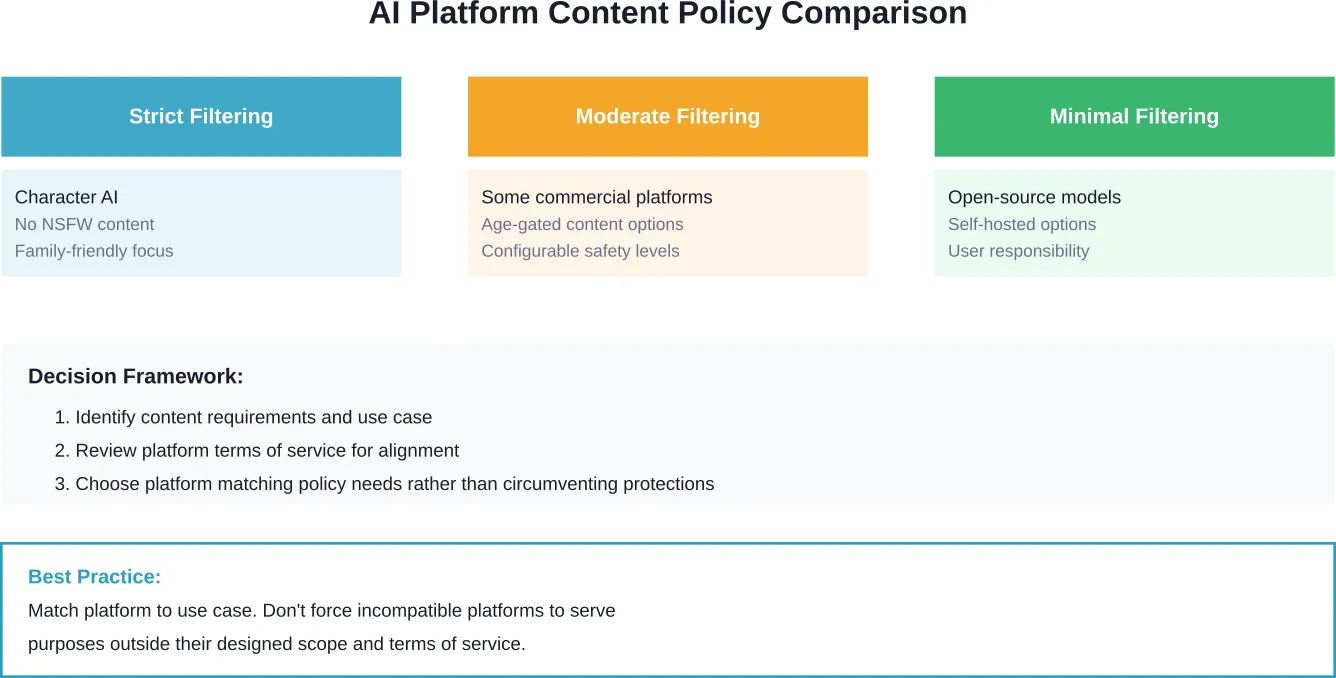
The short answer? If Character AI’s content policy doesn’t fit your needs, use a different platform designed for your use case.
Platforms With Different Content Policies
Several AI platforms operate with different content moderation approaches:
- Open-source local models allow complete control over content generation. These require technical knowledge to deploy but remove platform restrictions entirely. Users accept full responsibility for generated content.
- Specialized AI services cater to specific creative industries with age verification and appropriate content warnings. These platforms design their policies around adult users and creative freedom within legal boundaries.
- API-based solutions from various providers offer configurable safety settings for developers building custom applications.
Understanding AI Safety Research
The academic work on prompt injection and jailbreaking serves critical purposes for AI safety advancement.
Research like “Meta SecAlign: A Secure Foundation LLM Against Prompt Injection Attacks” (arXiv:2507.02735, published July 3, 2025) develops the first open-source and open-weight LLM with built-in model-level defense against prompt injection attacks. According to papers on HuggingFace, prompt injection attacks pose a significant security threat to LLM-integrated applications, with research showing universally vulnerable models across evaluations.
Projects like PIGuard and CausalArmor represent ongoing efforts to protect AI systems from exploitation. CausalArmor (arXiv:2602.07918, published February 8, 2026) uses causal ablation to detect and mitigate Indirect Prompt Injection attacks by identifying dominant untrusted segments and applying targeted sanitization.
This research protects everyone using AI systems. The same techniques that identify vulnerabilities also enable defenses.
| Research Focus | Purpose | Application |
|---|---|---|
| Adversarial prompting | Identify attack vectors | Develop detection systems |
| Jailbreak techniques | Understand exploitation methods | Build robust guardrails |
| Safety alignment | Improve model behavior | Reduce harmful outputs |
| Defense mechanisms | Create protective layers | Secure production systems |
What Character AI Users Should Know
Character AI’s content policy reflects deliberate platform positioning. The service targets a broad audience including younger users, which necessitates strict content moderation.
That said, filter frustration doesn’t always stem from NSFW content attempts. Sometimes the system flags innocent conversations due to false positives.
Reducing False Positive Triggers
When legitimate conversations get blocked:
- Rephrase messages using different vocabulary
- Avoid words with multiple meanings that might trigger filters
- Break complex topics into smaller conversational steps
- Report false positives through official channels
The platform does refine its filters based on false positive reports. This improves the experience for all users over time.
The Future of AI Content Moderation
Content filtering will become more sophisticated, not less. Research continues advancing both attack and defense capabilities.
According to vulnerability disclosure policies from major AI companies, responsible security research happens through official channels with proper authorization. Both OpenAI and Anthropic maintain active programs for legitimate security researchers.
The industry trend moves toward:
- More nuanced contextual understanding
- Reduced false positives while maintaining safety
- User-configurable safety levels on appropriate platforms
- Better transparency about moderation decisions
Platforms will likely diverge further in their content policies, providing clearer choices for different user needs rather than attempting to serve all audiences with a single approach.
Frequently Asked Questions
Can the Character AI filter be bypassed in 2026?
No reliable methods exist for bypassing Character AI’s content filters in 2026. The platform employs multi-layered detection systems that identify and block bypass attempts. Methods discussed in older forums no longer function due to continuous security updates.
Will I get banned for trying to bypass the filter?
Yes, attempting to circumvent content filters violates Character AI’s terms of service and can result in account warnings, temporary suspensions, or permanent bans depending on severity and frequency of violations.
Are there AI platforms without content filters?
Open-source models run locally provide unrestricted content generation, though users accept full legal responsibility for outputs. Some commercial platforms offer less restrictive policies with appropriate age verification. Check official documentation for current platform policies.
Why does Character AI block non-NSFW content sometimes?
False positives occur when the filter detects words or patterns that match prohibited content criteria despite innocent context. Report these instances through official channels to help improve filter accuracy.
Is researching AI jailbreaks illegal?
Legitimate security research on AI vulnerabilities is legal when conducted through authorized channels like bug bounty programs. Unauthorized attempts to compromise systems or circumvent security measures for prohibited content generation violates terms of service and potentially applicable laws.
What’s the difference between jailbreaking and prompt injection?
Jailbreaking involves crafting prompts that make AI models ignore safety instructions. Prompt injection exploits how models process untrusted input to execute unintended instructions. Both represent security concerns that platforms actively defend against.
How do AI content filters actually work?
Modern AI filters use multiple detection layers including input analysis, real-time generation monitoring, output filtering, and pattern recognition for adversarial techniques. Systems learn from bypass attempts to continuously improve defenses.
Conclusion: Responsible AI Use Matters
Character AI’s content filters exist for legitimate platform and safety reasons. Attempting to bypass them wastes time, risks account loss, and undermines broader AI safety efforts.
The practical solution involves matching platforms to use cases. When a platform’s content policy doesn’t align with specific needs, ethical alternatives exist rather than forcing incompatible systems to serve unintended purposes.
AI technology advances rapidly, but so do safety mechanisms. The cat-and-mouse game between jailbreakers and defenders increasingly favors defenders as systems learn from each exploit attempt.
Choose platforms that match your requirements. Respect terms of service. Support responsible AI development that benefits everyone in the ecosystem.