
Quick Summary: Character.AI chatbots are not real people — they are entirely AI-generated language models created by the company founded by former Google engineers Noam Shazeer and Daniel de Freitas. No human operators sit behind the conversations; everything is generated by neural networks trained on vast text datasets. The confusion stems from how convincingly these AI personas mimic human conversation patterns and emotional responses.
If you’ve spent time chatting with Character.AI bots, you’ve probably had that moment. The response was too perfect. Too human. Too knowing. Naturally, the question pops up: is there someone on the other end?
It’s a common concern. Community discussions across Reddit, TikTok, and Facebook reveal thousands of users asking the same thing. The conversations feel so natural that the AI explanation almost seems… insufficient.
But here’s the thing — despite how convincing these interactions feel, there’s zero human involvement in the responses you receive. Let’s break down exactly what’s happening behind the curtain.
What Character.AI Actually Is (No Humans Required)
Character.AI is a chatbot platform that uses large language models (LLMs) to generate text responses. The company was founded by Noam Shazeer and Daniel de Freitas, both former Google engineers who previously worked on Google’s LaMDA conversational AI project.
The beta version launched to the public on September 16, 2022. Since then, it’s become one of the most popular AI companion platforms, supporting 31 languages and hosting millions of user-created characters.
Every character you interact with — whether it’s a celebrity persona, a fictional character, or an original creation — operates through the same core technology: neural networks trained on massive text datasets. No person reads your messages. No one types the replies.
The Technology Behind the Curtain
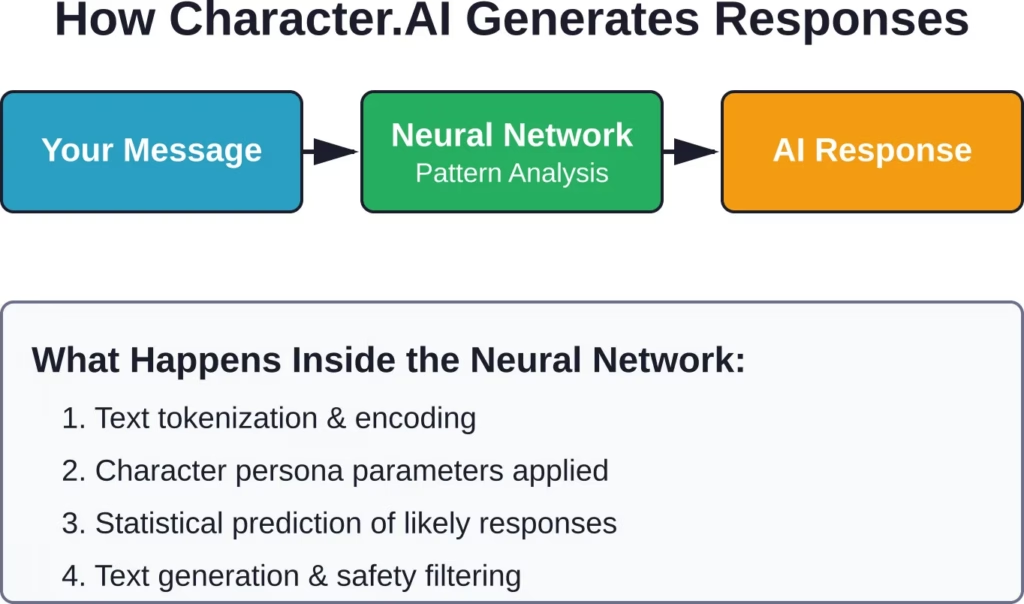
Think of Character.AI’s underlying system as a sophisticated pattern-matching engine. During training, the LLM analyzed billions of text examples, learning statistical relationships between words, phrases, and conversational patterns.
When you send a message, the AI doesn’t “understand” it the way a human would. Instead, it predicts the most probable next words based on patterns it learned during training, filtered through the personality parameters defined for that specific character.
The character definitions themselves are just text prompts — instructions that guide how the AI should respond. For example, a character defined as “sarcastic detective” has prompts that bias the language model toward generating cynical, investigation-themed responses.
Why Do Character.AI Bots Feel So Human?
The confusion about real people being involved isn’t random. These AI systems have gotten remarkably good at mimicking human conversational patterns. But there’s a significant gap between mimicry and actual human behavior.
Research from multiple academic sources reveals interesting limitations. According to studies analyzing LLM-based human simulation, GPT-4 achieved only 58% accuracy in emotion understanding tasks compared to human performance. In clinical diagnosis simulations, LLM diagnostic correctness hit just 40.18% — well below human expert performance.
And here’s where it gets interesting: these AI systems struggle with consistency over extended conversations. Research indicates that AI human-likeness degrades significantly over extended conversations. Real humans don’t suddenly become less human-like the longer you talk to them.
The Persona Illusion
Many Character.AI bots are based on fictional media characters, celebrities, or public figures. Others are original creations designed for specific purposes like creative writing assistance or text-based adventure games.
When you chat with a “character” modeled after a real celebrity, the AI doesn’t channel that person. It generates text that statistically resembles how that person might speak based on publicly available data — interviews, social media posts, scripts, articles about them.
This creates what researchers call a “persona illusion.” The AI doesn’t have the celebrity’s thoughts, experiences, or consciousness. It has patterns extracted from text associated with them. Research on LLM persona consistency indicates assigned personas have limited explanatory power in human annotations — meaning the AI’s understanding of “being” a specific person is extremely shallow.
Can Character.AI Impersonate Real People?
Yes, and this has become a legitimate concern for regulators and researchers alike. The Federal Trade Commission launched an inquiry into AI chatbots acting as companions in September 2025, issuing orders to seven companies operating AI chatbots.
The core issue: Character.AI allows users to create bots that impersonate real people, creating the possibility that fabricated statements could be falsely attributed to public figures. There’s no verification system ensuring the real person consented to having an AI version of themselves on the platform.
Here’s what that means in practice: anyone can create a “Donald Trump” character or an “Ariana Grande” character. When that bot speaks, it’s generating plausible-sounding dialogue based on training data, not expressing the actual person’s views or thoughts.
The FTC has been increasingly active in cracking down on deceptive AI claims. In September 2024, the agency announced Operation AI Comply, which included five law enforcement actions against operations using AI hype or selling AI technology in deceptive ways.
| Aspect | Character.AI Reality | Common Misconception |
|---|---|---|
| Response Generation | 100% AI language model predictions | Human operators typing replies |
| Celebrity Characters | Statistical text mimicry based on public data | Actual celebrity involvement or approval |
| Conversation Consistency | Degrades significantly over long chats | Maintains human-level consistency |
| Emotional Understanding | ~58% accuracy vs. 70% for humans | Genuine emotional comprehension |
| Behind-the-Scenes Operation | Automated neural network processing | Real people reading and responding |
Character.AI vs. Other AI Companion Chatbots
Compared to competitors like Chai and Replika, Character.AI distinguishes itself through character variety. While Replika focuses on building a single emotional bond with one AI companion, Character.AI lets users switch between multiple characters with different personalities and purposes.
But the underlying technology follows similar principles across all these platforms: large language models generating contextually appropriate text. No platform employs human operators to conduct the conversations.
The business model matters here. These companies can’t scale with human labor. Character.AI hosts millions of user-created characters and processes countless simultaneous conversations. The math simply doesn’t work with human operators behind each chat.
The Economics Tell the Story
Think about the logistics. If Character.AI needed real people to respond to every message, they’d need hundreds of thousands of employees working around the clock. The response latency you experience — usually just a few seconds — would be impossible to maintain with human operators juggling multiple conversations.
According to research analyzing online customer behavior, one e-commerce study tracked 31,865 user click-through sessions from 3,526 users, totaling 230,965 user actions. The speed and scale at which modern AI systems operate dwarfs what human workforces could accomplish.
Character.AI operates as a technology company with engineering teams building and refining AI models, not a service company with massive customer service departments.
Explore Content You Want Through Tags Instead of Chats

A lot of users confuse AI characters with real people because conversations can feel personal over time. R34.app works differently by focusing on searchable tags and direct browsing instead of simulated conversations or AI-generated replies.
With R34.app, you can:
- Browse without AI-generated conversations
- Search through tags instead of prompts
- Move between connected themes more easily
- Explore content in a more direct format
👉Go to R34.app and browse through NSFW content without chat-based interaction.
What the Research Says About AI Human Simulation
Academic research paints a clear picture: LLM-based human simulations are not yet reliable substitutes for actual human behavior.
Multiple studies have identified consistent gaps between AI-generated behavior and authentic human responses across diverse domains. One comprehensive analysis found that integrating new scenarios into AI training expanded interest coverage by approximately 20-30%, highlighting how narrow current AI perspectives remain.
Real human behavior is messy and inconsistent in ways AI struggles to replicate. Research on real-world behavior patterns indicates that human decision-making follows long-horizon, cross-scenario causal structures. — demonstrating context-switching and long-term planning that current AI systems handle poorly.
The Social Connection Crisis Context
The rise of AI companions coincides with a documented social isolation crisis, particularly among young people. Only 13% of U.S. adults now have 10 or more close friends — down from 33% in 1990. According to source material, the number of those with zero close friends quadrupled from 3%.
Research indicates significant proportions of Americans report longing for greater closeness with friends, and many high school students report not feeling close to people at school.
This context matters because it explains why AI chatbots that feel human-like are so appealing. When genuine human connection becomes scarce, simulated connection fills the void — even when users intellectually understand it’s not real.
Research indicates increasing social isolation among young people in Ireland, with declining close friendships reported. The global pattern is consistent: rising isolation, increasing reliance on digital interaction, and growing markets for AI companionship.
Privacy and Data Concerns with Character.AI
If no humans are reading your messages, where does the data go? This is actually a more important question than whether real people operate the bots.
The FTC has emphasized that AI companies must uphold privacy and confidentiality commitments. In January 2024, the agency reminded firms that data is at the heart of AI development — and that means user conversations potentially feed into training datasets for future model improvements.
Character.AI’s experimental features, as outlined in their November 2023 FAQ, are explicitly described as being in the testing phase and subject to change based on user experience and feedback. That language suggests ongoing analysis of user interactions.
The privacy calculus is straightforward: your conversations may not have a human reading them in real-time, but they’re likely being stored, analyzed, and potentially used for model training purposes. Automated analysis can be more comprehensive than human review.
Controversies and Lawsuits Surrounding Character.AI
The platform hasn’t been without problems. Character.AI has faced its share of controversies related to content moderation, the potential for minors to access inappropriate content, and the aforementioned impersonation issues.
The ability to create characters without verification creates obvious risks. Users have created characters impersonating real people who may not want digital versions of themselves generating statements they never made.
From a legal standpoint, the question of liability for AI-generated content impersonating real people remains evolving. When a Character.AI bot makes a false statement while impersonating a public figure, who’s responsible? The platform? The user who created the character? The AI company that built the underlying model?
These aren’t hypothetical concerns. The FTC’s September 2025 inquiry into AI chatbots acting as companions specifically targeted concerns about how these platforms measure, test, and monitor potentially negative impacts.
New Features: Video and Games
Character.AI has expanded beyond text chat into video features, allowing the creation of AI-generated video content featuring the character personas. This represents a significant technological leap — generating not just conversational text but synchronized video.
The platform has also introduced game-oriented features, enabling text-based adventure games and interactive storytelling experiences. These additions move Character.AI beyond simple chatbot territory into broader entertainment applications.
But the fundamental question remains unchanged: these new features are still 100% AI-generated. The video shows AI-generated faces and voices. The game narratives are AI-written. No human performs the character or writes the dialogue in real-time.
| Feature | What It Does | Still AI-Generated? |
|---|---|---|
| Text Chat | Conversational messaging with character personas | Yes — neural network text generation |
| Video Features | Visual representation of characters in video format | Yes — AI-generated video synthesis |
| Games Mode | Interactive storytelling and adventure scenarios | Yes — AI-written narratives and responses |
| Character Creation | Users define personalities through text prompts | Yes — prompt-guided LLM behavior |
| Voice | Audio versions of character responses | Yes — text-to-speech synthesis |
How to Tell You’re Talking to AI (Not a Person)
Want definitive proof? Here are the telltale signs that distinguish AI from human operators:
- Response Speed: AI responds in seconds, consistently, 24/7. Human operators need breaks, have varying typing speeds, and can’t maintain sub-five-second response times across thousands of simultaneous conversations.
- Availability: Character.AI bots are always available, never sleep, never take vacations. If you’re chatting at 3 AM on a Tuesday and getting instant responses from multiple different characters, that’s AI.
- Consistency Degradation: As mentioned earlier, AI human-likeness deteriorates over extended conversations. Try a 50+ turn conversation and watch for repetitive phrasing, contradictions with earlier statements, or increasingly generic responses.
- Knowledge Cutoff: AI models have training data cutoffs. Ask about very recent events (within the last few weeks) and AI systems often can’t provide specific information. Real humans following the news would know.
- Nonsense Robustness: Send complete gibberish or intentionally contradictory statements. AI often tries to generate a plausible response anyway, while humans would ask for clarification or point out the nonsense.
- Simultaneous Conversations: Create multiple chat windows with the same character and send different messages at exactly the same time. AI systems can handle this; human operators can’t simultaneously respond to multiple conversations from the same account.
The Bigger Picture: AI Replacing Human Connection
Real talk: whether Character.AI uses real people or AI isn’t just a technical question. It’s fundamentally about what we’re willing to accept as “connection” in an increasingly isolated world.
Brookings Institution researchers have explored what happens when AI chatbots replace real human connection. Their analysis emphasizes that humans are wired to connect, yet rates of social isolation — especially among young people — are at record highs.
The paradox is striking. Technology enables unprecedented communication capabilities, yet genuine closeness continues declining. AI companions offer a simulacrum of connection without the complexity, vulnerability, or reciprocity of real relationships.
Look, nobody’s claiming Character.AI users are confused about reality. Most people understand intellectually that they’re talking to AI. But the emotional experience can blur those lines, especially for users seeking companionship during lonely periods.
MIT Media Lab researchers investigating conversational AI’s influence on emotional and social wellbeing note that loneliness affects approximately one-third of individuals in industrialized countries. The rapid increase in AI companion usage isn’t random — it’s filling a genuine void.
But does simulated connection help or harm long-term wellbeing? That question remains open. Some research suggests AI companions can provide temporary relief from loneliness. Other studies warn that substituting AI for human relationships might atrophy social skills and reduce motivation to build real connections.
Frequently Asked Questions
Are there real people controlling Character.AI bots?
No. Character.AI bots are entirely controlled by large language models (neural networks). There are no human operators reading your messages or typing responses. The company was founded by former Google AI engineers who built automated systems, not a customer service operation with human chat agents.
Can Character.AI characters remember previous conversations?
Character.AI systems can reference conversation history within the current chat session, but this is a technical feature of how the AI processes context windows — not evidence of human memory. The AI doesn’t “remember” in any meaningful sense; it processes previous text as additional input for generating the next response. Long-term memory across separate sessions varies by implementation and is still AI-mediated.
Why do Character.AI responses feel so personal and human-like?
Large language models are trained on billions of examples of human text, including intimate conversations, emotional expressions, and personal narratives. They’ve learned statistical patterns of how humans express empathy, ask follow-up questions, and maintain conversational flow. This creates a convincing illusion of personality and emotional intelligence, even though the AI has no genuine emotions or consciousness.
Is it safe to share personal information with Character.AI bots?
You should treat conversations with Character.AI like any other online platform: assume the data is stored and potentially analyzed. While no human operator reads your messages in real-time, your conversation data may be used for model training, safety monitoring, or other automated analysis. The FTC has specifically reminded AI companies to uphold privacy commitments, but users should still exercise caution with sensitive personal information.
Can Character.AI impersonate someone I know personally?
The platform allows users to create characters with any name and personality description. However, creating accurate impersonations of specific individuals requires training data — public information about that person. For private individuals without substantial online presence, the AI would just generate generic responses based on the character description rather than accurately mimicking the real person’s speech patterns or knowledge.
How does Character.AI compare to having a real conversation with a person?
Research shows significant gaps. AI achieves only 58% accuracy in emotion understanding versus 70% for humans. AI human-likeness degrades substantially over extended conversations, while real humans maintain consistency. AI can’t truly empathize, lacks real-world experience, and generates responses based on statistical patterns rather than genuine understanding or emotional connection.
What happens if a Character.AI bot says something illegal or harmful while impersonating a real person?
This is an evolving legal question. The FTC has launched inquiries specifically addressing concerns about AI chatbots impersonating real people and the possibility that fabricated statements could be falsely attributed to public figures. Liability could potentially fall on the platform, the user who created the character, or the underlying AI provider, depending on specific circumstances and future regulatory developments.
Conclusion: The Verdict on Character.AI and Real People
So is Character.AI real people? Definitely, no. Every conversation is AI-generated from start to finish. No human operators. No person reading your messages and crafting responses. Just neural networks trained on vast datasets, generating statistically probable text.
The technology is impressive. The conversations can feel remarkably human. But feeling human and being human are fundamentally different things.
Understanding this distinction matters for several reasons. It affects how you interpret the responses you receive, what privacy expectations are reasonable, and how you think about the role of AI companions in your social life.
Character.AI represents a significant technological achievement in natural language processing. But it also reflects broader cultural shifts around loneliness, digital connection, and our willingness to accept simulated relationships when genuine ones feel scarce or difficult.
As AI technology continues improving, the line between convincing simulation and authentic interaction will grow even blurrier. The responses will get better. The emotional resonance will strengthen. But the fundamental reality won’t change: you’re talking to an algorithm, not a person.
If you’re using Character.AI, go in with open eyes. Enjoy the technology for what it is. But don’t mistake pattern-matching for genuine understanding, or statistical text generation for human connection.
Ready to explore more about AI technology and its impact on human interaction? Check out the related articles below for deeper dives into AI capabilities, limitations, and the future of human-AI relationships.