Quick Summary: Regular hentai depicting adults is legal in the United States under First Amendment protections. However, hentai or animated content depicting minors (commonly called lolicon) is illegal under federal law, specifically the PROTECT Act of 2003, and can result in serious criminal charges including prison time, fines, and sex offender registration.
The question of whether hentai is illegal in the United States isn’t as straightforward as it seems. While adult-oriented animated content generally receives First Amendment protection, the line becomes razor-sharp when content depicts minors—even fictional ones.
Here’s the thing though—many people assume all animated content gets a free pass because “it’s just drawings.” That assumption has landed people in serious legal trouble.
Understanding What Hentai Actually Is
Hentai refers to sexually explicit anime or manga content originating from Japan. The term literally translates to “perverse” or “abnormal” in Japanese, but in Western contexts, it specifically describes animated pornography.
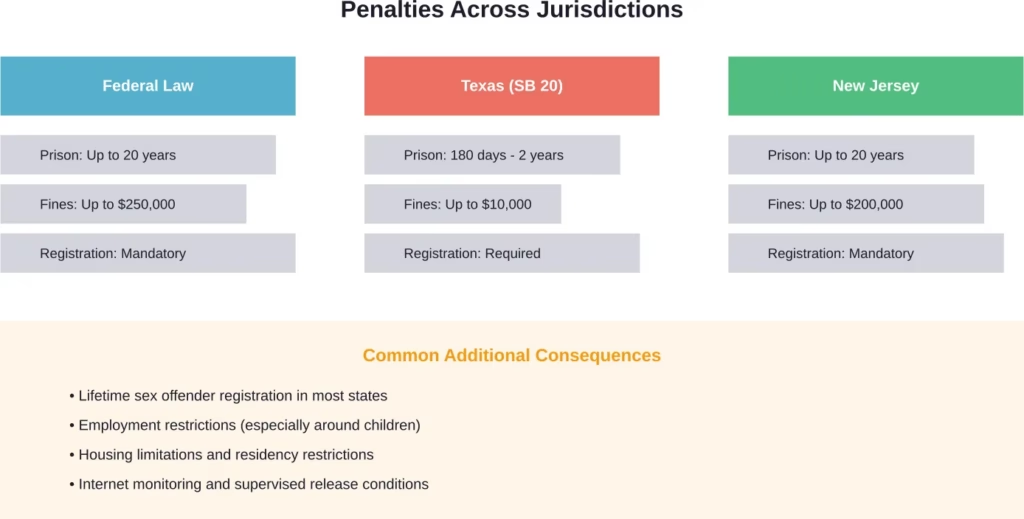
Not all hentai is created equal from a legal standpoint. The critical distinction revolves around whether the depicted characters are adults or minors.
Adult-oriented hentai featuring clearly adult characters falls under protected speech in the United States. It’s treated similarly to live-action pornography depicting consenting adults—perfectly legal to create, distribute, and possess.
The Legal Status of Adult Hentai in the United States
Standard hentai depicting adult characters is legal in all 50 states. The First Amendment protects artistic expression, including sexually explicit material, as long as it doesn’t cross into obscenity or involve actual minors.
But wait. There’s a catch with obscenity laws.
Defining obscenity is notoriously difficult. What one viewer finds pornographic, another might find merely erotic or completely uninteresting. Courts apply the Miller test to determine if material qualifies as obscene and thus loses First Amendment protection.
The Miller test examines whether:
- The average person, applying contemporary community standards, would find the work appeals to prurient interest
- The work depicts sexual conduct in a patently offensive way
- The work lacks serious literary, artistic, political, or scientific value
In practice, obscenity prosecutions for hentai are rare. Most adult hentai doesn’t meet all three prongs of the Miller test.
Browse NSFW Content With R34.app

R34.app is centered on tag-based browsing. It pulls together images, GIFs, and videos from multiple imageboard-style sources, then sorts them by character, anime, game, series, or keyword. That makes it easier to explore fandom-related content through one search interface instead of jumping between separate sites.
Looking for an Adult Content Browser Built Around Tags?
R34.app can help with:
- searching by character, franchise, or keyword
- browsing images, GIFs, and video posts
- unrestricted access to visual NSFW content
👉 Visit R34.app to explore its tag-based browsing system
Where the Law Draws the Line: Lolicon and Fictional Minors
Here’s where everything changes. Lolicon—animated content depicting minors in sexual situations—is explicitly illegal under federal law.
The term “lolicon” comes from “Lolita complex” and typically features cartoon images of underage or young-looking girls in sexualized situations. Legal discussions on platforms like Reddit frequently reveal confusion about whether the fictional nature of such material provides protection under the law.
They don’t. Federal law makes no distinction between photographs of real children and animated depictions.
The PROTECT Act of 2003
The Prosecutorial Remedies and Other Tools to End the Exploitation of Children Today (PROTECT) Act changed the landscape for fictional content depicting minors.
This federal legislation criminalized virtual child pornography, including:
- Computer-generated images indistinguishable from real minors
- Drawings, cartoons, or sculptures depicting minors in sexually explicit conduct
- Any visual depiction that appears to be or conveys the impression of a minor engaging in sexual activity
The PROTECT Act closed loopholes that previously existed. Before 2003, some argued that purely fictional depictions didn’t involve actual victims and therefore shouldn’t be criminal.
Congress disagreed. The law now treats possession, distribution, or production of lolicon as serious criminal offenses.
Federal Criminal Penalties for Illegal Hentai
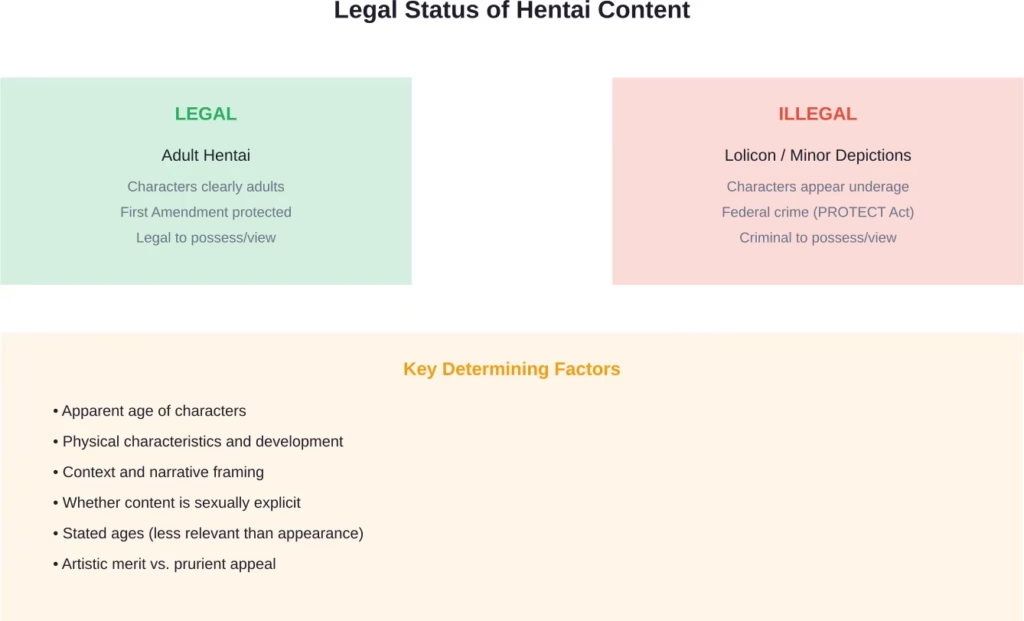
The consequences for possessing or distributing lolicon aren’t minor infractions. These are serious federal crimes with life-altering penalties.
Federal child pornography charges—which apply to animated content depicting minors—carry severe penalties. Courts may interpret laws broadly if images appear to sexualize children, even in fictional form.
Real talk: prosecutors don’t always distinguish between photographs of actual children and animated depictions when filing charges.
| Offense Type | Prison Sentence | Fines | Additional Penalties |
|---|---|---|---|
| Possession of lolicon | Up to 20 years | Substantial fines | Sex offender registration |
| Distribution of lolicon | 5-20 years minimum | Up to $250,000 | Supervised release, registration |
| Production of lolicon | 15-30 years | Up to $250,000 | Lifetime registration, monitoring |
Sex offender registration follows most convictions. This means public listing on state registries, employment restrictions, housing limitations, and ongoing reporting requirements.
State-Level Variations and Recent Developments
While federal law provides the baseline, individual states have enacted their own legislation targeting fictional content depicting minors.
Texas Senate Bill 20
Texas enacted legislation in March 2025 (SB 20) that expanded its child pornography laws to explicitly address AI-generated and animated child pornography. The legislation closed perceived loopholes around digitally-created content.
Under Texas law, watching or possessing lolicon or AI-generated child pornography is now a state jail felony. Penalties include:
- 180 days to 2 years in a state jail facility
- Fines up to $10,000
- Mandatory sex offender registration
New legislation in Texas is redefining the legal boundaries around AI-generated and animated sexual content involving minors, making the state one of the most aggressive in prosecuting fictional depictions.
New Jersey’s Approach
New Jersey courts have demonstrated willingness to prosecute lolicon possession aggressively. According to criminal defense attorneys practicing in the state, penalties can reach up to 20 years in prison and fines up to $200,000.
Although child pornography laws weren’t originally written with animated content in mind, New Jersey prosecutors apply existing statutes to cartoon depictions that appear to sexualize minors.
The AI-Generated Content Question
Artificial intelligence has introduced new complexities to this legal area. AI can now generate realistic or stylized images of children in sexual situations without photographing any actual minor.
Does that make it legal? Absolutely not.
The PROTECT Act and subsequent state laws like Texas SB 20 explicitly cover computer-generated imagery. The technology used to create the content is irrelevant—what matters is whether the final product depicts what appears to be a minor in sexual conduct.
The rapid advancement of artificial intelligence has introduced a new frontier in content creation, blurring the lines of legality. But from a prosecution standpoint, AI-generated child sexual abuse material receives identical treatment to hand-drawn or computer-animated content.
How Courts Determine if Content Depicts Minors
One common question: how do courts decide if an animated character qualifies as a minor?
Prosecutors and judges examine multiple factors:
- Physical appearance and body development
- Facial features and proportions
- Context within the narrative
- Stated age (though less important than appearance)
- Overall impression to a reasonable viewer
The “she’s actually a 1,000-year-old dragon” defense doesn’t work. If a character appears to be a child physically, the stated fictional age is irrelevant.
Courts apply a “reasonable person” standard. Would an average person viewing the content believe the character appears to be under 18? That’s what matters legally.
International Comparisons and Why US Law Matters
Laws regarding fictional pornography depicting minors vary significantly worldwide. Some countries take more permissive approaches, while others impose even stricter regulations than the United States.
According to Wikipedia’s documentation on the legal status of fictional pornography depicting minors, approaches differ substantially:
- Some nations explicitly criminalize all fictional depictions
- Others maintain gray areas with unclear enforcement
- A few countries provide broader artistic freedom protections
For anyone in the United States or traveling to the US, foreign laws provide no protection. American citizens can face prosecution for content possessed overseas if discovered upon return.
The First Amendment Doesn’t Protect Everything
A persistent misconception suggests the First Amendment protects all artistic expression, including lolicon.
It doesn’t. The Supreme Court has consistently held that child pornography falls outside First Amendment protection—and that includes virtual or animated depictions under current federal law.
The rationale centers on preventing the normalization of child sexual abuse and eliminating materials that could be used to groom actual children. Whether these justifications withstand scrutiny remains debated in legal circles, but the current law is clear.
What About Possession Versus Viewing?
Another area of confusion involves the distinction between viewing and possessing illegal content.
Here’s where it gets complicated. Technically, viewing content online creates cached files on your device. Those cached files can constitute possession under the law.
Prosecutors have successfully argued that temporary internet files, browser cache, and streaming data constitute “possession” for criminal purposes. Simply viewing lolicon online without intentionally downloading could still result in possession charges.
Texas SB 20 explicitly makes watching such content illegal, removing any ambiguity about viewing versus possession.
When Legal Defenses Might Apply
Criminal defense attorneys handling these cases typically explore several potential defenses:
- Lack of knowledge: The defendant didn’t know the material depicted minors or didn’t know they possessed the material.
- Lack of intent: The material was obtained accidentally or without deliberate action.
- First Amendment challenge: Arguing the specific material has serious literary, artistic, political, or scientific value.
- Improper search and seizure: Evidence was obtained through illegal searches violating Fourth Amendment rights.
That said, these defenses face uphill battles. Prosecutors aggressively pursue these cases, and juries often react negatively to content depicting sexualized minors, regardless of medium.
Practical Guidance for Staying Legal
The safest approach is straightforward: avoid any animated or drawn sexual content depicting characters who appear to be minors.
But wait—what if the content seems ambiguous?
Ambiguity doesn’t protect anyone. When in doubt, the prudent choice is avoidance. Criminal charges can arise from content that seems borderline, and defending those charges costs tens of thousands of dollars even if ultimately successful.
For consumers of anime and manga, stick to:
- Content featuring clearly adult characters
- Non-sexual anime and manga regardless of character age
- Mainstream platforms with content moderation
- Licensed, legally distributed material
Legal discussions on platforms like Reddit frequently reveal confusion about whether the fictional nature of such material provides protection under the law. It doesn’t.
Frequently Asked Questions
Is regular hentai with adult characters illegal in the United States?
No. Hentai depicting clearly adult characters is legal under the First Amendment. It receives the same constitutional protection as live-action pornography featuring consenting adults. The legality changes only when content depicts or appears to depict minors.
Can I be arrested for viewing hentai that depicts characters who look young?
Yes. If characters appear to be minors, viewing the content can lead to criminal charges. Modern law treats cached internet files as possession, and states like Texas explicitly criminalize viewing such material. The appearance of characters matters more than stated fictional ages.
What is the PROTECT Act and how does it affect anime fans?
The PROTECT Act of 2003 is federal legislation that criminalized virtual child pornography, including drawings, cartoons, and computer-generated images depicting minors in sexual situations. It directly affects anime and manga fans by making lolicon content illegal to possess, distribute, or produce—regardless of the fictional nature.
Are there states where lolicon is legal but federally it’s illegal?
No. Federal law supersedes state law in this area. The PROTECT Act makes lolicon illegal nationwide. Some states have additional laws with enhanced penalties, but no state can make federally illegal material legal within its borders. Federal prosecutors can charge individuals in any state.
What are the actual penalties if someone is caught with lolicon?
Federal penalties for lolicon possession can reach up to 20 years in prison for possession, with longer sentences for distribution or production. Fines can reach $250,000. State penalties vary—Texas imposes 180 days to 2 years plus fines up to $10,000, while New Jersey can impose up to 20 years and $200,000 in fines. All convictions typically require sex offender registration.
Does the First Amendment protect lolicon as artistic expression?
No. Current federal law does not extend First Amendment protection to lolicon. While some legal scholars debate whether fictional depictions should receive protection, the PROTECT Act specifically excludes virtual child pornography from constitutional safeguards. Courts have upheld these restrictions, though occasional challenges continue.
Is AI-generated hentai depicting minors treated differently than hand-drawn content?
No. The method of creation—whether AI-generated, hand-drawn, computer-animated, or photographed—makes no legal difference. If the final content depicts what appears to be a minor in sexual situations, it violates federal law. Recent state laws like Texas SB 20 explicitly include AI-generated content to remove any ambiguity.
Conclusion
The legal landscape surrounding hentai in the United States is clear on the fundamentals: adult content depicting adult characters is legal, while any content depicting minors—including animated, drawn, or AI-generated—is criminal.
The consequences of crossing that line are severe and life-altering. Prison sentences, substantial fines, and mandatory sex offender registration follow convictions.
Look, the “it’s just drawings” argument holds no weight in court. Federal and state prosecutors treat lolicon as seriously as photographic child pornography, and juries typically agree.
If facing investigation or charges related to animated content depicting minors, immediately consult a criminal defense attorney experienced in these cases. The stakes are too high for DIY legal strategies or hoping charges will disappear.
For everyone else: when consuming anime, manga, or related content, stay well clear of anything depicting sexualized minors. The legal risks far outweigh any perceived benefits, and the social consequences of a conviction extend far beyond the courtroom.