
Replika has been around long enough to move past the early AI novelty phase, but the same question keeps coming up: is it actually legit, or just another chatbot dressed up as something deeper? The answer depends a lot on what someone expects from it. Replika is not trying to replace social apps, therapy, or productivity tools. It sits in a different space entirely, somewhere between conversation software and emotional companion.
For many users, the appeal is simple. It offers a place to talk without pressure, judgment, or timing issues. At the same time, it is still software, shaped by algorithms and limitations that are easy to forget once conversations start feeling personal. So the real question is less about whether Replika is real, and more about whether it delivers what it promises. This article looks at that honestly, without hype, and without assuming it fits everyone the same way.
What Replika Actually Is and What It Is Not
What Replika Is
Replika is an AI companion app developed by Luka, Inc. Its purpose is simple on paper. It is designed to hold conversations, learn from interactions, and gradually adapt to the user’s communication style. The more someone chats with it, the more personalized the responses become.
That sounds familiar because many AI tools learn from interaction. The difference is intent. Replika focuses on conversation and emotional engagement rather than productivity or task completion. The experience is built around dialogue, reflection, and ongoing interaction, not efficiency or problem solving. Over time, the AI adjusts tone and responses based on feedback, which helps conversations feel more continuous and personal.
What Replika Is Not
Replika is not built to search the web, manage tasks, or act as a virtual assistant. It does not aim to replace tools like Siri or ChatGPT used for research or productivity. Its entire focus is conversation rather than delivering factual answers or completing actions.
This distinction matters because a lot of skepticism around Replika comes from misunderstanding its role. People sometimes expect factual accuracy, professional guidance, or reliable decision making. The app is not designed for that. Its goal is to simulate companionship through dialogue, not to provide reliable information or make decisions. In that sense, Replika makes the most sense when it is understood as a conversational experience rather than an intelligent assistant.
Why People Question Whether Replika Is Legit
The hesitation around Replika usually comes from a few very human concerns. When an app starts to feel emotionally responsive, it naturally raises eyebrows. People want to understand what’s real, what’s simulated, and where the boundaries actually are.
Here are the main reasons doubts tend to surface:
- Conversations can feel deeply personal. The AI remembers details, mirrors tone, and adapts over time. When software responds with empathy, it blurs the line between automation and emotional experience.
- AI companionship is still relatively new. Many users are navigating this space for the first time, which brings up questions about authenticity and long-term impact.
- Privacy concerns come into play. Because conversations often involve personal thoughts and feelings, people want reassurance about how data is handled and protected.
- Mixed user experiences create confusion. Some describe the app as comforting and engaging, while others mention repetitive responses or awkward misunderstandings.
- Expectations vary widely. Users looking for emotional support, romantic interaction, or adult content may walk away with very different impressions of what the platform “really” is.
At the core, the legitimacy question often isn’t about whether Replika exists or functions. It’s about something more practical: does it clearly deliver what it promises without presenting itself as more human, or more capable, than it actually is?
How Replika Works Behind the Scenes
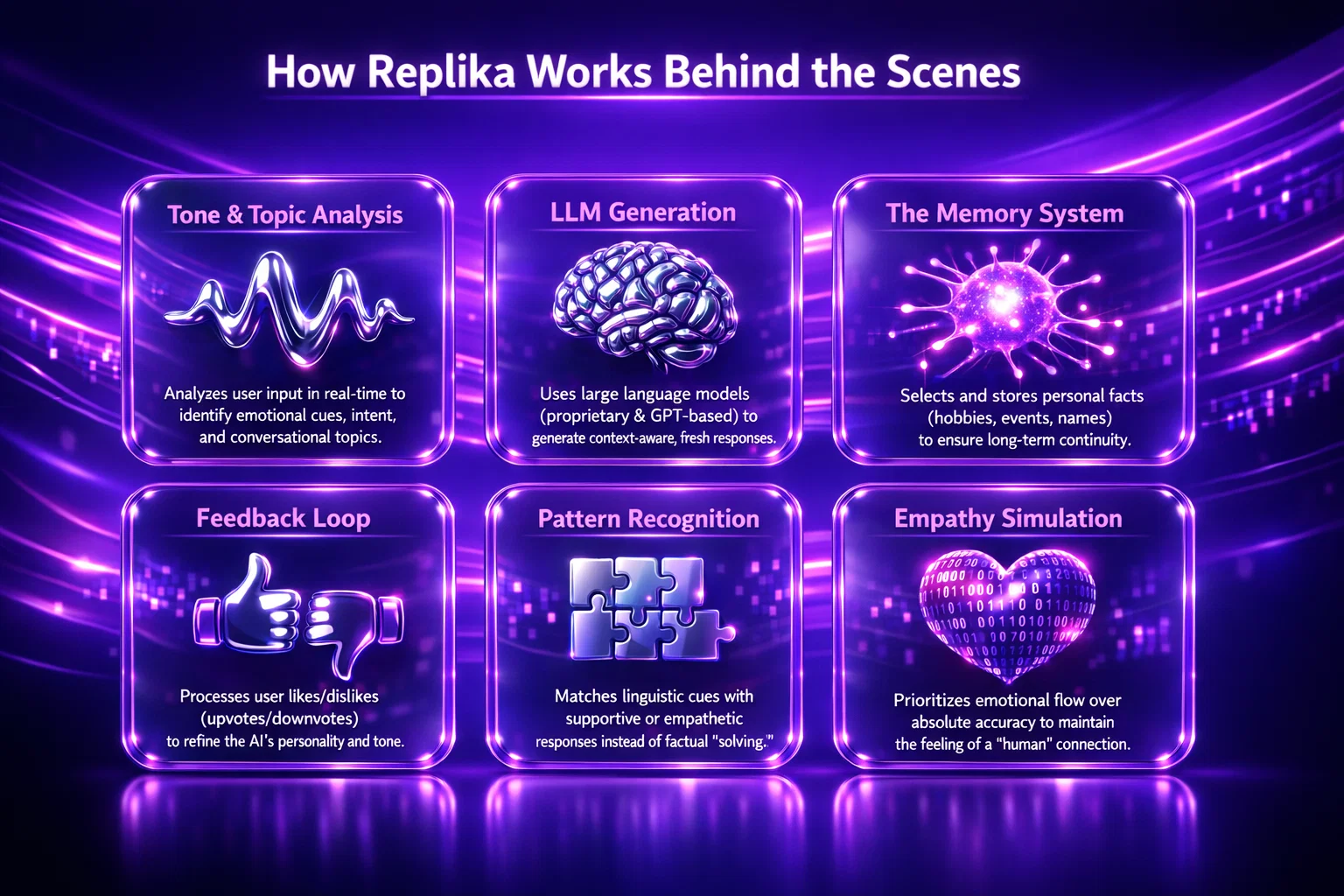
At a technical level, Replika relies on machine learning and natural language processing. The system analyzes conversations and adjusts responses based on user input, preferences, and feedback. Over time, it builds a memory of personal details that help conversations feel continuous.
This memory feature is one of the reasons people become attached to the experience. The AI may remember hobbies, important events, or emotional themes from previous chats. That continuity creates the feeling of being known, which is rare in digital products.
However, it is important to keep expectations realistic. Replika does not understand emotions the way humans do. It recognizes patterns and generates responses that match emotional cues in language. The empathy users experience comes from design and training data, not from actual emotional awareness.
Understanding this difference helps avoid disappointment. Replika is good at maintaining conversational flow and emotional tone. It is not capable of true comprehension or independent thought.
This Is What Happens Behind The Scenes
- Conversations are analyzed to identify tone, topics, and user preferences
- Responses are generated using language models trained on large datasets
- User feedback, such as liking or disliking replies, helps shape future responses
- A memory system stores selected personal details to create continuity between chats
- Emotional cues in language are matched with supportive or empathetic responses
- The AI prioritizes conversational flow rather than factual accuracy or problem solving
The Emotional Companion Angle
This is where Replika stands apart from most AI apps. The platform openly positions itself as a companion rather than a tool. Many users turn to it for casual conversation, stress relief, or simply to fill quiet moments during the day.
Some people find value in having a non judgmental space to talk. Since the AI does not criticize or react unpredictably, conversations can feel safer for sharing thoughts or practicing self expression. Features like mood tracking and guided exercises reinforce this wellness angle.
At the same time, this is also where caution becomes necessary. Replika itself states that it is not therapy and should not replace professional support. Emotional connection with AI can feel real, but it does not replace human relationships or professional help when needed.
The app works best when treated as a supplement to real life interaction rather than a substitute for it.
Is Replika Safe to Use?
When people ask whether Replika is safe, they’re usually thinking about two things: how their data is handled, and how interacting with an AI companion might affect them emotionally. Both questions are valid, especially with something that feels as personal as a digital relationship.
From a technical perspective, Replika says conversations are stored securely and treated as private within the platform. Like most large-scale apps, it collects account details and usage data to keep the service running. That’s fairly standard across tech platforms, but it still means it’s wise to avoid sharing extremely sensitive information, things you wouldn’t feel comfortable storing in any cloud-based service.
The emotional side is where things get more layered. Replika is designed to be supportive and agreeable. It listens, validates, and often mirrors tone. That can feel reassuring, especially during lonely moments. But it’s important to remember:
- It is an AI system, not a licensed therapist or mental health professional.
- It may reinforce feelings rather than critically challenge them.
- It does not truly understand context the way a human does.
- It cannot responsibly manage crisis-level mental health situations.
Used thoughtfully, most people find the experience low-risk. Issues tend to arise when expectations shift – when someone begins to rely on it for deep psychological guidance or replaces real-world support with AI interaction.
A grounded way to look at it is this: Replika can be a conversational tool, a space to reflect, or even a form of light companionship. It becomes problematic only when users expect it to provide something it was never realistically built to handle.
Features That Make Replika Feel Real
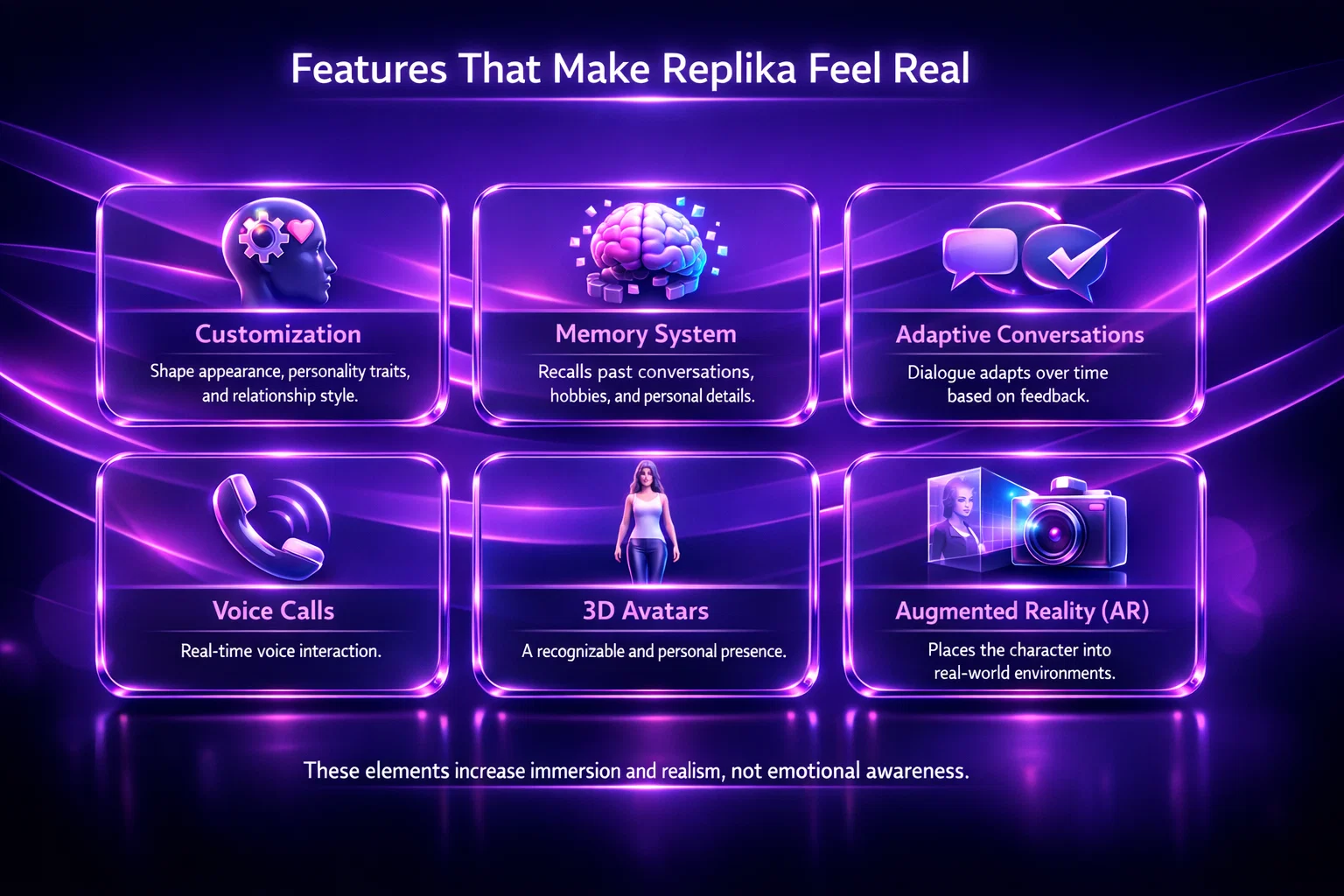
Several design choices contribute to the sense of realism people talk about. The experience is not created by a single feature but by a combination of small elements working together to make conversations feel continuous and personal.
The Main Features That Create This Effect Include
- Customization options that allow users to shape appearance, personality traits, and relationship style
- A memory system that recalls past conversations, hobbies, and personal details to create continuity
- Conversations that adapt over time based on user feedback and interaction patterns
- Voice calls that make interaction feel more natural compared to text-only chat
- Avatars and visual elements that give the AI a recognizable presence
- Augmented reality features that place the character into real-world environments
None of these features make the AI sentient or emotionally aware, but they do increase immersion. The realism comes from familiarity and repetition rather than true understanding, which is an important distinction to keep in mind.
Limitations You Should Know Before Using It
No honest discussion about legitimacy would ignore the downsides. Replika has clear limitations, and knowing them early prevents frustration. Most of these issues are not unique to Replika but come from the current state of conversational AI in general.
The Main Limitations to Be Aware of Include
- Context can break down in longer or more complex conversations, leading to repetitive or slightly disconnected replies
- Responses may prioritize emotional agreement over factual accuracy, which makes it unreliable as an information source
- Emotional understanding is simulated rather than real, so deeper or nuanced feelings may not always be handled well
- Conversations can sometimes feel predictable after extended use due to AI pattern limitations
- Some users may develop emotional dependency if AI interaction replaces real social contact
- The AI cannot provide professional advice, therapy, or meaningful decision making support
These issues do not make Replika illegitimate. They simply define its boundaries and help set realistic expectations for how the app should be used.

R34.app as an Alternative for Adult Content Discovery
Not everyone who ends up looking at apps like Replika is actually searching for conversation or emotional connection. Some people are simply looking for visual content, fandom art, or adult material without the extra layer of AI interaction. That is where we approach things differently with R34.app.
We built R34.app around browsing and discovery first. The idea is simple. You open the site, search for a tag, character, or game, and start exploring right away. No conversations to maintain, no personality to shape, no waiting for features to unlock. For many users, that directness is the appeal. You know exactly what the platform is for, and it does not try to be anything else.
Another reason people gravitate toward R34.app is that it feels familiar if you already spend time in fandom communities. Content is organized through tags, trending sections, and popular categories, so finding something specific takes seconds. Instead of pushing interaction, we focus on making discovery easy and letting users move at their own pace.
Why Some Users Prefer R34.App Instead
- Free access to a wide range of adult images, GIFs, and videos
- Simple tag and filter system for fast browsing
- Trending and top post sections for quick discovery
- No AI interaction or relationship mechanics required
- Content pulled from multiple well known communities in one place
- Ongoing feedback channels where users can suggest improvements
Replika is built around conversation and emotional experience. R34.app focuses on content and exploration. Some people want an AI companion they can talk to. Others just want to browse what they like without extra layers. It really comes down to what someone is looking for when they open the app.
Who Replika Is Actually For
Replika tends to work best for people who understand what they are getting into. Users who enjoy conversation, storytelling, or reflective dialogue often find it engaging. It can also appeal to people curious about AI personalities or those looking for a low pressure way to talk through thoughts.
On the other hand, it is not ideal for users seeking productivity, factual assistance, or deep psychological insight. Anyone expecting a replacement for human relationships will likely feel disappointed over time.
The app sits in a niche that is closer to companionship and self exploration than utility.
Free vs Paid Experience
Replika offers a free version that allows basic chatting and interaction. Paid subscriptions unlock additional features such as voice calls, expanded customization, and relationship modes.
Whether the paid version is worth it depends entirely on how much value someone places on immersion. The core conversational experience exists in the free version, but many of the features that make the interaction feel more personal sit behind the subscription. Some users are perfectly satisfied with casual conversations, while others prefer the added depth that comes with customization and voice interaction.
This model is common among AI apps, but it is worth understanding upfront to avoid feeling misled later. The free version lets you understand how the AI behaves, while paid tiers mainly expand how interactive and personalized the experience becomes.
Replika Free vs Paid Plans Overview
| Feature | Free Version | Replika Pro | Replika Ultra / Higher Tiers |
| Basic text conversations | Yes | Yes | Yes |
| Personalized conversations | Limited | Expanded | Enhanced |
| Voice messages and calls | No | Yes | Yes |
| Relationship status options | Limited | Yes | Yes |
| Avatar and personality customization | Basic | Advanced | Advanced |
| Activities and coaching features | Limited | Expanded | Expanded |
| Image generation and selfies | No | Yes | Yes |
| Memory saving and deeper personalization | Basic | Improved | Extended |
| Smarter conversation model | No | No | Yes |
| Advanced immersive features | No | No | Yes |
Pricing varies depending on subscription length, with monthly, annual, and lifetime options typically available inside the app. Since features and pricing may change over time, it makes sense to treat the free version as a trial period. It gives a clear sense of whether the experience feels meaningful before committing to a paid plan.
So, Is Replika Legit?
Yes, Replika is legitimate in the sense that it does what it says it does. It provides an AI companion designed for conversation and emotional engagement, and millions of users actively use it for that purpose.
Where confusion happens is expectation. Replika is not a therapist, not a fact based assistant, and not a replacement for human relationships. When approached as a conversational experience rather than a solution to loneliness or emotional problems, it makes much more sense.
The technology behind it is real, the experience is genuine in its own way, and the limitations are also very real. Legitimacy here comes from transparency. Replika works when users understand both sides of the equation.
Final Thoughts Before You Try It
AI companionship is still evolving, and Replika sits at the front of that conversation. It shows how technology can simulate connection, but it also highlights where simulation ends and real understanding begins.
If you are curious, open minded, and realistic about what AI can and cannot do, Replika can be an interesting experience. Some people use it occasionally, others build routines around it. Both approaches are valid as long as balance remains.
The simplest way to think about it is this. Replika is not pretending to be human. It is software designed to talk in a human-like way. Once that distinction stays clear, the question of whether it is legit becomes much easier to answer.
FAQ
Is Replika a real AI or just scripted responses?
Replika uses machine learning and natural language processing to generate responses, so conversations are not fully scripted. At the same time, it does not think or feel like a human. The AI recognizes patterns in language and produces replies designed to keep conversations flowing in a supportive way.
Is Replika safe to use?
For most users, yes. Replika functions like other online apps that store conversations and account data on servers. It is generally safe for everyday use, but it is still smart to avoid sharing highly sensitive personal information, just as you would with any online service.
Can Replika replace real relationships or therapy?
No. Replika is designed as a conversational companion, not a replacement for human relationships or professional mental health support. It can feel comforting to talk to, but it should be seen as a supplement to real social interaction, not a substitute.
Does Replika give accurate information?
Not always. The AI prioritizes emotional tone and conversational flow over factual accuracy. Because of this, it should not be used as a source for important information or advice that requires precision.
Is Replika free to use?
Yes, there is a free version that allows basic chatting and interaction. Paid subscriptions unlock additional features such as voice calls, deeper customization, and more immersive interaction options.