
Quick Summary: Hentai is a Japanese term referring to pornographic anime and manga, though it originally meant ‘perversion’ or ‘abnormality’ in Japanese. While it’s become a globally recognized genre of animated adult content, the term carries different meanings in Japan versus Western contexts, and raises concerns about accessibility to minors and depictions of sexual violence.
The word ‘hentai’ carries significantly different meanings depending on where you are in the world. In Western countries, it’s become shorthand for Japanese pornographic cartoons. In Japan? It literally translates to ‘pervert’ or ‘abnormal sexual desire.’
This linguistic disconnect creates confusion for many people trying to understand what hentai actually is. The term has evolved dramatically from its original Japanese usage to become a globally recognized porn genre. And with the rise of streaming platforms and internet accessibility, hentai has grown into a massive industry that extends far beyond simple animated content.
But here’s the thing—while some dismiss it as ‘just cartoons,’ the genre raises serious questions about sexual violence depictions, accessibility to minors, and its psychological effects on viewers.
The Definition and Terminology
According to Wikipedia, hentai is ‘a style of Japanese pornographic anime and manga.’ The Japanese characters ヘンタイ (hentai) or 変態 (hentai) literally mean ‘deviation,’ ‘abnormality,’ or ‘metamorphosis.’
In its native Japan, calling someone ‘hentai’ is basically calling them a pervert. It’s not a compliment. The term historically referred to abnormal sexual desires or perverted behavior, not pornographic cartoons.
So how did this semantic shift happen?
When Japanese adult anime and manga started gaining international attention in the 1990s, Western audiences needed a shorthand term for this type of content. They adopted ‘hentai’—a word they’d heard associated with sexual content in Japanese media—and repurposed it to describe the genre itself.
The result? Two completely different meanings separated by geography and culture.
| Context | Meaning | Usage Example |
|---|---|---|
| Japanese Usage | Pervert, abnormal sexual desire | ‘That person is a hentai’ (insult) |
| Western Usage | Pornographic anime/manga genre | ‘I watched some hentai last night’ (genre reference) |
| Formal Japanese | Abnormality, metamorphosis | Scientific or psychological contexts |
In addition to anime and manga, hentai works exist in multiple media formats. Video games featuring pornographic content—commonly called ‘eroge’ (erotic games)—represent a significant portion of the market. There’s also static artwork, visual novels, and even live-action adaptations.
The plural of hentai is just ‘hentai,’ not ‘hentais.’ Japanese doesn’t typically add ‘s’ for pluralization, and the Western adoption has maintained this linguistic quirk.
Historical Development and Cultural Context
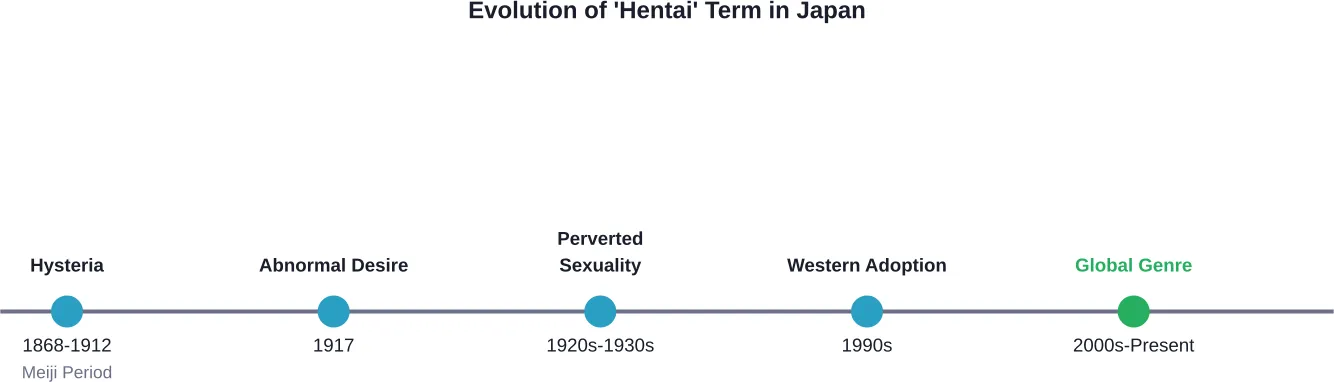
The evolution of the term ‘hentai’ in Japanese culture tells a fascinating story about changing attitudes toward sexuality.
During the Meiji period (1868-1912), the term was associated with hysteria. By 1917, it had shifted to mean ‘abnormal sexual desire.’ Through the 1920s and 1930s, it came to represent perverted sexuality and topics related to homosexual relationships.
The development of hentai as a pornographic medium has been heavily influenced by Japanese cultural and historical attitudes toward sexuality. Japan has a long tradition of erotic art, dating back centuries to shunga (春画)—woodblock prints depicting explicit sexual acts that were popular during the Edo period.
Modern hentai emerged as anime and manga industries grew in the post-war period. As animation techniques improved and manga publishing expanded, artists began creating adult-oriented content alongside mainstream works.
Censorship and Legal Framework
Here’s where things get complicated. Japan maintains strict obscenity laws that require censorship of genitalia in pornographic material—including hentai. That’s why you’ll notice pixelation or strategic blocking in Japanese hentai productions.
The trial for the book ‘In the Realm of the Senses’ (Ai no Korīda) ended in a victory for Nagisa Oshima, confirming that the text did not violate obscenity laws. However, Article 175 of the Japanese Penal Code remains in full effect for all media, including film, anime, and manga, requiring the mosaic censorship of genitalia to this day.
This creates an interesting paradox. Hentai must censor certain anatomical features, yet can depict virtually any sexual scenario imaginable—including violent or non-consensual acts that would be illegal if performed by real people.
Different countries have adopted varying approaches to regulating hentai. Some ban it outright, others regulate it like any pornography, and some maintain ambiguous legal positions that create uncertainty.
Why Hentai Has Become Popular Globally
The global popularity of hentai has surged dramatically with internet accessibility. But what drives this demand?
Several factors contribute to hentai’s widespread appeal:
- Anonymity and accessibility. Animated pornography can be consumed more discreetly than live-action content. There’s no actors involved, which some viewers find less morally complicated.
- Fantasy without limits. Animation allows depictions that would be impossible or illegal with real performers. This appeals to viewers seeking content that pushes beyond conventional pornography’s boundaries.
- Artistic style. The distinctive aesthetic of Japanese animation attracts people who appreciate the art form, even in adult contexts. Character designs, storytelling elements, and production values can be quite sophisticated.
- Variety of genres. Hentai encompasses countless subgenres catering to specific preferences. From romantic scenarios to extreme fetishes, the genre offers extensive variety.
Community discussions on platforms like Reddit reveal that many hentai consumers appreciate that ‘no real people are harmed’ in its production—a common justification for preferring drawn content over live-action pornography.
Real talk: this reasoning has significant flaws, which we’ll address shortly.
Explore How Hentai Is Tagged and Organized
A definition explains the word, but it doesn’t show how it’s actually used. In practice, “hentai” is tied to tags, characters, and fandoms that shape how content is categorized and found.
Platforms like r34.app make this clearer by pulling content from multiple sources and organizing it around tags, themes, and formats.
Inside r34.app, you can:
- search specific tags to see how content is labeled
- explore characters, games, and anime tied to those tags
- browse top and trending posts to understand common patterns
- switch between images, GIFs, and video content
👉 Open r34.app, search a term, and see how it’s actually used across posts and tags.
Concerns and Controversies Surrounding Hentai
While hentai doesn’t involve real performers, that doesn’t mean it’s without serious concerns. Organizations like Fight the New Drug have highlighted multiple problematic aspects of this porn genre.
Accessibility to Minors
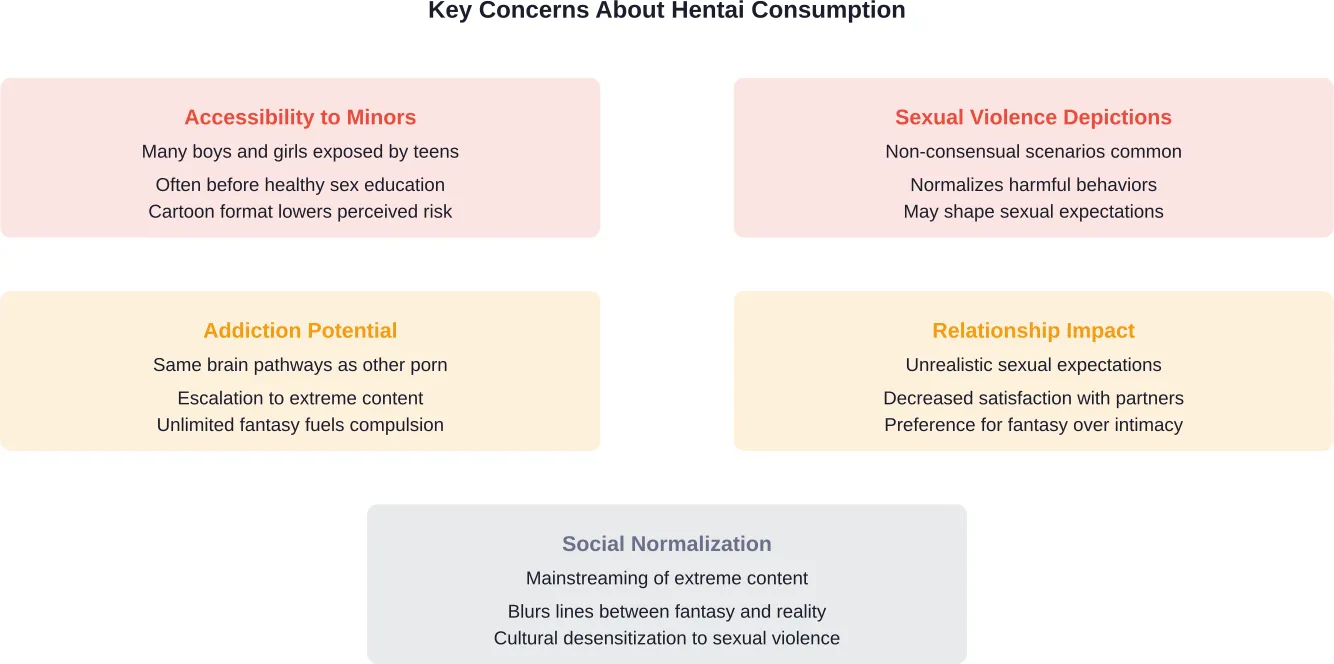
According to Fight the New Drug research, many kids are exposed to porn by age 12. By the time they’re teenagers, many boys and girls have already viewed it—often before they’ve had a single healthy conversation about sex.
Hentai presents a particular risk because its animated format can seem less ‘serious’ than live-action pornography. Parents and filters may not catch it as readily. Young people might encounter it while browsing general anime content, as the visual styles can appear similar at first glance.
The cartoon format doesn’t make the content any less explicit or potentially harmful to developing minds.
Depictions of Sexual Violence and Minors
This is where hentai becomes deeply controversial. Because animation has no physical limitations, hentai frequently depicts scenarios that would constitute serious crimes if performed with real people:
- Sexual assault and non-consensual scenarios
- Characters drawn to appear as minors in sexual situations
- Extreme violence combined with sexual content
- Incest and other taboo scenarios
The argument that ‘they’re just drawings’ doesn’t address the psychological and social implications. Research into pornography’s effects suggests that content shapes expectations, normalizes behaviors, and can desensitize viewers to violence.
When sexual violence becomes entertainment—even in animated form—it raises questions about what messages consumers internalize about consent, relationships, and acceptable sexual behavior.
Addiction and Compulsive Use
Fight the New Drug receives many messages from people struggling with hentai addiction. The animated format doesn’t make it less addictive than live-action pornography—it activates the same neural pathways and reward systems in the brain.
In fact, some argue hentai may present higher addiction risk precisely because it has no boundaries. When fantasy has no limits, escalation becomes almost inevitable. Viewers may find themselves seeking increasingly extreme content to achieve the same level of stimulation.
Cultural Differences in Perception
The way hentai is viewed varies dramatically across cultures. In Japan, while the content exists and has a market, it’s generally not discussed openly in polite society. The term itself is considered crude.
Western audiences often romanticize Japanese attitudes toward sexuality as more ‘open’ or ‘accepting.’ The reality is more nuanced. Japan maintains conservative social norms about public sexuality despite having a robust adult entertainment industry.
Academic research into hentai often struggles with this cultural translation. Western scholars analyzing the genre must navigate the gap between how Japanese creators intend the content and how international audiences interpret and consume it.
The Hentai Industry and Market
Hentai represents a significant segment of the broader anime and manga industries. Production ranges from small independent artists to major studios with substantial budgets.
Distribution has shifted dramatically with digital platforms. Where physical media once dominated, streaming sites now provide instant access to massive libraries of content. This accessibility has fueled global growth but also raised concerns about age verification and content moderation.
The industry includes:
- Animated series (OVAs): Original video animations produced specifically for home viewing
- Manga publications: Print and digital comics with pornographic content
- Eroge (erotic games): Visual novels and interactive games with sexual content
- Artwork and illustrations: Static images distributed online or in art collections
- Doujinshi: Self-published works, often featuring characters from mainstream anime/manga
Sound familiar? This diverse ecosystem mirrors mainstream entertainment media—just with explicit sexual content as the defining characteristic.
Understanding Genre Classifications Within Hentai
Like any media genre, hentai contains numerous subgenres and classifications. These range from relatively conventional romantic scenarios to extreme fetish content.
Some subgenres focus on specific character types (schoolgirls, office workers, fantasy creatures). Others center on particular sexual acts or scenarios. The sheer variety makes broad generalizations about ‘hentai’ somewhat meaningless—the category encompasses vastly different content.
This diversity also complicates discussions about the genre’s effects and appropriate regulations. Content that depicts consensual adult relationships differs dramatically from violent or exploitative scenarios, yet both fall under the hentai umbrella.
| Category Type | Characteristics | Common Elements |
|---|---|---|
| Romance-focused | Emphasizes relationships and emotional connection | Character development, consensual scenarios, softer tone |
| Fantasy-based | Features supernatural or sci-fi elements | Non-human characters, magical settings, impossible scenarios |
| Fetish-specific | Centers on particular sexual preferences | Specialized content for niche audiences, varied intensity |
| Extreme content | Depicts violence, non-consent, or taboo scenarios | Controversial themes, often banned in certain jurisdictions |
The Psychology Behind Hentai Consumption
What drives people toward animated pornography rather than live-action alternatives?
Psychological research into pornography consumption suggests several motivations. Some viewers prefer the emotional distance that animation provides—there’s no concern about exploitation of performers. Others find the artistic style more appealing or less ‘crude’ than filmed pornography.
But wait. The psychological effects appear similar regardless of format. Pornography consumption has been linked to:
- Decreased relationship satisfaction
- Escalating tolerance requiring more extreme content
- Unrealistic expectations about sex and partners
- Potential addiction and compulsive behavior patterns
- Reduced empathy in some cases, particularly with violent content
The ‘just cartoons’ defense ignores how media consumption shapes thoughts, attitudes, and behaviors. The brain processes arousal similarly whether the stimulus comes from real people or drawings.
Legal Status Around the World
Hentai occupies murky legal territory in many jurisdictions. Laws written for live-action pornography don’t always clearly apply to animated content.
Some countries have explicitly banned hentai depicting minors, even though no real children are involved. The reasoning centers on whether such content encourages or normalizes illegal desires. Other nations maintain that without actual victims, criminalization infringes on artistic expression.
Enforcement varies widely. Prosecution for hentai possession or distribution is relatively rare in most Western countries, though laws technically prohibit certain content. Japan’s censorship requirements create a unique situation where domestic producers must censor their work, but international distribution often includes uncensored versions.
This patchwork of regulations creates confusion for consumers, platforms, and creators operating across borders.
Impact on Relationships and Sexual Expectations
Community discussions and anecdotal reports suggest hentai consumption can significantly impact romantic relationships. Partners may feel inadequate compared to idealized animated characters who exist solely for sexual fantasy.
The complete fantasy nature of hentai—where characters always consent, physical limitations don’t exist, and scenarios play out perfectly—creates expectations that real intimacy cannot meet. This gap between fantasy and reality can damage sexual satisfaction and relationship quality.
Some individuals report preferring hentai to real relationships, finding animated content ‘simpler’ or less emotionally demanding. This substitution of fantasy for genuine human connection represents a concerning trend that extends beyond hentai to pornography consumption generally.
Frequently Asked Questions
Is watching hentai illegal?
The legality depends on location and content. In most Western countries, hentai depicting adults is legal to view, though distribution laws vary. Content depicting characters who appear to be minors is illegal in many jurisdictions, including the United States, Canada, and Australia, even though no real children are involved. Always check local laws, as regulations differ significantly between countries.
What’s the difference between anime and hentai?
Anime refers to Japanese animation generally, encompassing all genres from children’s shows to serious dramas. Hentai specifically refers to pornographic anime and manga featuring explicit sexual content. While both use similar animation styles, hentai is explicitly adult material created for sexual arousal, whereas anime covers the full spectrum of entertainment content.
Is hentai less harmful than regular porn since no real people are involved?
This common assumption is questionable. While hentai production doesn’t exploit real performers, research suggests consumption effects on viewers are similar to live-action pornography. Both can contribute to unrealistic expectations, relationship problems, and potentially addictive viewing patterns. The lack of real performers doesn’t eliminate psychological or social impacts on consumers.
Why do people prefer hentai over live-action pornography?
Common reasons include appreciation for the artistic style, preference for the emotional distance animation provides, attraction to fantasy scenarios impossible with real performers, and the perception that animated content is less exploitative. Some viewers also cite the variety of genres and styles available within hentai as appealing compared to conventional pornography.
Can hentai be addictive like other forms of pornography?
Yes. Hentai activates the same reward pathways in the brain as other pornography. Many people report struggling with compulsive hentai use and experiencing typical addiction symptoms: escalating tolerance, difficulty stopping, negative life impacts, and using it to cope with stress or emotions. The unlimited fantasy aspect may actually increase addiction risk for some individuals.
What does hentai mean in Japanese?
In Japanese, ‘hentai’ means ‘pervert,’ ‘abnormal,’ or ‘metamorphosis.’ It’s not actually used to describe pornographic anime in Japan—that’s a Western adaptation of the term. Japanese speakers use other terms like ‘ero anime’ or ‘adult anime’ to describe pornographic animated content. Calling someone ‘hentai’ in Japan is an insult meaning they’re a pervert.
How can parents protect children from accidental hentai exposure?
Use robust content filters on all devices, maintain open communication about online safety, supervise internet use especially for younger children, and educate kids that not all animation is appropriate for all ages. The visual similarity between mainstream anime and hentai makes parental awareness particularly important. According to Fight the New Drug, early education about healthy sexuality helps children contextualize what they might encounter online.
Conclusion: Understanding Hentai in Context
Hentai represents more than just ‘Japanese cartoon porn.’ It’s a globally recognized genre with deep cultural roots, a complex production industry, and significant social implications.
The semantic evolution from ‘pervert’ in Japanese to a Western genre label illustrates how cultural products transform as they cross borders. What emerged from Japanese artistic traditions and obscenity laws has become a worldwide phenomenon accessible to anyone with internet access.
That accessibility creates genuine concerns. Research showing many kids encounter pornography by age 12—often before any healthy sex education—should alarm parents, educators, and policymakers. Hentai’s animated format may actually increase risk, as it seems less ‘serious’ than live-action content while remaining just as explicit.
The psychological effects mirror other pornography: potential addiction, relationship damage, unrealistic expectations, and in cases of violent content, possible desensitization to sexual violence. The ‘just drawings’ argument provides a false sense of harmlessness that doesn’t match the research on how pornography consumption affects viewers.
Whether someone personally consumes hentai or not, understanding what it is and why it’s popular helps navigate modern digital culture. The genre isn’t disappearing—if anything, it continues expanding with new technologies and platforms.
For those struggling with compulsive hentai use, resources exist. Organizations like Fight the New Drug provide information and support for people working to quit pornography. Mental health professionals increasingly recognize pornography addiction and can offer evidence-based treatment approaches.
The conversation about hentai needs to move beyond dismissive ‘it’s just cartoons’ or sensationalized moral panic. Honest discussion about what the content actually depicts, who’s accessing it, and what effects it may have serves everyone better than polarized extremes.