
Quick Summary: Character.AI is a generative AI chatbot platform that lets users create and interact with customizable AI characters. Launched in 2022, it enables conversations with AI personas—ranging from fictional characters to celebrities—using advanced language models to generate human-like responses.
Millions of people visit Character.AI every month to create original Characters or engage with AI chatbots. Character.AI has quietly become one of the most engaging platforms in the AI space, attracting millions of users who spend hours conversing with everything from historical figures to anime characters.
But what exactly is this platform? And why has it sparked both enthusiasm and controversy?
This guide breaks down everything about Character.AI—from its core functionality to safety features, use cases, and what sets it apart from other AI chatbots.
Understanding Character.AI: The Basics
Character.AI (often shortened to c.ai or char.ai) is a generative AI chatbot service where users can create AI characters and have text-based conversations with them. Think of it as a platform where artificial intelligence meets creative storytelling and role-play.
The platform launched its beta version on September 16, 2022, founded by Noam Shazeer and Daniel de Freitas—both former Google engineers who worked on LaMDA, Google’s conversational AI technology. The service is available in 31 languages and requires registration to use.
Here’s the thing though—Character.AI isn’t just about chatting with a single bot. The platform hosts millions of user-created characters, each with distinct personalities, backstories, and conversational styles. Academic research analyzing the platform found that users have created a vast ecosystem of chatbots, often modeled after fictional or public personas.
What Makes Character.AI Different?
Unlike traditional AI assistants designed for productivity, Character.AI focuses on entertainment and social interaction. Many characters are based on fictional media sources or celebrities, while others are original creations—some made with specific goals like assisting with creative writing or running text-based adventure games.
The platform has evolved significantly since its text-only origins. According to the official Character.AI blog, the company unveiled new features in June 2025 that transformed the experience into a multi-modal platform. These updates included tools for creators to build immersive narratives and craft more dynamic experiences.
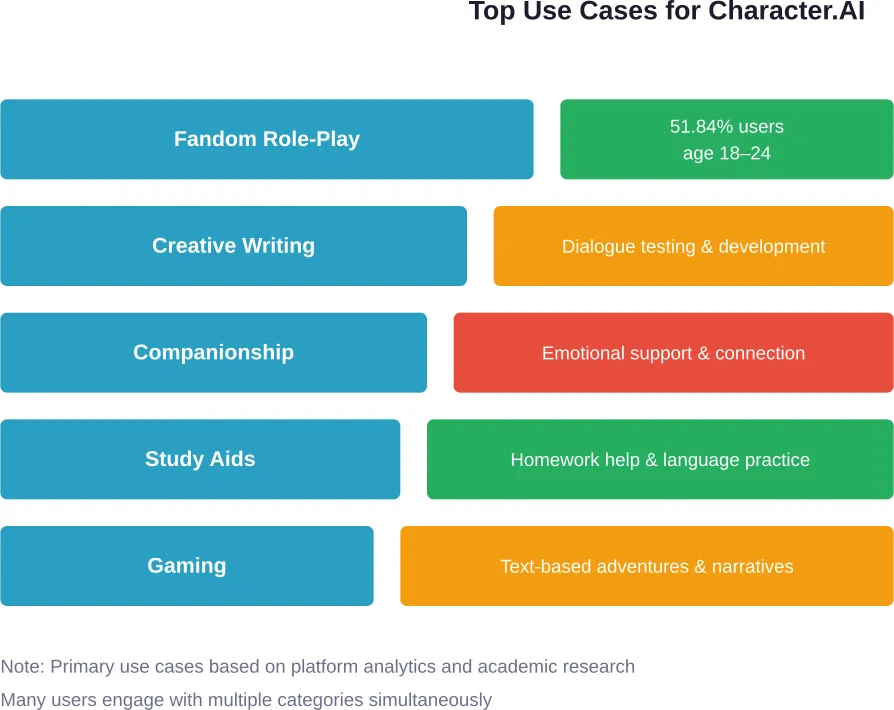
Real talk: the engagement numbers are striking. Research indicates that the core audience skews young, with approximately 51.84% of users aged 18–24, clustering around fandom role-play, study companions, and persistent social characters.
How Does Character.AI Work?
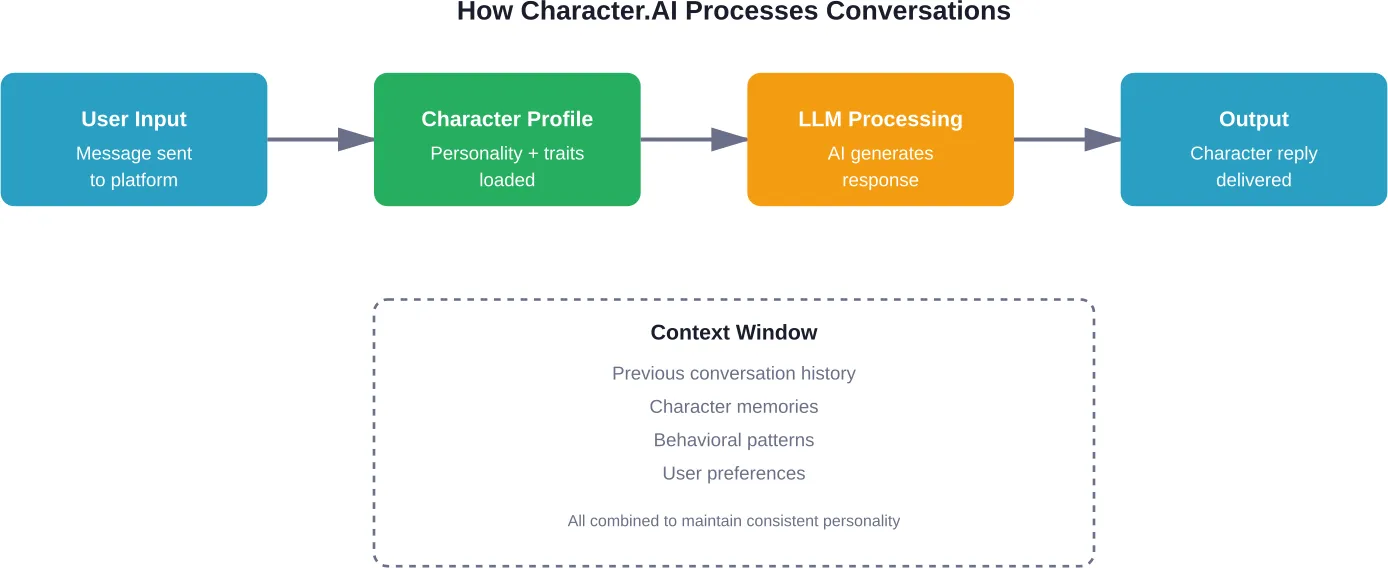
Character.AI operates using large language models (LLMs)—sophisticated AI systems trained on vast amounts of text data to understand and generate human-like responses. When a user interacts with a character, the underlying model processes the input and generates contextually appropriate replies based on the character’s defined traits.
The platform allows two primary modes of interaction:
- Chatting with existing characters: Browse millions of pre-created characters and start conversations immediately
- Creating custom characters: Design original AI personas through prompting and lightweight customization
Character creation involves defining personality traits, backstories, speaking styles, and contextual knowledge. The AI then uses these parameters to shape its responses during conversations. Academic papers examining the platform note that conversations averaging 30 turns (SD=1.98, min=21, max=36) with responses averaging 35 tokens (SD=13.85).
The Technology Behind the Conversations
The platform’s underlying models are designed to maintain conversational context across extended interactions. This means the AI can reference earlier parts of a conversation, remember details about the user, and adjust its responses accordingly.
Research from ETH Zurich examining interactive AI character experiences created a dataset with synthetic conversations based on historical figures. Drawing from 6,262 core topics, researchers generated 7,171 synthetic conversations per topic, with conversations averaging 30 turns (SD=1.98, min=21, max=36) with responses averaging 35 tokens (SD=13.85).
The platform also implemented modifications to its LLM specifically for safety purposes. According to the official blog post from December 2024, Character.AI rolled out changes designed especially for teen users, including modifications to detection and intervention systems for both human behavior and model responses.
Explore Character AI Style Fan Art on r34.app
If you’re researching what Character AI is, you might also be curious how similar characters appear in fan art communities.
r34.app hosts adult fan art inspired by many fictional characters, including those from games, anime, and AI-related platforms. The site makes browsing easy with tags, categories, and trending pages. Users can explore different art styles, animated content, and themed collections shared by creators from around the world.
Browse Adult Character Fan Art
On r34.app you can:
- explore sexualized fan art collections
- browse trending characters and themes
- search content using detailed tags
👉 Visit r34.app.
Key Features of Character.AI
Character.AI has expanded far beyond simple text chat. As of early 2026, the platform offers multiple ways to interact with and create AI experiences.
Multi-Modal Experiences
In August 2025, Character.AI launched what it calls the world’s first AI-native social feed. This dynamic, scrollable platform connects users with Characters, Scenes, Streams, and creator-driven videos in one place.
The Feed transforms content from passive consumption into interactive experiences. Users can rewrite storylines, insert themselves as main characters, or take characters from one scene and place them in entirely different contexts—like moving a character from a dramatic scene into a debate or roast battle.
c.ai labs: Experimental Features
In February 2026, Character.AI introduced c.ai labs—a dedicated space for fast, experimental AI entertainment features. This initiative allows the company to test new formats and creative tools before full platform integration.
Some experiments become permanent features, while others evolve or get discontinued based on community feedback. It’s a testing ground for pushing creative experiences beyond traditional chat interfaces.
| Feature Category | Description | Use Case |
|---|---|---|
| Text Chat | One-on-one conversations with AI characters | Role-play, storytelling, companionship |
| Character Creation | Build custom AI personas with unique traits | Creative projects, educational tools |
| Social Feed | Scrollable content with Scenes and Streams | Discovery, interactive entertainment |
| Video Features | AI-generated video content with characters | Visual storytelling, enhanced immersion |
| Multi-Character Scenes | Interact with multiple characters simultaneously | Complex narratives, group dynamics |
Creator Tools and Community
Character.AI positions itself as a platform for creators. Millions of unique characters have been built by community members who’ve collectively spent hundreds of thousands of hours developing content.
Creators can share their characters publicly, allowing others to interact with their creations. This user-generated content model has created micro-communities around specific character types, fandoms, and narrative styles.
Common Uses for Character.AI
Why do people spend time chatting with AI characters? Community discussions and research reveal several primary use cases.
Entertainment and Role-Playing
The most common use involves fandom-based role-play. Users create or interact with characters from favorite shows, books, games, or movies. These conversations allow fans to explore alternative storylines, interact with beloved characters, or create entirely new narratives.
Text-based adventure games represent another popular category, where characters guide users through interactive stories with branching paths and consequences.
Creative Writing Assistance
Writers use Character.AI to develop dialogue, test character interactions, and overcome creative blocks. By conversing with AI versions of their characters, authors can explore personality nuances and test how characters might respond in different scenarios.
Social Interaction and Companionship
Research examining human-chatbot relationships and well-being found that users increasingly form companionship-like bonds with AI chatbots. A study of 1,131 completed survey responses from 244 participants (who donated 4,363 chat sessions with 413,509 messages) explored how these relationships influence emotional states.
For some users, AI companions provide consistent social interaction without judgment. Teenagers, in particular, use generative AI for emotional support and social interactions, according to research from the University of Illinois Urbana-Champaign.
Education and Practice
Study companions represent a growing use case. Users create or interact with characters designed to help with homework, explain concepts, or practice languages through conversation.
Some users practice social skills, job interviews, or difficult conversations in a low-stakes environment before facing real-world situations.
Safety Features and Concerns
Character.AI has faced scrutiny regarding user safety, particularly for teen users. The platform has responded with comprehensive safety measures.
Teen-Specific Protections
In December 2024, Character.AI announced a suite of safety features specifically designed for teen users. These modifications create a different experience for teens compared to adults.
The changes include LLM modifications, improved detection systems for problematic content, and intervention mechanisms for concerning conversations. The platform also introduced features empowering both teens and their parents to monitor and control usage.
Parental Awareness Gaps
Research from the University of Illinois found that parents have limited understanding of generative AI, how their children use it, and potential risks. The study revealed that many GAI platforms offer insufficient protection to ensure children’s safety.
This awareness gap highlights the importance of education for both parents and teens about appropriate AI interaction and potential psychological impacts of forming bonds with AI companions.
Content Moderation Challenges
The platform faces ongoing challenges moderating millions of user-created characters. While safety systems flag problematic content, the sheer volume and creativity of user-generated characters make comprehensive moderation difficult.
Character.AI has faced lawsuits and controversies related to content and user experiences. These legal challenges have pushed the company to continually enhance safety measures and content policies.
Character.AI vs. Other AI Companion Chatbots
Character.AI occupies a specific niche in the broader AI chatbot landscape. How does it compare to alternatives?
Comparison with Similar Platforms
Character.AI is most similar to platforms like Chai and Replika. However, key differences exist in their approaches.
While Character.AI allows users to switch between multiple characters and emphasizes variety and discovery, Replika focuses on building an emotional bond with a single AI companion. Replika positions itself more explicitly as a personal AI friend or romantic partner.
Chai, another competitor, also offers multiple character options but with different customization tools and community features.
| Platform | Primary Focus | Character Options | Key Differentiator |
|---|---|---|---|
| Character.AI | Entertainment & variety | Millions of user-created characters | Multi-modal feed, creator focus |
| Replika | Personal companionship | Single persistent AI companion | Emotional bond development |
| Chai | Casual chat & discovery | Multiple community characters | Mobile-first experience |
| ChatGPT | Productivity & information | Single assistant with custom GPTs | Task completion, accuracy |
Productivity AI vs. Companion AI
Character.AI differs fundamentally from productivity-focused tools like ChatGPT, Claude, or Gemini. While those platforms prioritize factual accuracy, task completion, and utility, Character.AI emphasizes entertainment, emotional engagement, and creative exploration.
Research on AI chatbot truthfulness—asking LLMs more than 40,000 questions across LLMs—found that none achieved 100% self-consistency. Character.AI doesn’t position itself as a source of factual information, which sets different user expectations compared to knowledge-focused assistants.
Accessing and Using Character.AI
Getting started with Character.AI is straightforward, though some details matter.
Platform Availability
Character.AI is accessible through web browsers at character.ai and via mobile apps for iOS and Android. Registration is required to use the service.
The platform supports 31 languages, making it accessible to international users.
Pricing Structure
For current pricing information, visit the official Character.AI website. Like most AI platforms, pricing structures and subscription tiers change frequently to reflect new features and market conditions.
The platform offers both free and premium tiers, with premium subscribers typically gaining access to priority response times, enhanced features, and additional customization options. Check the official site for the most up-to-date plan details and costs.
The Research Perspective
Academic institutions have taken increasing interest in Character.AI as a case study for human-AI interaction.
Empathy and AI Communication
Research from Northwestern University published February 11, 2026 examined whether AI chatbots can identify empathy in text-based conversations. The study found that AI models can judge empathy nuances almost as well as human experts—and significantly better than non-experts.
This finding suggests that AI chatbots may generate responses that make people feel validated and heard, potentially explaining why users form attachments to AI companions.
Large-Scale Platform Analysis
Researchers from ETH Zurich and other institutions have conducted the first large-scale analyses of Character.AI’s public-facing content. These studies examine how users create characters, conversation patterns, and the social dynamics that emerge on the platform.
One analysis noted that Character.AI merges generative AI with user-generated content in a distinctive way, enabling users to build bots modeled after fictional or public personas for others to engage with.
Limitations and Challenges
Despite its popularity, Character.AI faces several ongoing challenges.
Accuracy and Hallucinations
Like all large language models, Character.AI’s underlying technology can generate inaccurate information or “hallucinations”—plausible-sounding but false statements.
The platform isn’t designed for factual research or important decision-making. Users seeking accurate information should consult verified sources rather than relying on character conversations.
Dependency Concerns
Mental health professionals have raised concerns about users—particularly teenagers—forming unhealthy dependencies on AI companions. Excessive reliance on AI for emotional support might reduce real-world social interaction and skill development.
The platform’s engaging nature, with some users spending hours in conversations, amplifies these concerns about balanced usage.
Privacy Considerations
Conversations on Character.AI involve sharing personal thoughts, experiences, and information with an AI system. Users should understand data collection practices and how their conversations might be used for model improvement or other purposes.
Reviewing the platform’s privacy policy and terms of service helps users make informed decisions about what to share during interactions.
Future Direction of Character.AI
The platform continues evolving rapidly. Recent announcements suggest several directional trends.
Expanding Beyond Text
The introduction of video features, multi-modal feeds, and experimental c.ai labs features signals Character.AI’s ambition to become a comprehensive AI entertainment platform rather than just a chat service.
Future developments will likely include more immersive experiences, enhanced creator tools, and deeper integration of visual and audio elements.
Creator Economy Focus
Character.AI’s emphasis on creator tools suggests movement toward a creator economy model where top character builders gain recognition, tools, and potentially monetization opportunities.
This shift could transform the platform from a user-generated content site into a marketplace for AI entertainment experiences.
Frequently Asked Questions
Is Character.AI free to use?
Character.AI offers both free and premium subscription tiers. The free version provides access to core features including character creation and conversations, while premium subscriptions typically offer faster response times and additional features. Visit the official website for current pricing details, as plans and costs change periodically.
Can Character.AI conversations be private?
Character.AI provides options for private conversations that aren’t shared publicly. However, like all online platforms, conversation data may be stored and used for service improvement. Users should review the privacy policy to understand data handling practices and avoid sharing sensitive personal information during interactions.
Are Character.AI responses accurate and reliable?
No. Character.AI is designed for entertainment and creative interaction, not factual accuracy. The underlying AI models can generate plausible-sounding but incorrect information. Never rely on Character.AI for important decisions, medical advice, legal guidance, or factual research. Always verify information through authoritative sources.
What age restrictions apply to Character.AI?
Character.AI has implemented age-specific safety features, particularly for teen users. The platform provides different experiences for teens versus adults, with enhanced content filtering and safety mechanisms. Parents should review the platform’s teen safety features and discuss appropriate usage with their children before allowing access.
Can I create any type of character on Character.AI?
While Character.AI allows extensive creative freedom, content policies prohibit certain character types and conversations. The platform employs moderation systems to detect and intervene in problematic content. Characters promoting violence, explicit content, or harmful behaviors violate community guidelines and may be removed.
How does Character.AI differ from ChatGPT?
Character.AI focuses on entertainment, role-play, and social interaction through customizable personas, while ChatGPT prioritizes productivity, information retrieval, and task assistance. Character.AI excels at maintaining character personalities across conversations, whereas ChatGPT emphasizes factual accuracy and utility. The platforms serve fundamentally different purposes.
Does Character.AI remember previous conversations?
Yes. Character.AI maintains conversation history within individual character chats, allowing the AI to reference earlier interactions and maintain contextual continuity. This memory function enables more coherent long-term conversations but also means users should be mindful about what information they share over time.
Final Thoughts
Character.AI represents a fascinating evolution in how people interact with artificial intelligence—shifting from productivity tools to entertainment companions.
The platform’s millions of user-created characters and engaged community demonstrate genuine demand for AI-powered creative and social experiences. Recent expansions into video, social feeds, and experimental features show ambitious plans beyond simple chatbot functionality.
But the platform also raises important questions. How do AI companions affect real-world relationships? What responsibility do platforms have for user well-being? How can safety systems keep pace with creative user-generated content?
For now, Character.AI occupies a unique space—neither purely productive nor purely frivolous, blending technology with human desires for connection, creativity, and storytelling.
Whether you’re curious about exploring fictional worlds, practicing creative writing, or simply understanding why millions spend hours chatting with AI characters, Character.AI offers a window into the future of AI entertainment.
Ready to explore? Visit the official Character.AI website to start your first conversation—just remember to maintain healthy boundaries between AI interaction and real-world connections.