Quick Summary: AI hentai art generation uses text-to-image models like Stable Diffusion to create anime-style NSFW artwork from written prompts. Modern generators leverage generative adversarial networks (GANs) and diffusion models to transform descriptions into detailed images without requiring artistic skills. Most platforms offer both free and premium tiers with varying resolution limits and content filters.
AI-generated hentai has transformed from a niche experiment into a mainstream creative outlet. The technology powering these generators—primarily Generative Adversarial Networks and diffusion models—has evolved dramatically since the early implementations documented in academic research from 2016.
What once required extensive artistic training now takes minutes with the right tools and prompts. But here’s the thing: not all generators produce equal results, and understanding the underlying mechanics makes a substantial difference in output quality.
Understanding the Technology Behind AI Hentai Generation
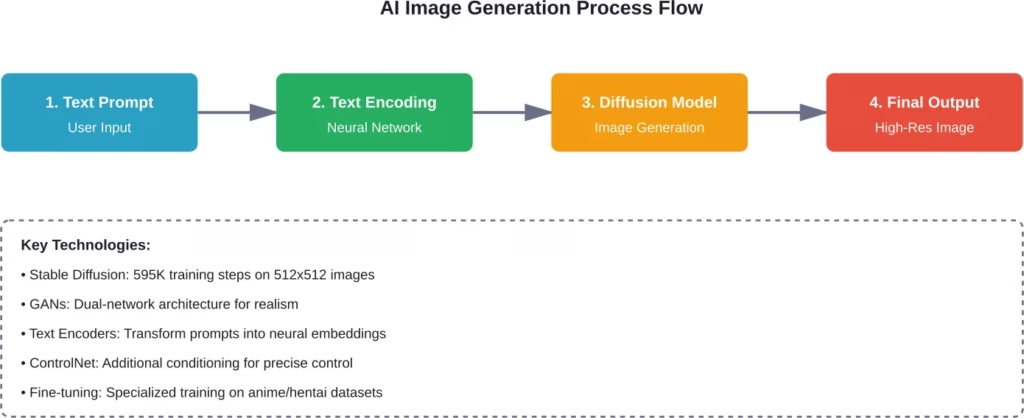
Text-to-image synthesis relies on deep learning models trained on millions of image-caption pairs. According to research published on arXiv, Generative Adversarial Networks create realistic images by pitting two neural networks against each other: a generator that creates images and a discriminator that evaluates their authenticity.
Modern hentai generators typically use Stable Diffusion models—latent diffusion models that work in a compressed representation space. Stable Diffusion v1.5, for instance, was fine-tuned for 595K steps on 512×512 images from the LAION-Aesthetics V2 dataset, as documented by Hugging Face.
The process works like this: text prompts get encoded into embeddings, the diffusion model gradually denoises random pixels into coherent images, and specialized fine-tuning guides the output toward anime aesthetics and NSFW content.
Explore Hentai Content Across Tags and Sources

Instead of acting like a single gallery, R34.app works more like a hub. It connects multiple sources and gives users one place to search, filter, and browse content by tag. The layout is centered on quick discovery through keywords, categories, and animated sections.
Want a More Centralized Browsing Tool?
R34.app can help with:
- searching across fandom tags and categories
- unrestricted access to visual NSFW content
- switching between linked source sites more easily
👉 Visit R34.app to explore its tag-based browsing system
Step-by-Step Guide to Creating AI Hentai Art
Step 1: Choose a Generator Platform
The generator landscape has expanded significantly in 2026. Platforms vary in model quality, content policies, and customization options.
Community discussions highlight several standout options. BasedLabs offers a limited free tier with a daily credit system; resolution and volume are restricted unless upgraded to a premium subscription. OurDream.ai specializes in richly detailed renderings with advanced style controls.
For those prioritizing ease of use, YumeAI provides streamlined interfaces that don’t require technical knowledge. The platform handles all parameter tuning automatically while still allowing manual adjustments for advanced users.
Step 2: Create an Account and Configure Settings
Most generators require account creation to prevent abuse and track usage limits. The setup process typically involves:
- Email verification and age confirmation (18+ requirements)
- Selecting content filter preferences
- Choosing default image dimensions and output format
- Setting privacy controls for generated content
Privacy matters here. Check whether the platform stores prompts, shares data with third parties, or uses generated images for model training. Reputable platforms explicitly state their data handling policies.
Step 3: Master Prompt Engineering
Prompt quality directly determines output quality. Effective prompts balance specificity with creative latitude.
Strong prompts include: character descriptions (hair color, body type, expression), scene context (setting, lighting, perspective), style modifiers (anime studio references, artist styles), and technical parameters (resolution, aspect ratio).
Here’s what works: “anime girl, long silver hair, red eyes, sitting on bed, soft lighting, detailed shading, high quality, 4k” versus what doesn’t: “sexy girl.”
Negative prompts—terms that tell the model what to avoid—are equally crucial. Common negative prompts include: “blurry, low quality, distorted anatomy, watermark, text.”
| Prompt Element | Purpose | Example |
|---|---|---|
| Subject Description | Defines main character | “anime girl, blue hair, green eyes” |
| Scene Context | Sets environment | “bedroom interior, soft moonlight” |
| Style Modifiers | Controls art style | “Studio Ghibli style, watercolor” |
| Quality Boosters | Improves technical output | “high detail, 4k, masterpiece” |
| Negative Prompts | Excludes unwanted elements | “blurry, distorted, low quality” |
Step 4: Adjust Advanced Parameters
Beyond prompts, technical parameters fine-tune generation behavior.
CFG Scale (Classifier-Free Guidance) controls prompt adherence. Lower values (3-7) allow creative interpretation; higher values (10-15) stick rigidly to prompts. For hentai generation, 8-12 typically produces the best balance.
Steps determine generation quality versus speed. More steps (50-100) yield refined details but take longer. Diminishing returns typically occur after 30-40 steps for most models.
Sampling methods affect image characteristics. DPM++ 2M Karras and Euler a are community favorites for anime content, producing cleaner lines and better color saturation than older samplers.
Step 5: Generate and Iterate
First attempts rarely produce perfect results. The workflow involves generating multiple variations, identifying strong candidates, and refining prompts based on what works.
Batch generation speeds this process. Generate 4-8 images simultaneously with slight prompt variations to explore the possibility space.
When results meet expectations, upscaling tools enhance resolution. Many generators include built-in upscalers; external tools like Real-ESRGAN can push images to 2048×2048 or higher without quality loss.
Legal and Ethical Considerations
The U.S. Copyright Office released comprehensive guidance on AI-generated content in January 2025. According to their Part 2 Report, AI outputs generally lack sufficient human authorship for copyright protection unless substantial creative human input directs the generation process.
This creates complex questions around ownership. Users don’t automatically own generated images, but neither do most platforms—the legal status remains ambiguous.
Content policies vary dramatically. Some generators prohibit specific character types, copyrighted character likenesses, or extreme content categories. Violating terms of service can result in account termination.
For those concerned about ethical implications, consider that training datasets often include copyrighted artwork scraped without artist consent. This remains a contentious issue within creative communities.
Comparing Top Generators for 2026
Platform capabilities have diverged considerably. Some prioritize raw generation power; others emphasize interactive experiences.
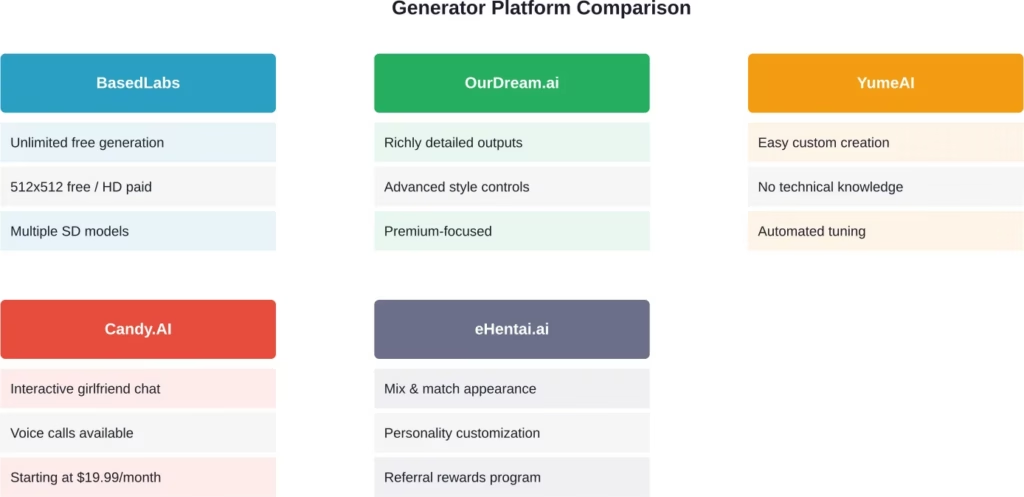
Candy.AI takes a different approach entirely, combining generation with conversational AI. Users design characters, then chat and generate contextual images. According to Candy.AI platform documentation, membership starts at $13.99 monthly (specifically the 1-month tier at this price point), with lust level controls and voice call features for premium subscribers.
eHentai.ai emphasizes character persistence. Create a character once, then generate unlimited content featuring that specific design.
Hardware Requirements and Performance
Running generators locally versus using cloud platforms presents trade-offs.
Cloud platforms handle all computation server-side. Users need only a browser and internet connection. This accessibility comes at the cost of privacy and ongoing subscription fees.
Local deployment requires substantial hardware. According to Hugging Face documentation, fine-tuning Stable Diffusion models with gradient checkpointing and mixed precision requires minimum 24GB GPU memory. Generation itself runs on less—8GB VRAM handles most workflows adequately.
For those building custom solutions, PyTorch provides the foundation most generators run on. The framework’s neural style transfer capabilities and model export features enable both inference and training workflows.
Troubleshooting Common Issues
Generation doesn’t always go smoothly. Certain problems recur frequently.
Distorted anatomy typically signals insufficient training data or conflicting prompt elements. Solutions include: adding “anatomically correct” to prompts, using negative prompts like “extra limbs, distorted,” and lowering CFG scale to reduce overfitting.
Blurry outputs often result from too few steps or poor sampling methods. Increase step count to 40-50 and switch to DPM++ or Euler samplers.
Content filters blocking legitimate prompts frustrate many users. Some platforms implement overzealous filtering that catches non-explicit terms. Rewording prompts with synonyms or more clinical language often bypasses false positives.
Frequently Asked Questions
Can AI hentai generators create images of real people?
Most reputable platforms explicitly prohibit generating images of real individuals without consent. The U.S. Copyright Office’s 2024 report recommends federal legislation around digital replicas to address this concern. Attempting to generate recognizable likenesses violates terms of service on major platforms and raises serious ethical and legal issues.
Do I need artistic skills to use AI hentai generators?
No artistic ability is required. These tools democratize creation by handling all technical rendering. However, understanding composition, lighting, and anatomy helps craft better prompts that yield higher-quality results. The learning curve focuses on prompt engineering rather than drawing skills.
Are AI-generated hentai images copyrightable?
According to the U.S. Copyright Office’s January 2025 guidance, AI outputs generally lack sufficient human authorship for copyright protection. Images generated with minimal human direction fall outside copyright. However, works involving substantial creative human input—extensive prompt engineering, manual editing, curated selection—may qualify for limited protection of the human-contributed elements.
How long does generating a single image take?
Generation speed varies by platform and parameters. Cloud-based generators typically produce images in 10-30 seconds for standard settings. Increasing steps to 50+ or requesting higher resolutions extends wait times to 1-2 minutes. Local generation on consumer GPUs ranges from 5 seconds to several minutes depending on hardware capabilities.
Can I sell AI-generated hentai art commercially?
Platform terms of service dictate commercial use rights. Some generators grant commercial licenses to paid subscribers while prohibiting commercial use on free tiers. Additionally, copyright ambiguity means enforcement risks exist. Check specific platform policies before monetizing generated content, and consider consulting legal counsel for commercial ventures.
What’s the difference between GAN and diffusion models for hentai generation?
GANs use dual-network competition—a generator creates images while a discriminator evaluates authenticity. Diffusion models like Stable Diffusion gradually denoise random pixels into coherent images. In practice, diffusion models currently dominate hentai generation due to superior quality, better prompt following, and more stable training. Most 2026 platforms use diffusion architectures exclusively.
Conclusion
AI hentai generation has matured into an accessible creative medium powered by sophisticated neural networks. The process—selecting platforms, crafting prompts, adjusting parameters, and iterating—remains straightforward enough for beginners while offering depth for advanced users.
Technical foundations like Stable Diffusion and GANs continue evolving. Models trained on hundreds of thousands of steps produce increasingly realistic outputs that respond predictably to natural language descriptions.
Legal frameworks lag behind technological capability. Copyright status remains uncertain, and ethical considerations around training data and content policies demand ongoing attention.
For those ready to start creating, choose a platform aligned with specific needs—whether unlimited free generation, advanced controls, or interactive experiences. Experiment with prompts, study what works, and refine the approach iteratively. The barrier to entry has never been lower.