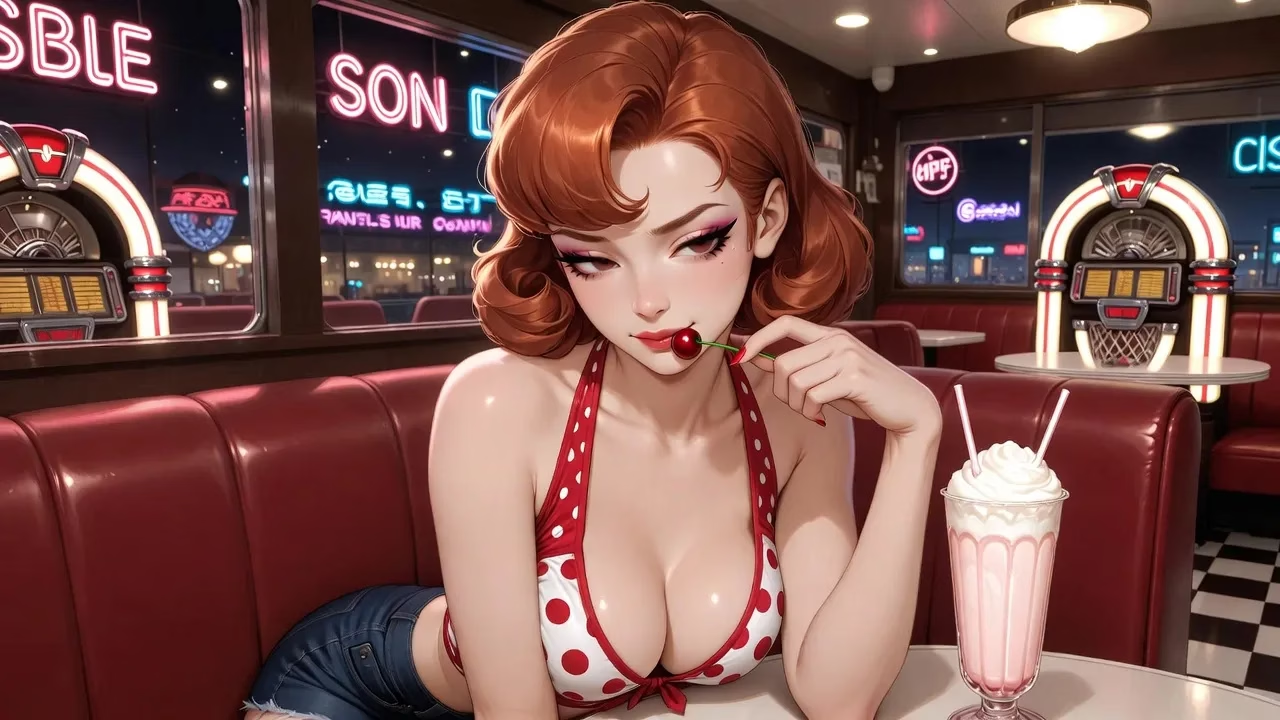
Quick Summary: Creating hentai with AI involves using specialized generative models and platforms designed for anime-style NSFW content. The most common approaches include using dedicated AI hentai generators like BetterWaifu or eHentai.ai for beginners, or training custom Stable Diffusion models with anime datasets for advanced users. Most platforms offer text-to-image generation where users input prompts describing characters, poses, and settings, with the AI rendering the artwork in seconds.
The intersection of anime art and generative AI has created entirely new possibilities for creating custom hentai content. What once required professional illustration skills now takes seconds with the right AI tools.
This isn’t just theoretical. According to competitor analysis, millions of custom NSFW images were generated in 2025 alone, representing a significant portion of the broader adult entertainment industry. The technology has matured rapidly, with models now understanding complex prompts and rendering detailed characters with consistent features.
But here’s the thing: not all approaches work equally well. Some platforms deliver better anatomy, while others excel at specific art styles. Understanding which method fits specific needs makes the difference between frustrating results and genuinely impressive artwork.
Understanding AI Hentai Generation Technology
The core technology powering AI hentai creation builds on diffusion models, the same architecture behind mainstream image generators. These models learn from massive datasets of existing artwork, understanding how visual elements combine to create coherent images.
Stable Diffusion represents the foundation for most custom anime content generation. According to Hugging Face documentation, Stable Diffusion v1.5 is a latent diffusion model initialized from Stable Diffusion v1-4 and finetuned for 595K steps on 512×512 images from the LAION-Aesthetics V2 dataset. This extensive training enables the model to understand artistic composition, character design, and stylistic elements.
The process works through iterative denoising. Starting with random noise, the model gradually refines the image based on text prompts, using cross-attention mechanisms to align visual features with prompt semantics. Many implementations incorporate classifier-free guidance, which blends conditional and unconditional outputs to strengthen prompt adherence.
For anime-specific content, specialized models get fine-tuned on curated datasets of anime and manga artwork. This additional training helps the AI understand distinctive anime characteristics like exaggerated proportions, specific line work styles, and character archetypes common in the medium.
Explore Hentai Content Faster With R34.app

R34.app is designed for people who prefer browsing by tag instead of searching site by site. It organizes images, GIFs, and videos around fandom categories, making it easier to explore related content through featured tags and post sections.
Want a Faster Tag-Based Browser?
R34.app can help with:
- unrestricted access to visual NSFW content
- browsing popular and animated posts
- switching between linked source websites more easily
👉 Visit R34.app to explore its tag-based browsing system
Method 1: Using Dedicated AI Hentai Generators
The fastest path to creating AI hentai involves using platforms purpose-built for this content. These generators handle the technical complexity behind user-friendly interfaces.
Top Platforms for Beginners
BetterWaifu markets itself as the most accurate hentai and anime generator available. The platform emphasizes prompt understanding, claiming it grasps exactly what users want. BetterWaifu claims over 1 million images are created daily on the platform, indicating substantial user adoption.
The generator supports thousands of different characters across hundreds of styles. Users describe desired characters through text prompts, and the system renders corresponding artwork. The platform requires no technical knowledge and provides an aesthetically pleasing interface accessible to newcomers.
eHentai.ai offers a structured approach through a step-by-step character creation process. Users create an account, then mix and match appearance attributes before selecting personality traits. This guided workflow helps those unfamiliar with prompt engineering still achieve desired results.
According to competitor data from Chicago Reader, one platform’s monthly membership can cost around $19.99, though specific current pricing should be verified on official sites as rates change.
How to Use Generator Platforms Effectively
Creating quality output requires understanding how to structure prompts. Most platforms interpret prompts as collections of descriptive tags rather than natural sentences.
Start with character basics: body type, hair color and style, eye color, and distinctive features. Then add clothing descriptions, poses, and environmental context. Finally, specify the art style if desired.
Here’s what a structured prompt looks like:
- Character attributes: tall, athletic build, long purple hair, green eyes, cat ears
- Clothing: school uniform, short skirt, thigh-high stockings
- Pose and setting: sitting on desk, classroom, window lighting
- Style: anime style, detailed shading, soft colors
Many platforms include lust level or intensity controls that adjust content explicitness. These typically range from suggestive to fully explicit, allowing control over final output appropriateness.
Method 2: Stable Diffusion for Custom Hentai Creation
For those seeking greater control and customization, running Stable Diffusion locally or through cloud platforms offers significantly more flexibility than web generators.
Setting Up Stable Diffusion
Stable Diffusion can run on consumer hardware with adequate GPU memory. According to BentoML documentation, the 4B variant can run on consumer GPUs with approximately 13GB VRAM, making it accessible for many gaming PCs.
The setup process involves installing the Diffusers library from Hugging Face, downloading a base model, then loading anime-specific checkpoints. Hugging Face documentation shows the basic implementation:
from diffusers import StableDiffusionPipeline
model_id = “runwayml/stable-diffusion-v1-5”
pipeline = StableDiffusionPipeline.from_pretrained(model_id)
pipeline.save_pretrained(“local-model-directory”)
After loading the base model, swapping in anime-focused checkpoints transforms output from photorealistic to anime-styled. Community-trained models specifically for anime content circulate through model-sharing platforms.
Choosing the Right Anime Model
Different Stable Diffusion derivatives excel at different anime substyles. Some prioritize clean linework similar to professional manga, while others emphasize painterly qualities resembling digital illustrations.
The model selection depends on desired aesthetic outcomes. Testing multiple models with identical prompts reveals which architecture best matches artistic vision for specific projects.
Specialized models for anime content are trained on curated anime datasets to achieve realistic anime aesthetics rather than relying on general-purpose checkpoints. The training data fundamentally shapes what stylistic qualities the model can reproduce.
Advanced Prompting Techniques
Stable Diffusion offers more sophisticated prompt controls than simplified web generators. Weighted prompts allow emphasizing certain elements over others by adding numerical weights.
Negative prompts prove equally important, specifying what to avoid in generated images. Common negative prompts for anime content include elements like photorealistic textures, wrong anatomy ratios, or Western cartoon styles.
The combination of positive prompts, negative prompts, and guidance scale settings provides granular control over generation outcomes. Higher guidance scales force stronger adherence to prompts but may reduce creative variation.
Method 3: Training Custom Models
The most advanced approach involves training custom models on specific character datasets or artistic styles.
When Custom Training Makes Sense
Custom training becomes worthwhile when consistently generating specific characters or maintaining highly consistent art styles across many images. Pre-trained models struggle with character consistency across multiple generations, often producing variations rather than identical characters.
For creators building ongoing series or developing specific character portfolios, the initial investment in custom training pays dividends through improved consistency.
The Training Process Overview
According to Hugging Face training documentation, the process involves collecting a curated dataset of reference images, preparing them with appropriate tags, then running fine-tuning on a base model.
Dataset quality matters more than quantity. Twenty high-quality, properly-tagged images of a specific character often produce better results than a hundred inconsistent examples.
Training typically employs techniques like DreamBooth or LoRA (Low-Rank Adaptation) which efficiently adapt models to new concepts without full retraining. These methods require less computational resources while achieving targeted improvements.
The actual training process can take several hours on consumer GPUs, depending on dataset size and desired refinement level. Cloud GPU services provide alternatives for those without local hardware.
Ethical and Legal Considerations
Creating AI-generated adult content exists within complex ethical and legal frameworks that vary significantly by jurisdiction.
Legal Status Across Jurisdictions
According to recent legislative developments, governments increasingly address AI-generated content through new regulations. South Carolina Bill 28 (2025-2026) addresses AI child abuse and was signed by the Governor on May 22, 2025, while the Take It Down Act passed in April 2025 establishes penalties for nonconsensual intimate imagery distribution.
Florida Senate Bill 1344 from 2026 introduces regulations around companion AI chatbots, requiring operators to implement user account systems and display notifications during interactions. The bill mandates pop-up notifications at least every 60 minutes during user interactions.
These legislative developments reflect growing government attention to AI-generated content regulation. Content creators must stay informed about applicable laws in their jurisdictions.
Misinformation and Deepfake Concerns
Research from arXiv highlights broader concerns about generative AI misuse. Studies on fake news generation and deepfake videos demonstrate how the same technologies enabling creative expression can facilitate harmful applications.
According to a 2023 Gartner survey referenced in research on AI-generated video platforms, half of respondents wanted to limit social media use due to misinformation, toxic environments, and bot activity. AI-generated content contributes to these concerns when used deceptively.
Responsible use requires clearly distinguishing AI-generated content from human-created work and never misrepresenting synthetic images as photographs of real people.
Privacy and Data Security
When using cloud-based generators, understanding data handling practices becomes critical. Uploaded images and generated content may be stored, analyzed, or potentially accessed by platform operators.
Reading platform privacy policies before use reveals what happens to generated content. Some platforms retain rights to user-generated imagery, while others maintain stricter privacy protections.
For maximum privacy, locally-run Stable Diffusion installations keep all generation processes on personal hardware, eliminating concerns about cloud storage or data transmission.
| Consideration | Web Generators | Local Stable Diffusion |
|---|---|---|
| Privacy | Content uploaded to servers | All processing stays local |
| Cost | Monthly subscriptions | Free after initial setup |
| Customization | Limited to platform features | Full control over models and settings |
| Ease of Use | Beginner-friendly interfaces | Requires technical knowledge |
| Hardware Requirements | None (cloud-based) | GPU with 8-13GB+ VRAM recommended |
| Generation Speed | Dependent on server load | Dependent on local GPU power |
Comparing Image Quality Across Methods
Output quality varies significantly between different generation approaches.
Dedicated web generators often excel at user-friendly experiences but may produce somewhat homogeneous results due to standardized underlying models. The platforms prioritize consistency and ease over bleeding-edge quality.
Stable Diffusion with custom anime models generally produces higher-quality results for experienced users who invest time learning effective prompting. The additional control over sampling methods, CFG scales, and seed values enables fine-tuning outputs.
Custom-trained models deliver the best results for specific use cases but require significant upfront investment. Character consistency and style coherence dramatically improve compared to generic models.
According to BentoML documentation, the 4B variant of modern models can achieve sub-second inference times with end-to-end latency as low as sub-second. This enables rapid iteration and experimentation during the creative process.
Common Challenges and Solutions
Anatomy and Proportion Issues
AI models frequently struggle with anatomical accuracy, particularly with hands, complex poses, and unusual angles. These challenges stem from underrepresentation of difficult poses in training datasets.
Solutions include using negative prompts specifically targeting common errors, adjusting sampling steps for more refined outputs, or employing inpainting techniques to manually correct problematic regions after initial generation.
Style Consistency Problems
Maintaining consistent art style across multiple generations presents another common challenge. Models may drift between different anime substyles or introduce unwanted variations.
Fixing seed values helps maintain consistency when generating variations of similar content. The seed determines the initial noise pattern, so identical seeds with similar prompts produce related outputs.
Prompt Interpretation Failures
Sometimes models simply misinterpret prompts, producing unexpected results. This often happens with complex multi-character scenes or abstract concepts.
Breaking complex prompts into simpler components helps. Generate individual elements separately, then combine through image editing or use multi-stage generation workflows where initial outputs inform subsequent prompts.
Advanced Features and Workflows
Image-to-Image Generation
Beyond text-to-image generation, image-to-image workflows enable using existing artwork as templates. This approach maintains composition while altering style, characters, or details.
According to OpenAI API documentation, the Edits endpoint allows modifying existing images using masks where users can specify which regions should change. The mask indicates areas for AI modification while preserving other sections.
This technique proves valuable for iterative refinement or adapting existing compositions to new characters or scenarios.
Video Generation Capabilities
Emerging capabilities extend beyond static images into video generation. Competitor analysis indicates some platforms offer video generation capabilities, though current implementations produce short clips of several seconds rather than full animations.
Research on AI-generated video platforms like Sora highlights ongoing ethical discussions around authenticity, ownership, and governance for synthetic video content. These conversations will likely shape how adult video generation develops.
Interactive Character Creation
Some platforms integrate character generation with conversational AI, creating interactive experiences beyond static imagery. These systems combine image generation with chatbot functionality.
One competitor review reported that voice calls during custom scenes with responsive dialogue synchronized to visuals create more immersive experiences. Generated scenes can include voice-guided interactions that adapt to conversation flow.
Frequently Asked Questions
Is creating AI hentai legal?
Legal status depends on jurisdiction and specific content. Generally, AI-generated fictional adult content depicting adults remains legal in most jurisdictions. However, content depicting minors, even if entirely fictional and AI-generated, is illegal in many countries including the United States. Recent legislation like South Carolina’s Bill 28 specifically targets AI child abuse imagery. Content creators must ensure compliance with local laws and avoid generating any content depicting underage characters. Additionally, nonconsensual deepfakes face increasing legal penalties under laws like the Take It Down Act passed in 2025.
What’s the best free AI hentai generator?
Free options exist but typically impose limitations. Platforms like BetterWaifu offer free tiers with restricted generation counts or reduced resolution. For unrestricted free use, locally-run Stable Diffusion provides the best option after initial setup. This requires downloading open-source software and models but eliminates ongoing costs. The trade-off involves technical complexity and hardware requirements versus the simplicity of web-based free tiers.
Can AI generate consistent characters across multiple images?
Achieving character consistency challenges generic models but becomes manageable with proper techniques. Using identical seeds with similar prompts helps maintain consistency. More reliably, custom-trained models using DreamBooth or LoRA specifically learn individual characters, enabling consistent reproduction across generations. Web generators typically struggle with this unless they offer specific character-locking features. The most consistent results come from dedicated character training rather than prompt engineering alone.
How long does generating AI hentai take?
Generation speed varies by method and hardware. Web generators typically produce images in 5-15 seconds, though server load can increase wait times. Local Stable Diffusion generation depends on GPU power, ranging from under 10 seconds on high-end cards to over a minute on modest hardware. According to BentoML documentation, the 4B variant of modern models can achieve sub-second inference times with end-to-end latency as low as sub-second. Video generation takes significantly longer, often several minutes for short clips.
Do I need coding knowledge to create AI hentai?
Web-based generators require zero coding knowledge and provide entirely graphical interfaces. Platforms like eHentai.ai and BetterWaifu emphasize accessibility for non-technical creators. Running local Stable Diffusion requires minimal coding—typically just copying provided code snippets for model loading. Advanced customization like training models involves more technical depth but abundant tutorials simplify the process. The barrier to entry has dropped dramatically, making creation accessible regardless of programming background.
Can I sell AI-generated hentai?
Commercial use depends on platform terms of service and applicable laws. Some generators explicitly prohibit commercial use of free-tier outputs while allowing it for paid subscriptions. Stable Diffusion models often permit commercial use under their licenses, though specific checkpoint licenses vary. Beyond licensing, consider intellectual property concerns if generating content resembling existing copyrighted characters. Original character designs face fewer restrictions. Always review specific platform terms and relevant laws before attempting commercial distribution.
What hardware do I need for local generation?
Minimum requirements include a GPU with at least 8GB VRAM, though 12-16GB enables better performance and higher resolutions. According to BentoML documentation, the 4B variant can run on consumer GPUs with approximately 13GB VRAM. NVIDIA cards generally offer better software support than AMD alternatives. CPU-only generation remains possible but proves impractically slow. For those without adequate hardware, cloud GPU services provide pay-per-use alternatives to local processing.
Conclusion
Creating hentai with AI has become remarkably accessible through multiple approaches suited to different skill levels and requirements.
Beginners benefit most from dedicated web generators offering user-friendly interfaces and immediate results without technical complexity. These platforms trade customization depth for convenience.
Intermediate creators seeking greater control should explore Stable Diffusion with anime-specific models. This approach requires modest technical investment but unlocks significantly more creative flexibility and eliminates ongoing subscription costs.
Advanced users pursuing character consistency or unique styles will find custom model training worth the additional complexity. The results justify the effort when building character portfolios or maintaining distinctive artistic visions.
Regardless of chosen method, responsible creation requires awareness of legal frameworks, ethical considerations, and privacy implications. Recent legislative developments demonstrate growing government attention to AI-generated content, making ongoing awareness of applicable regulations essential.
The technology continues evolving rapidly. What required professional illustration skills just years ago now takes seconds with properly configured AI systems. As models improve and new capabilities emerge, the possibilities expand while the technical barriers continue dropping.
Start with simple web generators to understand basic concepts, then progress to more advanced techniques as skills develop. The learning curve rewards investment with unprecedented creative control over custom anime content generation.