
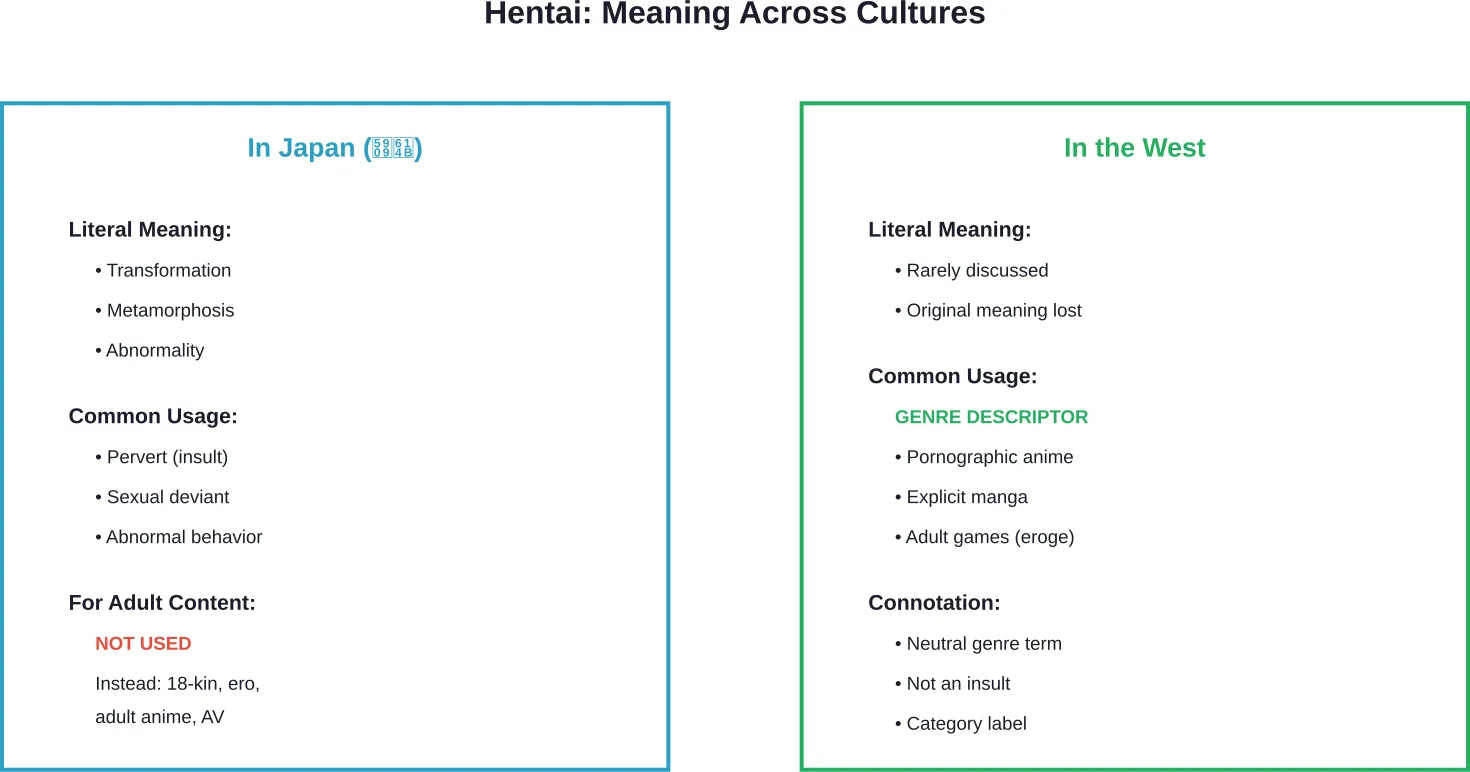
Quick Summary: The Japanese word ‘hentai’ (変態) literally means ‘transformation,’ ‘metamorphosis,’ or ‘abnormality’ and in Japan refers to perverted or abnormal sexual behavior. However, in Western contexts, ‘hentai’ has evolved to specifically describe Japanese animated and illustrated pornography featuring explicit sexual content. This linguistic shift demonstrates how Japanese terms can acquire entirely different meanings when adopted by international audiences.
Walk into any conversation about Japanese media in the West, and chances are someone will mention hentai when talking about adult animation. But here’s the thing — use that same word in Tokyo, and you’ll get some awkward looks.
The term ‘hentai’ represents one of the most fascinating linguistic transformations in modern pop culture. What started as a clinical Japanese term for abnormal behavior has become an entire genre classification in Western media circles. Understanding this evolution reveals much about cultural exchange, language adaptation, and how context shapes meaning.
So what does hentai actually mean in Japanese, and how did it end up describing something completely different outside Japan?
The Literal Japanese Meaning of Hentai
In Japanese, ‘hentai’ (変態) is written with two kanji characters. According to Nihongo Master, the first character 変 (hen) means ‘change,’ ‘strange,’ or ‘unusual,’ while the second character 態 (tai) means ‘condition,’ ‘appearance,’ or ‘attitude.’
When combined, these characters create a word that literally translates to ‘transformation’ or ‘metamorphosis.’ But that’s just the surface definition.
In everyday Japanese usage, hentai carries a distinctly negative connotation. It’s commonly used to describe someone or something as perverted, abnormal, or sexually deviant. Call someone a hentai in Japan, and it’s an insult — plain and simple.
The term isn’t playful or casual. It’s the kind of word parents might use to warn their children about suspicious strangers, or that news reports might employ when discussing criminal sexual behavior.
How Japanese Speakers Actually Use the Word
Real talk: Japanese people rarely use ‘hentai’ in casual conversation unless they’re making a serious accusation. The word carries weight.
When describing someone with abnormal sexual tendencies, Japanese speakers might say ‘ano hito wa hentai da’ (あの人は変態だ), meaning ‘that person is a pervert.’ The context is almost always derogatory.
Here’s what makes this interesting — the Japanese don’t use ‘hentai’ to refer to pornographic anime or manga at all. That’s a Western invention.
What the West Calls Hentai vs. What Japan Calls It
This is where the linguistic divergence becomes crystal clear. In Western countries, hentai specifically refers to Japanese pornographic anime and manga. According to Dictionary.com, it describes ‘a subgenre of Japanese manga, anime, computer games, etc., characterized by explicit sexual themes and imagery.’
But ask a Japanese person about hentai anime, and they’ll likely be confused by the terminology.
In Japan, the preferred terms for explicit animated or illustrated content are:
- 18-kin (18禁) — literally ’18-prohibited,’ referring to adult-only content
- Adult anime (アダルトアニメ) — straightforward descriptor for pornographic animation
- AV (エーブイ) — short for ‘adult video’
- Ero manga (エロ漫画) — erotic manga, from ‘erotic’
- Seijin manga (成人漫画) — adult manga
The term ‘ero’ (エロ), derived from the English word ‘erotic,’ is far more common in Japanese conversations about sexual content than ‘hentai’ ever is.
Etymology and Historical Development of the Term
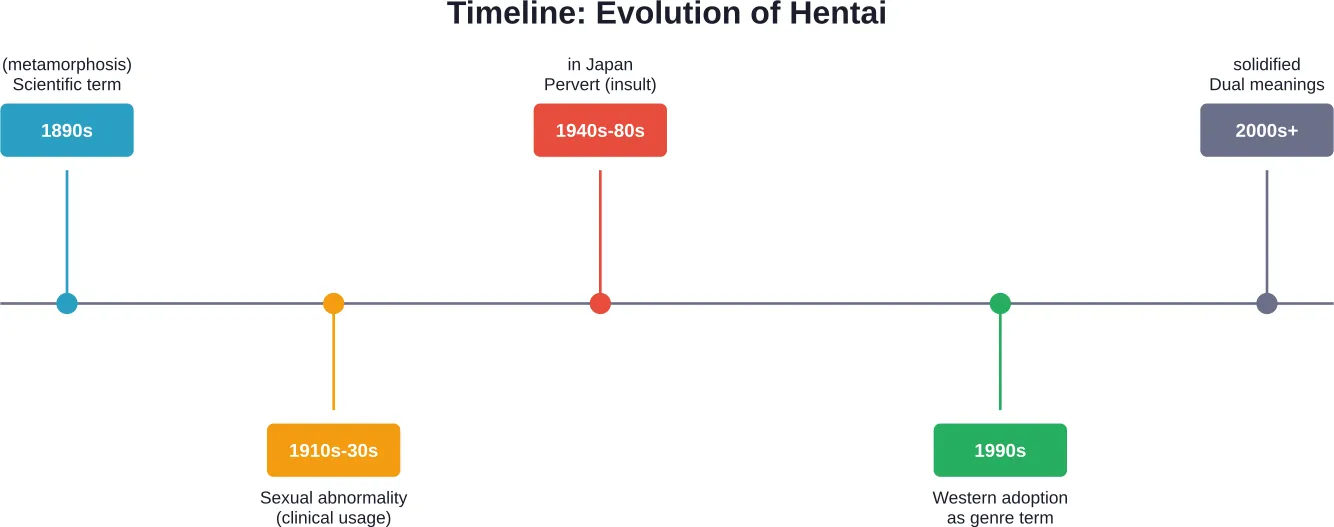
The word hentai didn’t start its life with sexual connotations at all. Originally, it served as a scientific term in biology and zoology.
According to Wiktionary, hentai was first used as an entomological term in publications by the Entomological Society of Japan, with later non-entomological applications in broader zoology and botany.
The broader zoological and botanical applications followed, where hentai simply meant biological transformation or morphological change.
The Semantic Shift to Sexual Abnormality
So how did a word about butterfly metamorphosis become an insult about perverts?
The narrower sense of hentai as ‘abnormal’ appeared in Chinese works by authors like Mao Dun. But the strictest sense — ‘abnormal sexual desire’ — developed within Japanese culture over time.
According to Wikipedia, the development timeline looks something like this:
| Time Period | Meaning and Usage |
|---|---|
| Meiji Period (1868-1912) | Hysteria; medical terminology |
| 1910s | Abnormal sexual desire (clinical) |
| 1920s-1930s | Perverted sexuality; topics related to homosexual relationships |
| 1940s onwards | General perversion; sexual deviance |
| 1990s | Western adoption as genre term |
By the mid-20th century, hentai had firmly established itself in Japanese as a derogatory term for sexual perversion. That’s where it sat until Western anime fans got involved.
How Western Anime Culture Adopted and Transformed Hentai
The transformation of hentai into a genre descriptor happened primarily in the 1990s. According to Dictionary.com, the English usage emerged around 1990–95.
Early Western anime fans encountered Japanese adult animation through various channels — imported VHS tapes, underground trading circles, and eventually the early internet. These fans needed vocabulary to categorize what they were discovering.
But here’s where it gets messy. Most Western fans didn’t speak fluent Japanese. They picked up terms from context, subtitles, and limited translations.
Someone, somewhere, likely saw or heard ‘hentai’ associated with adult content — perhaps in a context where it was condemning perverted material. Western fans latched onto the term as a convenient label, completely divorced from its actual Japanese usage.
The Role of Internet Communities
Once internet forums and early websites started cataloging anime, the term hentai became standardized in English. Websites used it as a category tag. Forums created hentai-specific boards. Fan communities adopted it universally.
By the early 2000s, hentai had become the dominant English-language term for Japanese pornographic animation, despite Japanese people not using it that way themselves.
This created an odd linguistic situation: a Japanese word that means one thing in Japan and something completely different everywhere else.
The Scientific and Biological Origins
Before all the cultural appropriation and semantic shifts, hentai belonged to scientists. The original biological usage remains technically valid in Japanese academic contexts today.
In entomology, hentai still describes insect metamorphosis — the transformation from larva to pupa to adult form. This scientific meaning coexists alongside the sexual meaning, though obviously in very different contexts.
The Entomological Society of Japan employed this terminology precisely because the kanji characters (変態) accurately describe biological transformation. The word made perfect scientific sense.
What happened over time was a semantic split. The scientific community continued using hentai in its original transformational sense, while popular culture increasingly associated it with sexual abnormality.
Explore Anime Art References in One Place
If you’re trying to understand how terms like “hentai” are used in modern internet culture, it can help to look at how anime-style content is organized online. Platforms like r34.app collect and categorize user-generated artwork, often tagged with specific genres, styles, and themes. This makes it easier to see how certain words are actually applied in practice, beyond just dictionary definitions.
You can use r34.app to:
- browse tagged anime-style artwork by category
- understand how specific terms are labeled and grouped
- explore how online communities interpret and apply these labels
👉 Open r34.app and search for a term to see how it’s used across different posts and tags.
Modern Usage in Japan vs. International Contexts
Walk into a Japanese bookstore today, and you won’t find a ‘hentai’ section. Instead, look for sections labeled ‘成人向け’ (seijin muke, ‘for adults’) or areas marked 18-kin.
Japanese retailers, publishers, and consumers understand hentai as an insult, not a product category. Using it to label merchandise would be like calling a section ‘perverted stuff’ — technically accurate about the content, perhaps, but socially unacceptable and commercially bizarre.
Meanwhile, Western sites and services freely use hentai as a straightforward category term. Streaming platforms, forums, and databases employ it without hesitation because in English-speaking contexts, it doesn’t carry the same insulting weight.
Cultural Awareness and Linguistic Confusion
This disconnect creates real confusion for Japanese people encountering Western anime culture online. They see English-language discussions casually using ‘hentai’ as a neutral descriptor and often find it jarring.
Community discussions on platforms like Reddit’s LearnJapanese forum frequently address this exact confusion. Language learners discover that the hentai they’ve heard in Western contexts doesn’t match up with how Japanese speakers actually use the word.
The reverse confusion happens too. Western fans visiting Japan and asking about ‘hentai’ in shops or conversations quickly learn they’re using problematic terminology.
Related Japanese Terms and Proper Terminology
If hentai isn’t the right word to use in Japan, what should someone say instead? The answer depends entirely on context.
For discussing adult anime and manga in Japanese, these terms work better:
- Ero anime (エロアニメ) — erotic animation
- Ero manga (エロ漫画) — erotic comics
- Eroge (エロゲ) — erotic games, short for ‘ero game’
- Adult anime (アダルトアニメ) — straightforward adult animation
- Seijin manga (成人漫画) — adult manga
- 18-kin (18禁) — 18-prohibited content
The prefix ‘ero’ (エロ) gets used extensively in Japanese conversations about sexual content because it comes from the loan word ‘erotic’ and doesn’t carry the harsh judgment of ‘hentai.’
Ecchi: The Softer Alternative
Another term worth understanding is ‘ecchi’ (エッチ), which comes from the Japanese pronunciation of the letter ‘H’ — itself standing for ‘hentai’ originally.
But ecchi has evolved to mean something milder: sexually suggestive content that stops short of explicit pornography. Think fan service, suggestive situations, and provocative imagery without actual sex acts.
Both Japanese and Western anime communities use ecchi consistently to describe this middle ground between mainstream content and full pornography.
Common Misconceptions About Hentai
Several persistent myths surround the term hentai, particularly among Western audiences who’ve never studied Japanese seriously.
- Misconception #1: Japanese people use hentai to describe adult anime. They don’t. This is purely Western terminology that would confuse or offend Japanese speakers in most contexts.
- Misconception #2: Hentai is a neutral, technical term in Japanese. It’s not. The word carries strong negative connotations and functions primarily as an insult.
- Misconception #3: The word came from anime culture. Actually, hentai predates modern anime by decades and originally belonged to scientific and medical terminology before shifting to sexual contexts.
- Misconception #4: Japanese retailers label adult content as hentai. Real Japanese stores use terms like 18-kin or seijin muke instead.
Why These Misconceptions Persist
Language learning doesn’t happen in a vacuum. Western anime fans developed their terminology before Wikipedia, before widespread internet access, before easy translation tools.
Early adopters established conventions, and those conventions stuck. Once thousands of websites, forums, and databases labeled content as hentai, the term became self-perpetuating in English.
Now, even people who know better often use hentai in English contexts simply because it’s the established term everyone understands.
The Linguistic Phenomenon of Semantic Drift
What happened to hentai represents a fascinating case study in semantic drift — when a word’s meaning changes over time or across communities.
Linguists recognize several types of semantic change. The hentai case involves both narrowing (from general abnormality to specifically sexual perversion in Japanese) and divergence (developing completely different meanings in Japanese versus English contexts).
Other Japanese words have undergone similar transformations when adopted by English speakers. Consider ‘anime’ itself, which just means ‘animation’ in Japanese but specifically refers to Japanese animation in English.
Or ‘manga,’ which means comics generally in Japanese but specifically Japanese-style comics in English.
Cross-Cultural Linguistic Borrowing
When languages borrow terms from each other, meaning often shifts in the process. English borrowed ‘hentai’ but assigned it new semantic boundaries that make sense within English-speaking anime culture.
This isn’t wrong, exactly — language evolution happens naturally. But it does create communication barriers between Japanese speakers and English speakers who think they’re using the same terminology.
The result is that hentai has effectively become two different words: the Japanese hentai meaning pervert, and the English hentai meaning pornographic anime.
Cultural Context and Censorship in Japan
Understanding hentai also requires understanding Japanese attitudes toward sexual content and censorship. Japan has complex, sometimes contradictory approaches to pornography.
Japanese law prohibits the display of genitalia in pornographic materials. This censorship requirement, established in Article 175 of the Japanese Penal Code, applies to anime, manga, and live-action content alike.
Nagisa Oshima and his publisher were indeed acquitted in the ‘In the Realm of the Seuses’ (Ai no Korīda) obscenity trial in 1982, but this did not lift the legal requirement for genital censorship under Article 175. To this day, all commercial adult media in Japan, including live-action films, anime, and manga, must still censor genitalia.
This is why Japanese adult anime typically features pixelation, black bars, or strategic positioning — not artistic choice, but legal requirement.
The Paradox of Japanese Sexual Content
Japan produces massive amounts of sexual content across all media types while simultaneously maintaining strict censorship laws. This creates a unique cultural landscape.
Explicit manga sits on convenience store shelves. Adult anime receives commercial releases. But all of it follows censorship guidelines that Western versions often remove when licensed internationally.
The Japanese term for this censored adult content isn’t hentai — it’s still ero, adult, or 18-kin material, just legally compliant.
Hentai in Academic and Research Contexts
Academic researchers studying Japanese media, sexuality, or cultural exchange frequently encounter the hentai terminology problem.
Scholarly papers must address what they’re actually discussing. Academic sources reference hentai kambun as a historical linguistic variant, representing a hybrid Sino-Japanese language system used by male elites in premodern Japan — completely unrelated to sexual content.
Contemporary academic work on pornographic anime typically acknowledges the terminology gap explicitly. Researchers will note that they’re using ‘hentai’ as the established English term while recognizing it doesn’t reflect Japanese usage.
This creates interesting citation challenges. How do academics reference a genre that has different names depending on the language and cultural context?
Research into Adult Anime as Cultural Product
Academic interest in adult anime extends beyond terminology into cultural studies, gender studies, and media analysis. Publications in journals like Mechademia examine these materials as legitimate cultural products worthy of serious analysis.
Such research necessarily grapples with proper terminology, audience reception, and the cultural contexts that produce and consume this material differently across societies.
Practical Implications for Language Learners
So what should Japanese language students take away from all this?
First, be cautious about using anime-derived vocabulary in real Japanese contexts. Many terms that seem normal in Western anime communities don’t translate well to actual Japanese conversation.
Second, understand that hentai as an insult is serious business. Don’t casually call someone a hentai unless you intend to make a harsh accusation.
Third, learn the proper Japanese terminology for discussing adult content if that’s relevant to your interests. Using ero or 18-kin demonstrates cultural awareness that hentai doesn’t.
Building Cultural Competence
Language learning extends beyond vocabulary and grammar into cultural understanding. Knowing that hentai means different things in different contexts represents valuable cultural competence.
Community discussions on platforms like HiNative regularly feature confused learners asking about this exact discrepancy. Native Japanese speakers patiently explain that the Western usage doesn’t match Japanese reality.
These conversations highlight how important context and cultural awareness are for effective communication across languages.
The Global Spread of Japanese Media Terms
Hentai isn’t alone in acquiring new meanings through international adoption. The global spread of Japanese media has introduced dozens of Japanese terms into English and other languages.
Terms like otaku, kawaii, and cosplay have all undergone similar transformations — borrowed into English with meanings that sometimes diverge from their Japanese origins.
Otaku originally carried negative connotations in Japan (obsessive nerd) but became a more neutral or even positive identifier among Western anime fans.
This pattern repeats across cultural exchange: terms get borrowed, meanings shift, and suddenly you have words living double lives across languages.
| Japanese Term | Original Japanese Meaning | Western/English Meaning | Semantic Shift |
|---|---|---|---|
| Hentai (変態) | Pervert; abnormal (insult) | Pornographic anime/manga (neutral genre term) | Complete transformation |
| Otaku (オタク) | Obsessive fan (negative) | Anime/manga enthusiast (neutral/positive) | Value shift |
| Anime (アニメ) | All animation | Specifically Japanese animation | Narrowing |
| Manga (漫画) | All comics | Specifically Japanese comics | Narrowing |
| Kawaii (可愛い) | Cute (general adjective) | Cute aesthetic style (noun/aesthetic) | Category creation |
Why the Distinction Matters
Does it really matter if English speakers use hentai differently than Japanese speakers? In some ways, no — languages evolve, terms adapt, and communication happens within communities that establish their own conventions.
But the distinction matters for several practical reasons.
First, miscommunication. Using hentai around Japanese speakers while thinking it’s a neutral genre term can create seriously awkward situations or give offense.
Second, cultural respect. Understanding that a borrowed term has different meanings shows awareness of and respect for the source culture.
Third, language learning. Students seriously studying Japanese need accurate information about how words actually function in their native context, not just how English speakers have repurposed them.
Bridging the Communication Gap
Awareness helps bridge the gap. When Western fans understand why Japanese people find their use of hentai odd, and when Japanese people understand that English speakers aren’t trying to be offensive, better cross-cultural communication becomes possible.
The internet has made these conversations increasingly common. International forums, social media, and language exchange platforms facilitate direct dialogue between Japanese speakers and Western anime fans.
These interactions gradually spread awareness of the terminology discrepancy, even if they don’t eliminate it.
Future Evolution of the Term
Language never stops evolving. Where will hentai go from here?
In English-speaking contexts, hentai seems firmly established as the standard term for Japanese pornographic animation. Dictionaries include it. Major platforms use it as a category label. That’s unlikely to change soon.
But increasing cultural exchange might gradually make English speakers more aware of the terminology gap. More language learners, more direct communication with Japanese speakers, and more cultural education could shift usage patterns over time.
Meanwhile, younger Japanese people growing up with internet access and international cultural exchange are becoming aware of how Western fans use hentai. Some may adopt that usage in English-language contexts while maintaining the traditional meaning in Japanese.
Parallel Meanings May Persist
Most likely, hentai will continue functioning as two distinct words in two different linguistic communities. English hentai and Japanese hentai will coexist as separate entities, much like how ‘anime’ means different things in different languages.
This linguistic dualism reflects our increasingly interconnected but still culturally distinct world. Terms cross borders, but they don’t always carry their meanings intact.
Frequently Asked Questions
What does hentai literally translate to in English?
The word hentai (変態) literally translates to ‘transformation,’ ‘metamorphosis,’ or ‘abnormality’ based on its kanji characters. The first character 変 means ‘change’ or ‘strange,’ while the second character 態 means ‘condition’ or ‘state.’ However, in common Japanese usage, it means ‘pervert’ or ‘sexually abnormal’ and functions as an insult rather than a neutral descriptor.
Do Japanese people call pornographic anime ‘hentai’?
No, Japanese people typically don’t use hentai to describe pornographic anime or manga. Instead, they use terms like ‘ero anime’ (エロアニメ), ’18-kin’ (18禁), ‘adult anime’ (アダルトアニメ), or ‘seijin manga’ (成人漫画) for adult content. The term hentai in Japan primarily means ‘pervert’ and is considered an insult, not a genre label.
How did hentai become a genre term in Western countries?
Western anime fans in the 1990s adopted hentai as a convenient label for Japanese pornographic animation, likely encountering the term in limited Japanese contexts without fully understanding its actual meaning. As early internet communities, forums, and websites established hentai as a standard category term, it became widespread in English usage despite not reflecting how Japanese speakers use the word.
Is it offensive to use the word hentai in Japan?
Using hentai to describe a person in Japan is definitely offensive — it’s calling someone a pervert or sexual deviant. Using it to describe adult anime might simply confuse Japanese people rather than offend them, since they wouldn’t typically use that terminology for content. Context matters, but generally it’s better to use proper Japanese terms like ‘ero’ or ’18-kin’ when discussing adult content in Japanese.
What’s the difference between hentai and ecchi?
In Western anime terminology, ecchi refers to sexually suggestive content that stops short of explicit pornography — fan service, provocative situations, and suggestive imagery without actual sex acts. Hentai refers to fully explicit pornographic content with actual sexual acts depicted. Ecchi occupies a middle ground between mainstream anime and hentai, similar to the difference between a PG-13 movie and an X-rated film.
When did hentai first acquire sexual connotations in Japanese?
The word hentai began shifting from its scientific meaning (metamorphosis) to sexual contexts in the early 20th century. According to historical linguistic research, by the 1910s it was being used to describe abnormal sexual desire in clinical contexts, and by the 1920s-1930s it was associated with perverted sexuality and discussions of non-normative sexual relationships. By the 1940s, its primary meaning had become sexual perversion and deviance.
What terms should I use instead of hentai when speaking Japanese?
When discussing adult content in Japanese, use terms like ‘ero’ (エロ) for erotic, ’18-kin’ (18禁) for age-restricted content, ‘adult anime’ (アダルトアニメ), ‘ero manga’ (エロ漫画) for adult comics, or ‘eroge’ (エロゲ) for adult games. These terms are widely understood in Japan and don’t carry the harsh insulting connotation that hentai does. The prefix ‘ero’ is particularly useful and commonly used in Japanese conversations about sexual content.
Conclusion: Understanding Language in Cultural Context
The story of hentai demonstrates how language functions as a living, evolving system shaped by cultural exchange, community usage, and historical context.
What began as a scientific term for insect metamorphosis transformed into a Japanese insult for sexual perverts, then was borrowed by Western anime fans and repurposed as a neutral genre descriptor for pornographic animation. Each transformation reflects the communities using the term and their specific needs and contexts.
Understanding what hentai actually means in Japanese — versus how English speakers use it — requires looking beyond simple dictionary definitions. It demands awareness of cultural attitudes, historical development, and cross-linguistic borrowing patterns.
For language learners, this serves as a valuable lesson: context determines meaning. Words don’t exist in isolation, and borrowed terms often acquire new meanings when transplanted into different linguistic communities.
For anime fans, it highlights the importance of cultural awareness. Enjoying Japanese media doesn’t automatically confer understanding of Japanese language and culture. Terms that seem standard in Western fan communities may not translate to actual Japanese usage.
And for everyone interested in how humans communicate across cultures, hentai offers a perfect case study in semantic drift, cultural exchange, and the beautiful messiness of language evolution.
Whether discussing biological metamorphosis, calling out perverted behavior, or categorizing adult animation, the word hentai continues its own transformation — proving that language, like the insects the term originally described, never stops evolving.
Want to learn more about Japanese language and culture? Understanding terms in their proper context makes all the difference between confident communication and embarrassing misunderstandings.