Quick Summary: Hentai legality depends on content and jurisdiction. Adult-oriented hentai depicting only adults is generally legal in the United States under First Amendment protections. However, hentai depicting minors—even fictional, animated characters—is illegal under federal law via the PROTECT Act and increasingly strict state laws like Texas SB 20, which classifies AI-generated and animated child sexual material as felony offenses regardless of whether real children were involved.
The question “is hentai illegal” doesn’t have a simple yes-or-no answer. Legal status shifts dramatically based on what the content depicts, where someone lives, and how local laws interpret fictional versus real depictions of sexual content.
Here’s the thing though—while mainstream adult hentai featuring clearly adult characters operates in a legal gray zone similar to other pornography, anything depicting minors triggers an entirely different legal framework. And that distinction matters more than ever in 2026.
This guide breaks down federal law, state-specific regulations, international perspectives, and the evolving legal landscape around animated sexual content. Understanding these boundaries isn’t just academic—criminal penalties can include years in prison and permanent registration as a sex offender.
Understanding Hentai: Definitions and Categories
Hentai refers to sexually explicit anime and manga originating from Japan. The term encompasses everything from mild romantic content to hardcore pornographic material, all created through illustration, animation, or digital rendering rather than filmed with real people.
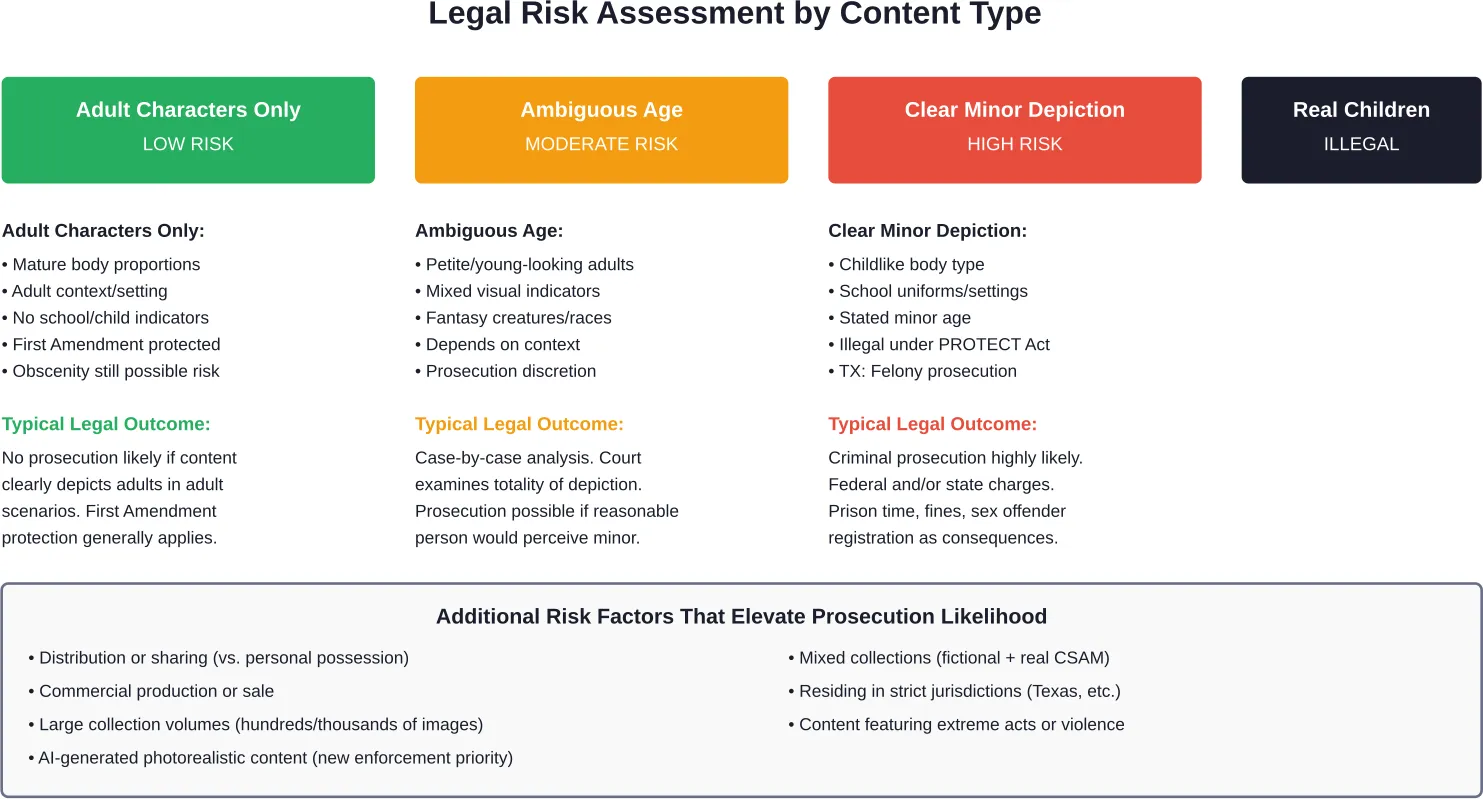
The legal analysis hinges on several critical distinctions. Adult hentai depicts characters who are clearly adults—mature body types, adult scenarios, no indicators of minority status. This category generally receives First Amendment protection as artistic expression, similar to written erotic fiction or illustrated adult comics.
Lolicon and shotacon represent the problematic categories. These subgenres depict characters who appear to be minors—whether through childlike body proportions, school settings, stated ages, or other contextual markers. Even when creators claim characters are “actually 18” or “just small adults,” courts examine the totality of how characters are presented.
The newest category causing legal confusion is AI-generated content. Software can now create photorealistic or anime-style sexual imagery without any human model. Texas and other states have moved aggressively to classify this material as illegal when it depicts minors, even though no actual child was photographed or harmed in creation.
Check the Content Before You Click
Whether hentai is legal depends heavily on your country and the specific type of content. In general, adult animated content featuring clearly fictional adults is often treated differently from illegal material – but laws can change, and some categories are strictly prohibited. For example, many countries have strict rules around any content that depicts minors, even if it’s drawn or animated .
Platforms like r34.app don’t host content themselves – they organize and surface posts from different sources using tags and filters. That means it’s up to the user to understand what they’re viewing and how it’s categorized.
On r34.app, you can:
- search and filter content by tags before opening anything
- see how posts are labeled across different sources
- switch between categories like images or animated posts
- quickly check what type of content you’re about to view
👉 Open r34.app, search a tag, and review how content is labeled before clicking through.
Federal Law: The PROTECT Act and Obscenity Standards
Federal law addresses fictional child pornography primarily through the PROTECT Act of 2003. This legislation emerged after the Supreme Court struck down portions of the earlier Child Pornography Prevention Act in Ashcroft v. Free Speech Coalition.
In that 2002 decision, the Court ruled that virtual child pornography created without real children didn’t automatically qualify as unprotected speech. The decision, decided April 16, 2002, established that the government needed to prove either real children were harmed or the material qualified as legally obscene.
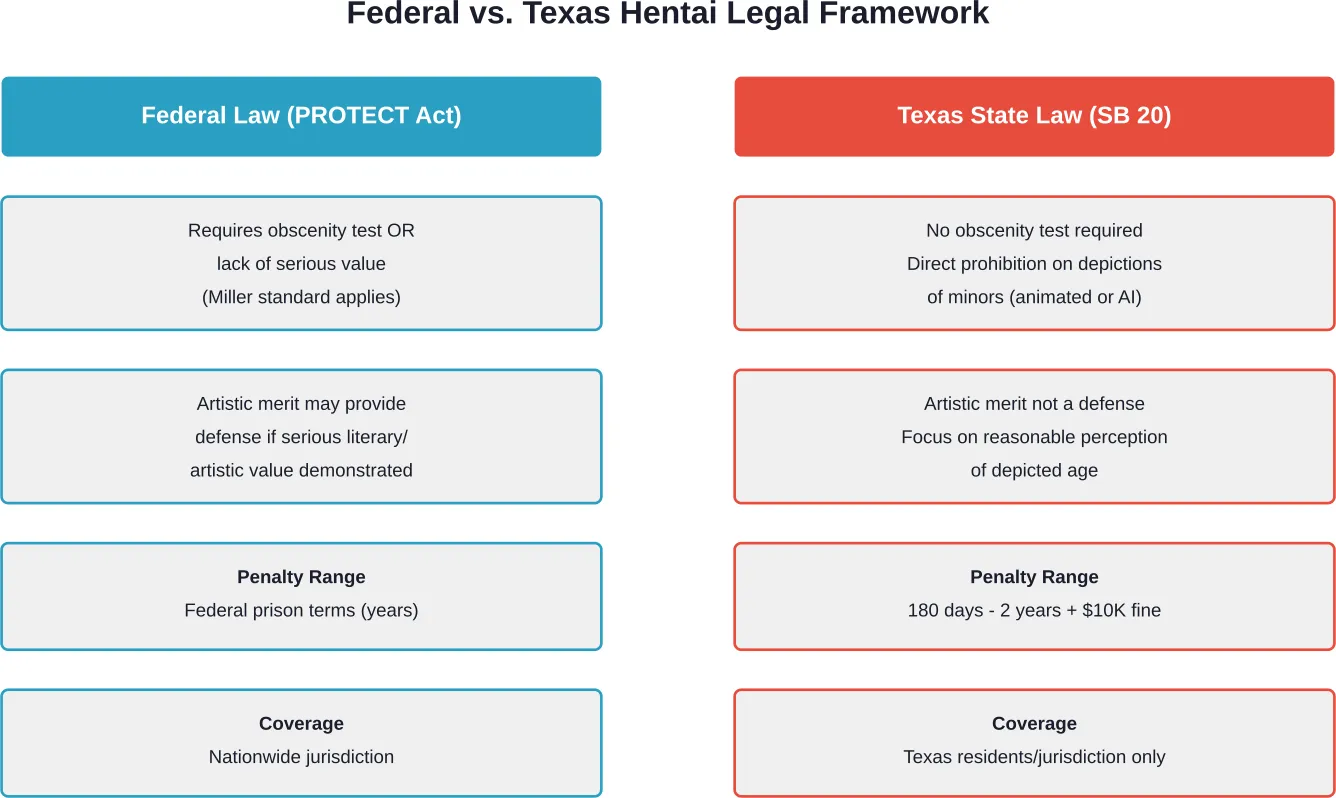
Congress responded with the PROTECT Act, which prohibits any visual depiction of a minor engaging in sexually explicit conduct—including drawings, cartoons, sculptures, and paintings—if the material is obscene OR if it lacks serious literary, artistic, political, or scientific value and depicts minors in certain graphic ways.
The obscenity test comes from the Miller standard, which asks whether the average person, applying contemporary community standards, would find the work appeals to prurient interest, depicts sexual conduct in a patently offensive way, and lacks serious value. All three prongs must be met for material to be classified as obscene and therefore unprotected.
This creates uncertainty. A hentai manga with plot, character development, and artistic merit might survive legal scrutiny even with sexual content, while purely pornographic material depicting child characters almost certainly won’t.
Texas SB 20: The New Frontier of State Regulation
Texas passed Senate Bill 20, with the law taking effect in March 2025, dramatically expanding what qualifies as illegal child sexual material. The law specifically targets AI-generated and animated content depicting minors.
Under Texas law, watching hentai or AI-generated child pornography is now a state jail felony. The punishment can include 180 days to 2 years in a state jail facility and fines up to $10,000.
What makes SB 20 particularly aggressive is its broad definition. The law doesn’t require that a real child was harmed or even that the images be photorealistic. Animated characters, cartoon drawings, and digitally created imagery all fall under the prohibition if they depict what a reasonable person would perceive as a minor engaged in sexual conduct.
Texas isn’t alone in this approach, but it represents one of the strictest state-level frameworks. The law eliminates previous arguments that fictional characters can’t be victims or that artistic expression deserves protection when no actual children are involved.
Criminal Penalties: What’s Actually at Stake
The consequences for possession, distribution, or creation of illegal hentai material aren’t trivial. Federal convictions under the PROTECT Act carry sentences measured in years, not months.
Possession charges at the federal level can result in multiple years in federal prison. Distribution, production, or receipt with intent to distribute brings even harsher penalties—potentially decades behind bars depending on the quantity of material and prior criminal history.
State penalties vary considerably. In Texas, possession for personal viewing constitutes a state jail felony with 180 days to 2 years incarceration and fines up to $10,000. But distribution or production charges escalate to higher-degree felonies with proportionally severe sentences.
Beyond incarceration and fines, conviction typically requires sex offender registration. This carries lifelong consequences: housing restrictions, employment barriers, public notification requirements, and travel limitations. Registration requirements persist for decades or life, depending on the jurisdiction and offense classification.
Courts don’t consistently distinguish between real child pornography and fictional animated material when determining sentences. Prosecutors argue that consumption of such material normalizes sexual interest in children and should be punished accordingly, regardless of whether real victims exist.
International Perspectives on Hentai Legality
Legal approaches to fictional pornography depicting minors vary dramatically worldwide. Understanding international frameworks provides context for U.S. policy debates and highlights different philosophical approaches to regulation.
Japan: The Country of Origin
Japan, where hentai and manga culture originated, maintains a complicated legal relationship with this content. Japanese law prohibited possession of child pornography relatively recently compared to Western nations, and enforcement focuses primarily on photographic material involving real children.
Research on pornography harms in Japan, documented through surveys and feminist-abolitionist group activities, has raised concerns about societal impacts. Community discussions around these materials continue to evolve as Japan balances cultural expression with child protection concerns.
Lolicon manga remains widely available in Japan, though some prefectures have enacted local ordinances restricting sales to minors. The national legal framework doesn’t criminalize fictional depictions to the same extent as U.S. federal law.
Canada: Broad Prohibition
Canada takes a rigorous stance. Law prohibits any visual representation of sexual activity involving persons—or characters depicted as being—under 18 years, including cartoons, drawings, and computer-generated images. The law does not require proof of harm to a real child; if material depicts what appears to be a minor in sexual situations, it is generally illegal.
However, this prohibition is not absolute. In R. v. Sharpe (2001), the Supreme Court of Canada ruled that the Charter of Rights and Freedoms protects the possession of:
- Self-created works: Drawings or stories created by a person for their own private use.
- Private records: Personal diaries or internal thoughts recorded for oneself.
While these specific niches are protected under the right to privacy, the general possession, distribution, and sale of such material remain strictly prohibited.
United Kingdom: Context-Dependent Approach
The United Kingdom prohibits “indecent” images of children, including non-photographic images such as drawings, cartoons, and computer-generated imagery. The Coroners and Justice Act 2009 specifically criminalized possession of prohibited images of children, defined to include fictional depictions.
British law requires that images be “pornographic” and “grossly offensive, disgusting, or otherwise of an obscene character.” This introduces a subjective element where enforcement depends on how offensive the material is judged to be, not merely whether it depicts minors.
Australia: Classification and Criminal Law
Australia prohibits child abuse material including cartoons, drawings, and animations depicting minors in sexual contexts. The country’s classification system refuses classification to such material, making possession and distribution criminal offenses.
Australian law enforcement has prosecuted individuals for manga and anime possession, demonstrating active enforcement beyond photographic material. The legal framework doesn’t distinguish between realistic and stylized depictions.
Countries with Legal Gray Areas
Many nations have laws that theoretically could apply to fictional material but where enforcement remains unclear or inconsistent. Netherlands, Portugal, and several other European countries maintain child pornography laws that may or may not extend to entirely fictional content depending on how courts interpret existing statutes.
These jurisdictions often focus enforcement resources on material involving real children, leaving fictional content in legal limbo—not explicitly legal, but rarely prosecuted unless found alongside real child abuse imagery.
| Country | Legal Status of Fictional Child Pornography | Enforcement Level |
|---|---|---|
| United States | Illegal under PROTECT Act if obscene or lacks serious value | High (federal and increasingly state) |
| Canada | Explicitly illegal, broad prohibition | High |
| United Kingdom | Illegal if pornographic and grossly offensive | Moderate to High |
| Australia | Illegal, refused classification | Moderate to High |
| Japan | Generally legal, some local restrictions | Low |
| Netherlands | Gray area, unclear statutory application | Low |
| Philippines | Illegal under anti-child pornography laws | Moderate |
The AI-Generated Content Challenge
Artificial intelligence has introduced unprecedented complexity to hentai legality. Machine learning models can now generate photorealistic or anime-style sexual imagery without any human subject, photographer, or traditional artist.
This technology raises fundamental questions. If no real child is photographed, abused, or involved in any way, can the output constitute child pornography? Traditional legal justifications for criminalizing child sexual abuse material center on harm to actual children—either in production or through distribution that perpetuates their exploitation.
Texas SB 20 answers these questions with an unequivocal yes. The law makes clear that AI-generated child pornography carries the same legal status and penalties as photographed material. The question isn’t whether a real child was harmed in creation, but whether the output depicts what a reasonable person would perceive as a minor in sexual situations.
Other states are following Texas’s lead. Legislation introduced across multiple jurisdictions aims to close what lawmakers view as a dangerous loophole. The rapid advancement of AI technology has outpaced legal frameworks designed for an era of photographic and hand-drawn material.
Civil liberties organizations have raised concerns about these expansive approaches. Arguments focus on First Amendment implications, the fundamental difference between fictional depictions and records of actual abuse, and the potential for prosecuting thought crimes rather than conduct that harms real victims.
But legislative momentum favors broad prohibition. The political reality is that few lawmakers want to be perceived as defending any form of child sexual imagery, fictional or otherwise.
Adult Hentai: The Legal Safe Zone
So where does this leave adult-oriented hentai that depicts only clearly mature characters? This category exists in substantially safer legal territory.
Adult hentai receives First Amendment protection as artistic expression and sexual speech between consenting adults (even if those “adults” are fictional characters). The Supreme Court has consistently held that consenting adult sexual expression—whether filmed, photographed, written, or illustrated—deserves constitutional protection unless it crosses into obscenity.
Obscenity remains the limiting factor. Under the Miller test, material can be banned if it appeals to prurient interest, depicts sexual conduct in a patently offensive way, and lacks serious literary, artistic, political, or scientific value when judged by contemporary community standards.
Most mainstream adult hentai doesn’t meet all three obscenity prongs. While it certainly appeals to sexual interest and depicts sexual conduct, courts have been reluctant to declare illustrated or animated material obscene when it involves only adult characters and doesn’t venture into extreme fetish territory.
Community standards matter here. What might be tolerated in urban coastal areas could be prosecuted in conservative jurisdictions. Obscenity law explicitly allows for geographic variation in what communities will accept.
Practical enforcement focuses almost entirely on material depicting minors. Prosecutors have limited resources and overwhelming incentive to pursue cases involving apparent children rather than testing obscenity boundaries with adult-oriented anime.
That doesn’t mean adult hentai is risk-free. Possession of extreme material—particularly content involving bestiality, extreme violence, or other taboo elements—could theoretically trigger obscenity prosecution even without minor depictions. But such cases are rare.
Legal Defenses and Practical Realities
What defenses exist when someone faces charges related to hentai or fictional pornography? The answer depends heavily on the specific statute violated and the content at issue.
The Artistic Merit Defense
Under federal law and in states that apply obscenity standards, serious literary, artistic, political, or scientific value provides a complete defense. Material that tells a story, develops characters, or demonstrates genuine artistic effort may survive legal challenge even with sexual content.
This defense requires evidence. Expert testimony from art critics, literary analysts, or cultural scholars can establish that material transcends mere pornography. Published reviews, awards, cultural recognition, and scholarly analysis all support claims of serious value.
But this defense has limits. Courts distinguish between material with some plot or artistic elements and material where sexual content overwhelmingly dominates. A 300-page manga with character development and a story arc stands on firmer ground than a 20-page doujinshi that’s purely pornographic.
The Age Perception Challenge
Defendants sometimes argue that characters aren’t actually minors—they’re adults who happen to have youthful features, or they’re fantasy creatures with ambiguous ages, or the creator stated they’re over 18.
Courts generally reject these arguments when characters exhibit obvious markers of minority status. Small stature, childlike body proportions, school uniforms, stated ages in the narrative, and contextual clues all factor into analysis. A creator’s statement that a character is “actually 1,000 years old” doesn’t override visual depiction of a child’s body.
The standard is typically what a reasonable person would perceive, not what the creator claims or what fantasy lore establishes. This objective approach eliminates loopholes based on creative labeling.
Lack of Knowledge
Defendants might claim they didn’t know material depicted minors or that they unknowingly downloaded illegal content mixed with legal material. This defense faces steep challenges.
Prosecutors must generally prove knowing possession or distribution, but courts interpret “knowing” broadly. Willful blindness—deliberately avoiding knowledge of what material contains—typically satisfies the knowledge requirement. Downloading large collections without reviewing content doesn’t provide a defense.
First Amendment Challenges
Constitutional challenges to laws prohibiting fictional child pornography have achieved limited success. The Ashcroft v. Free Speech Coalition decision struck down overly broad provisions, but subsequent legislation like the PROTECT Act was crafted to withstand constitutional scrutiny by tying prohibitions to obscenity standards or lack of serious value.
Current challenges focus on AI-generated content and whether material created without any real child victim can constitutionally be criminalized. These cases are working through courts now, with outcomes uncertain.
What About Possession vs. Distribution?
Legal consequences escalate dramatically when someone moves from possession to distribution. This distinction matters enormously in charging decisions and sentencing.
Possession means having material stored on devices or accessible through cloud accounts. Simple possession carries serious penalties, but distribution charges bring far harsher consequences.
Distribution includes sharing files through peer-to-peer networks, uploading to websites or forums, sending via email or messaging apps, or making material available for others to access. Many people don’t realize that torrenting material constitutes distribution—uploading occurs automatically as files download.
Production charges apply when someone creates, commissions, or directs creation of illegal material. Commissioning an artist to draw lolicon content could theoretically trigger production charges, though such prosecutions are less common than possession or distribution cases.
Intent matters for distribution charges. Accidental sharing through misconfigured file-sharing software might provide some defense, but prosecutors will examine evidence of deliberate uploading, file organization that suggests distribution intent, and communication indicating knowledge of sharing activity.
Platform Policies vs. Criminal Law
It’s critical to distinguish between what’s illegal and what platforms prohibit. Many websites ban content that’s technically legal because they don’t want to host it or deal with gray areas.
Reddit, Twitter, Patreon, DeviantArt, and most major platforms ban lolicon and shotacon content regardless of legal status. These are private terms-of-service decisions, not legal determinations. Violating platform rules gets accounts banned—it doesn’t necessarily constitute criminal activity.
Conversely, some content allowed by platform policies might still carry legal risk. Adult hentai depicting clearly adult characters is permitted on many sites but could theoretically trigger obscenity charges in extremely conservative jurisdictions.
Payment processors create another layer of restriction. Visa, Mastercard, PayPal, and other financial services companies often prohibit transactions involving adult content broadly or specific categories of adult material. Creators may find content that’s legal and allowed by platforms still blocked from monetization.
Copyright presents separate issues. Much hentai uses characters from established franchises without authorization. While copyright infringement is civil rather than criminal in most cases, it creates legal exposure separate from obscenity or child pornography concerns. Research on copyright importance for manga and anime highlights ongoing challenges in this area.
Enforcement Realities and Prosecution Priorities
Understanding what’s technically illegal differs from understanding enforcement realities. Law enforcement agencies have limited resources and must prioritize cases.
Prosecutors focus overwhelmingly on material involving real children. Photographic and video child sexual abuse material receives top enforcement priority because it documents actual crimes against identifiable victims.
Fictional material prosecutions typically occur in specific contexts. Someone arrested for real child pornography who also possesses lolicon content will face charges for both. Cases involving distribution of large collections draw more enforcement attention than personal possession of small amounts. High-profile defendants or cases that generate public attention receive prosecution priority.
Geographic variation matters enormously. Federal prosecutors in major cities with extensive caseloads rarely pursue fictional material cases unless they’re particularly egregious or involve other criminal activity. Rural or suburban jurisdictions with less crime volume may more readily prosecute fictional content.
Texas enforcement has increased substantially under SB 20. The law’s explicit prohibition removes prosecutorial discretion about whether material qualifies as illegal—if it depicts minors in sexual content, it violates the statute regardless of whether it’s photographic, drawn, or AI-generated.
Internet investigations typically start with distribution rather than possession. Law enforcement monitors file-sharing networks, websites hosting illegal material, and forums where content is traded. Personal possession discovered through unrelated investigations (computer seized for other reasons, cloud account exposed through data breach) might not trigger prosecution unless material is extensive or particularly disturbing.
Copyright and Trademark Considerations
Beyond obscenity and child pornography concerns, hentai often raises intellectual property issues. Much content features characters from copyrighted anime, manga, and video games.
Japan’s doujinshi culture operates in a gray area where copyright holders generally tolerate fan-created works including sexual parodies. This tolerance isn’t legally binding—companies could enforce rights if they chose. Western intellectual property frameworks offer less flexibility for unlicensed derivative works.
Copyright holders occasionally issue takedown notices against hentai using their characters. This typically results in content removal rather than legal action, though persistent commercial infringement could trigger lawsuits.
Research highlighting the importance of copyright for manga and anime emphasizes tensions between fan culture and legal frameworks. Time for change may be needed in how copyright applies to transformative fan works, though current law provides little protection for unlicensed sexual content using established characters.
Trademark issues arise when hentai suggests official affiliation or endorsement. Using franchise names and character likenesses in ways that could confuse consumers about origin creates greater legal risk than clearly parodic or fan-labeled content.
Practical Guidance for Content Consumers
For those who consume hentai content, understanding practical risk management matters as much as knowing technical legal boundaries.
First, avoid any content depicting characters who could reasonably be perceived as minors. This includes obvious lolicon/shotacon content but also material with ambiguous age indicators. When in doubt, don’t download, save, or view it.
Second, stick to mainstream adult content featuring clearly mature characters. The vast majority of legal risk involves minor-coded material. Adult hentai from legitimate sources carries minimal legal exposure.
Third, understand that file-sharing networks create distribution exposure. Torrenting hentai means automatically uploading to other users, transforming possession into distribution. Direct downloads from websites avoid this risk.
Fourth, be aware of jurisdiction. Living in Texas or other states with strict fictional pornography laws increases risk compared to states without specific statutes targeting animated content.
Fifth, cloud storage creates unique vulnerabilities. Material stored on Google Drive, Dropbox, iCloud, or similar services is accessible to service providers who may scan for illegal content and report to law enforcement. Local storage offers more privacy.
Sixth, recognize that legal status can change. Material that’s technically legal today might become prohibited as states pass new legislation. AI-generated content in particular exists in rapidly evolving legal territory.
| Activity | Legal Risk Level | Risk Factors |
|---|---|---|
| Viewing adult hentai on legal streaming sites | Very Low | No possession, clearly adult content, legitimate platform |
| Downloading adult hentai for personal use | Low | Possession but no distribution, adult content only |
| Torrenting adult hentai | Moderate | Automatic distribution through upload, copyright exposure |
| Possession of ambiguous-age content | Moderate to High | Prosecutorial discretion, depends on specific depictions |
| Possession of clear lolicon/shotacon | High | Illegal under federal and many state laws |
| Distribution of minor-depicting content | Very High | Enhanced penalties, prioritized prosecution |
| Creation/commission of minor-depicting content | Very High | Production charges, maximum penalties |
Future Legal Trends and Developments
The legal landscape around hentai and fictional pornography continues evolving. Several trends suggest where regulation may head.
State-level legislation is expanding. Texas SB 20 represents a template other states are likely to follow. Expect more jurisdictions to pass laws explicitly criminalizing AI-generated and animated child sexual material without requiring obscenity determinations.
AI technology will drive new legal frameworks. As generation tools become more sophisticated and accessible, lawmakers will pressure to close perceived loopholes. The question of whether entirely fictional AI-generated content deserves First Amendment protection will likely reach appellate courts and potentially the Supreme Court.
International coordination may increase. Online content crosses borders effortlessly, creating challenges when material legal in one country is illegal in another. Pressure for harmonized standards could grow, though cultural differences make universal agreement unlikely.
Platform policies will probably tighten further. As laws become stricter, websites face increased liability risk for hosting material that might violate various jurisdictions’ standards. Expect broader content bans and more aggressive automated screening.
Technology for age verification and content classification may become mandatory. Lawmakers are exploring requirements that adult content platforms verify user ages and classify content by type. Such systems could extend to animated material.
When to Seek Legal Counsel
Certain situations require immediate consultation with a criminal defense attorney experienced in obscenity and child pornography cases.
If law enforcement contacts someone about internet activity, online accounts, or content possession, obtaining legal representation before answering any questions is critical. Anything said to investigators can be used in prosecution. Attorneys specializing in child pornography defense understand how to protect rights during investigations.
If devices are seized through search warrant execution, legal counsel becomes essential. Police don’t seize computers and phones for minor matters—such actions indicate serious investigation. An attorney can determine what evidence exists and what charges might be forthcoming.
For those arrested or charged with possession, distribution, or production of illegal hentai material, specialized legal defense is mandatory. These cases require attorneys familiar with federal sentencing guidelines, state-specific statutes, First Amendment defenses, and negotiation strategies for plea agreements.
Even before any law enforcement contact, those who realize they possess potentially illegal material should consult attorneys about risk assessment and mitigation. Learning that a collection includes content that could trigger prosecution warrants professional guidance about how to address the situation legally.
Finding qualified attorneys means looking for criminal defense lawyers with specific experience in obscenity, pornography, and computer crime cases. General practice attorneys often lack the specialized knowledge these cases require.
Frequently Asked Questions
Is all hentai illegal in the United States?
No. Hentai depicting clearly adult characters is generally legal under First Amendment protections as artistic expression. However, hentai depicting minors—even fictional animated characters—is illegal under the PROTECT Act if it’s obscene or lacks serious literary, artistic, political, or scientific value. States like Texas have passed even stricter laws prohibiting any animated or AI-generated sexual depictions of minors.
Can I go to jail for watching hentai?
Simply viewing adult hentai featuring only adult characters creates minimal legal risk. But watching or possessing hentai depicting minors can result in criminal prosecution. In Texas, under SB 20, watching hentai depicting minors is a state jail felony punishable by 180 days to 2 years in jail and fines up to $10,000. Federal charges carry even more severe penalties.
What’s the difference between lolicon and regular hentai legally?
Lolicon specifically depicts characters who appear to be underage girls in sexual situations. This falls squarely within prohibited content under federal law and most state statutes targeting fictional child pornography. Regular adult hentai depicting clearly mature characters receives First Amendment protection and isn’t criminalized unless it crosses into obscenity by other standards.
Is AI-generated hentai of minors illegal?
Yes, increasingly so. Texas SB 20 explicitly criminalizes AI-generated sexual imagery depicting minors, treating it the same as photographed child pornography or hand-drawn lolicon. Federal law under the PROTECT Act applies to computer-generated images as well. The fact that no real child was involved in creation doesn’t provide a legal defense in most jurisdictions.
What should I do if I accidentally downloaded illegal hentai?
Delete it immediately and thoroughly—including from trash folders and cloud backups. Don’t share it or distribute it in any way. If law enforcement later investigates, consult a criminal defense attorney before speaking to police. Accidental possession is difficult to prove, but immediate deletion upon discovery demonstrates lack of intent to possess illegal material.
Are lolicon and shotacon legal in Japan?
Japan’s laws focus primarily on photographic child pornography involving real children. Fictional manga and anime depicting minors, including lolicon and shotacon, are not criminalized to the same extent as in Western countries. Some local prefectures have ordinances restricting sales to minors, but possession and viewing of fictional content isn’t federally prohibited as it is in the United States, Canada, and many other nations.
Can I get in trouble for hentai that depicts characters who are stated to be adults but look young?
Potentially, yes. Courts apply a reasonable person standard—would an average person viewing the material perceive the character as a minor based on visual appearance, context, and setting? Creator statements that a character is “actually 18” or “a 1,000-year-old demon” don’t override visual depiction of childlike body proportions, school settings, or other minor indicators. When appearance suggests minority status, legal risk exists regardless of stated age.
Conclusion
The legality of hentai is not a simple question with a simple answer. Adult-oriented hentai depicting clearly mature characters generally enjoys First Amendment protection and exists in legal space similar to other forms of adult entertainment.
But the line between legal and illegal is bright and consequential when content involves depictions of minors. Federal law under the PROTECT Act, state statutes like Texas SB 20, and evolving regulations around AI-generated content create serious criminal exposure for possession, distribution, or creation of material depicting minor characters in sexual situations.
Penalties aren’t trivial. Federal prison sentences, state jail terms, substantial fines, and sex offender registration follow convictions. These consequences persist for years or decades, affecting employment, housing, and fundamental life opportunities.
The legal landscape continues to evolve. Technology outpaces legislation, creating gray areas that lawmakers rush to close. What might have operated in ambiguous legal territory five years ago is now explicitly criminalized in growing numbers of jurisdictions.
For anyone who consumes hentai content, the practical guidance is straightforward: stick to material depicting clearly adult characters from legitimate sources, avoid anything that could reasonably be perceived as depicting minors, understand that file-sharing creates distribution liability, and recognize that legal standards vary by jurisdiction.
When in doubt, don’t risk it. The legal consequences far outweigh whatever interest the content might hold.
If facing investigation, charges, or legal questions about material already possessed, consulting a criminal defense attorney experienced in obscenity and child pornography cases is essential. These cases require specialized knowledge that general practice lawyers typically lack.
Stay informed about legal developments in your jurisdiction, exercise caution about content consumption and storage, and recognize that the safest approach is avoiding any material depicting minors entirely—fictional or otherwise.