Quick Summary: Hentai is censored in Japan because Article 175 of the Japanese Penal Code prohibits the distribution of obscene materials, which includes explicit depictions of genitalia. This law has been in effect since 1907 and requires publishers to censor sexual content, even in adult-only media. Uncensored versions sometimes exist outside Japan because the censorship laws apply only within Japanese borders.
The censorship seen in hentai and other Japanese adult content puzzles many international audiences. Those black bars, pixelation, and strategic light beams aren’t artistic choices. They’re legal requirements baked into Japanese law for over a century.
Understanding why these censorship practices exist requires looking at Japan’s obscenity laws, their historical context, and how they apply to modern adult media. And yes, the situation gets interesting when content crosses international borders.
The Legal Foundation: Article 175
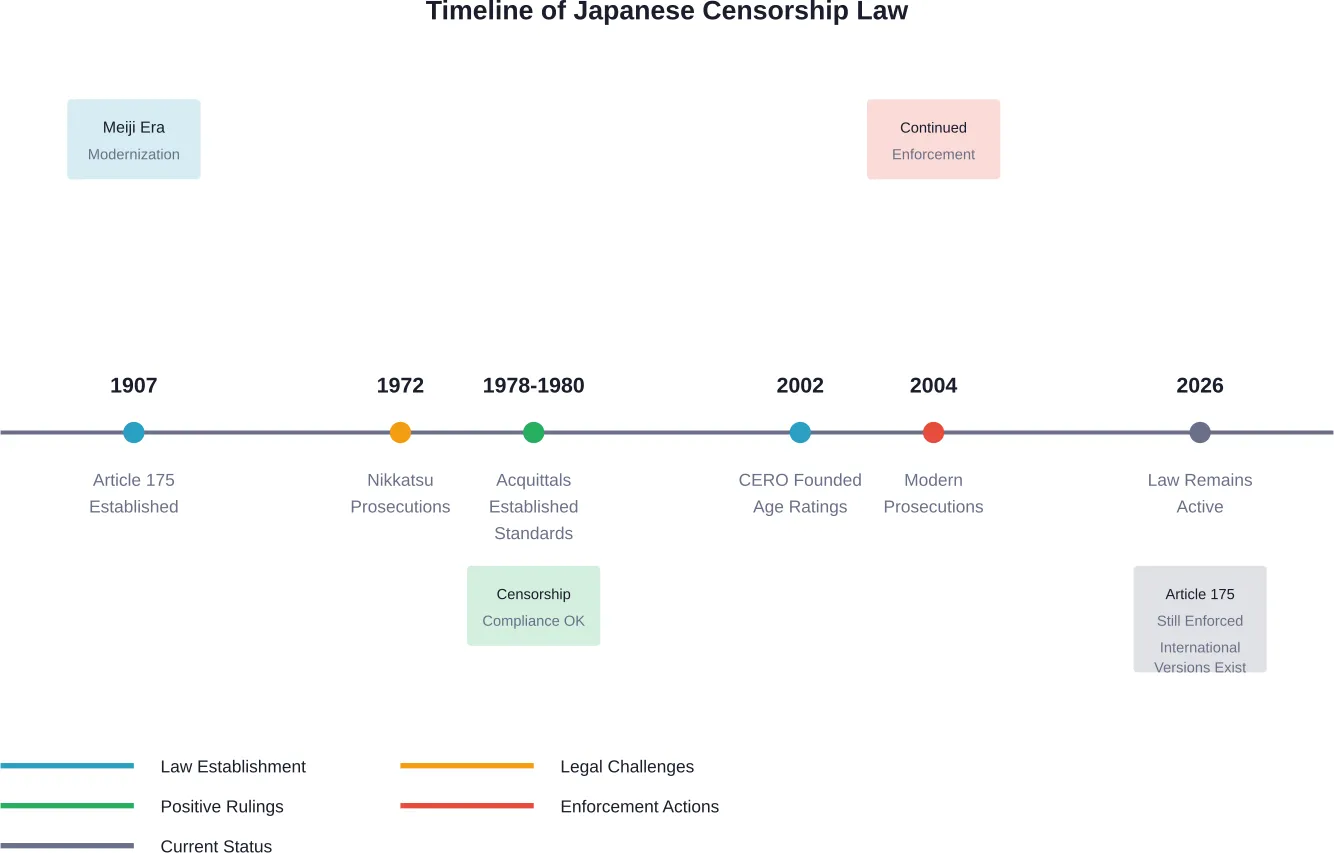
Japan’s censorship of sexual content stems directly from Article 175 of the Japanese Penal Code. This law, established in 1907, prohibits the sale or distribution of obscene materials within Japan.
Article 175 makes it illegal to distribute or sell materials that depict genitalia explicitly. The law doesn’t distinguish between photographs and illustrations, nor does it make exceptions for content clearly marketed to adults. Whether the material is anime, manga, live-action film, or digital media, the law applies equally.
The penalties are serious. According to Japanese law, Article 175 violations can result in penalties including fines or imprisonment. Publishers, distributors, and retailers all face potential prosecution if they handle uncensored material.
Here’s the thing though—the law doesn’t specify exactly what constitutes “obscene.” Courts have interpreted this through various rulings over the decades, but the consistent standard has been that explicit depictions of genitalia cross the line. This ambiguity has led to the various censorship techniques seen today.
Why the Law Was Created
Japan’s obscenity laws emerged during the Meiji era as part of broader efforts to modernize and align with Western legal standards. The government adopted these restrictions partially to present Japan as a civilized nation to international observers.
The irony? Japan was adopting Western-style censorship laws at roughly the same time Western nations were implementing similar restrictions. The difference is that while many Western countries gradually relaxed these laws through the 20th century, Japan’s Article 175 remained firmly in place.
Legal challenges have occurred. The Nikkatsu ‘Roman Porno’ case (1972–1980) ended with a guilty verdict. In 1978, the Tokyo District Court found the defendants guilty, and in 1980, the Tokyo High Court upheld this conviction, imposing fines. However, these rulings didn’t overturn Article 175 itself—they simply established that certain levels of censorship were sufficient to comply with the law.
Prosecutions for obscene content distribution have occurred in the modern era, including documented cases like those in 2004, reinforcing ongoing enforcement.
How Censorship Is Applied
Publishers and creators use several techniques to comply with Article 175 while still producing adult content. The most common methods include:
- Pixelation or mosaic blurring over genitalia
- Black bars or solid shapes blocking explicit areas
- Strategic light beams or artistic elements obscuring details
- White spaces or brightness adjustments
- Careful framing to keep explicit content out of view
The censorship happens at the production or publishing stage. Artists typically create their work uncensored, then either they or the publisher applies the required censorship before distribution. This is a legal compliance step, not an artistic decision.
Different publishers apply varying degrees of censorship. Some use minimal pixelation that barely obscures details, while others apply heavy censorship with large black bars. The law’s vagueness means publishers must balance commercial appeal with legal safety—too little censorship risks prosecution, but excessive censorship reduces market appeal.
| Censorship Method | Common Usage | Visibility Impact |
|---|---|---|
| Pixelation/Mosaic | Most common in digital and video content | Moderate to heavy obscuring |
| Black bars | Traditional manga and print media | Complete blocking of specific areas |
| Light beams/white areas | Anime and artistic applications | Variable, often lighter censorship |
| Strategic framing | All media types | Minimal if done carefully |
Rating Systems and Censorship
Japan has age rating organizations like CERO (Computer Entertainment Rating Organization) for video games. According to CERO’s official documentation, their age classification system started on October 1, 2002, and indicates target ages for potential game players based on content and expressions.
But here’s what trips people up: age ratings and censorship are separate issues. A game can be rated for adults only and still require censorship under Article 175. The rating indicates who can purchase the content, but doesn’t exempt it from obscenity laws.
This creates situations where content clearly marketed to adults, with appropriate age restrictions, still appears with pixelated or blocked genitalia. The legal requirement applies regardless of the intended audience age.
Real talk: this strikes many as contradictory. If content is already restricted to adult purchasers, why the additional censorship? The answer is simply that Japanese law doesn’t make that exception. Obscenity restrictions apply universally.
How Uncensored Versions Exist Outside Japan
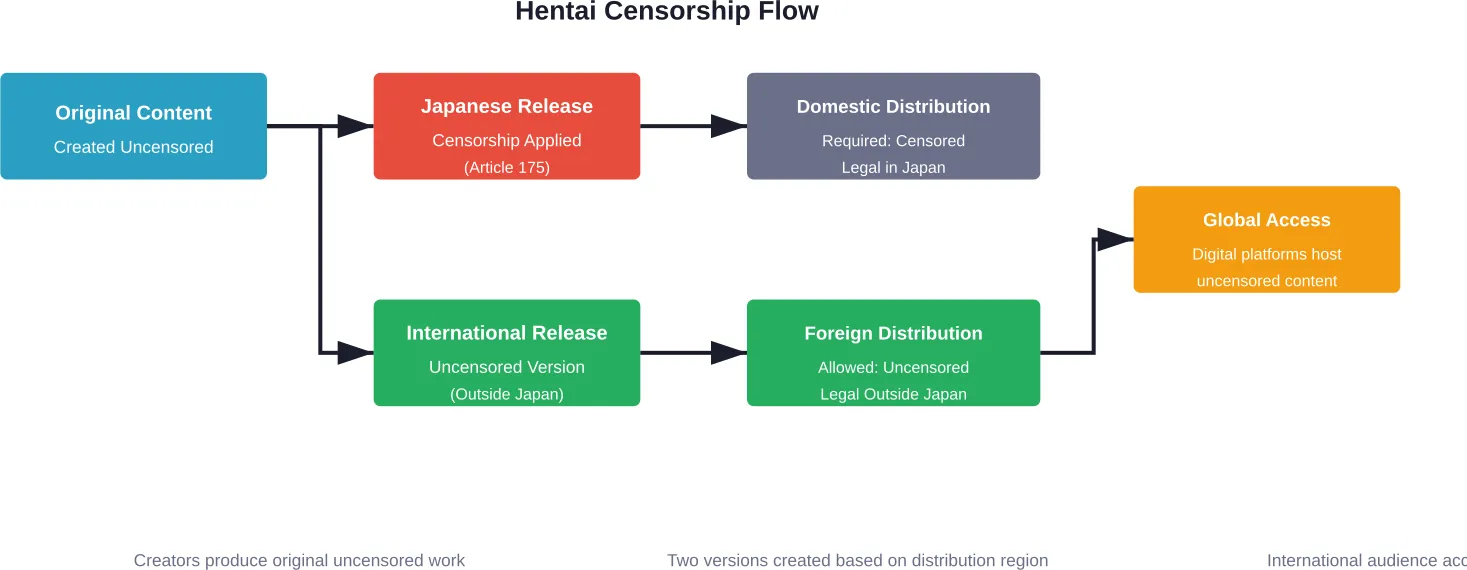
Anyone familiar with international hentai distribution knows uncensored versions circulate outside Japan. This isn’t illegal—it’s a jurisdictional reality.
Article 175 applies only within Japanese borders. Once content leaves Japan, it’s subject to the laws of whatever country it enters. Many countries have no laws specifically requiring censorship of illustrated sexual content, making distribution of uncensored versions legal.
Publishers sometimes create uncensored “international versions” specifically for foreign markets. The original Japanese release complies with Article 175 with required censorship, but the publisher produces an uncensored version exclusively for distribution outside Japan.
Digital distribution complicates enforcement. Content hosted on servers outside Japan and distributed internationally operates beyond Japanese legal jurisdiction. This has created a thriving market for uncensored content accessible globally, while the censored versions remain standard within Japan itself.
Now, this is where it gets interesting. Some content creators release only in international markets specifically to avoid Japanese censorship requirements. By never distributing within Japan, they sidestep Article 175 entirely.
Uncensored Browsing Through Tagged Content
Censorship in hentai usually comes from how the content is created and distributed, not how it’s later shared. Because of that, you’ll often see both censored and uncensored versions depending on the source and region.
Platforms like r34.app don’t apply their own edits – they organize posts from different sources using tags, so you can come across a mix of versions and formats in one place.
On r34.app, you can:
- explore how different versions of content are labeled
- browse tags tied to specific characters, games, or anime
- switch between images and animated posts
- check top and trending posts across sources
👉 Open r34.app, search a tag, and see how different versions appear across posts.
Enforcement and Prosecution
Japanese authorities do enforce Article 175, though enforcement patterns have varied over time. High-profile prosecutions serve as reminders that the law carries real consequences.
Legal records document prosecutions in the 1970s against Nikkatsu, with acquittals reported in 1978 and 1980. These cases demonstrated that even established companies faced legal action, though the acquittals were based on the censorship measures applied being sufficient to comply with the law.
Prosecutions for obscene content distribution have occurred in the modern era, reinforcing that compliance isn’t optional.
Generally speaking, enforcement focuses more on commercial distribution than individual possession. Someone possessing uncensored material for personal use faces lower risk than publishers or retailers selling such content.
That said, the legal uncertainty keeps most Japanese publishers strictly compliant. The potential penalties—both legal and reputational—outweigh any commercial benefit from testing the boundaries.
Cultural and Industry Perspectives
Community discussions reveal mixed feelings within Japan about censorship laws. Some view Article 175 as an outdated restriction inconsistent with modern society. Others accept it as established legal reality, working within its constraints rather than challenging it directly.
The manga and anime industries have adapted their creative approaches to work within censorship requirements. Artists develop techniques for implying sexual content without explicit depiction, or they structure scenes to minimize what needs censoring.
Interestingly, some creators argue censorship forces artistic creativity. Working within constraints can lead to innovative visual storytelling that suggests rather than shows. Whether this justifies the legal requirement remains debated.
Economic factors also play a role. The international market for uncensored versions generates significant revenue. Publishers benefit from selling censored versions domestically while profiting from uncensored international releases—essentially monetizing the same content twice with minimal additional production cost.
Comparison to Other Media Regulations
Japan’s approach to sexual content censorship contrasts with regulations in other countries. Many nations regulate sexual content through age restrictions and distribution limitations rather than mandatory censorship of the content itself.
The Entertainment Software Rating Board (ESRB) identifies descriptors like “mild provocative references” for content. Analyses of ESRB classifications show ratings based on content present rather than mandatory censorship requirements.
The Video Standards Council (VSC), acting as the statutory body for PEGI in the UK, refused to grant Omega Labyrinth Z a PEGI 18 rating, effectively banning its sale. The VSC noted the game’s style might attract audiences below 18 and expressed concerns about impressionable viewers. However, this was a distribution ban, not a censorship requirement—the game wasn’t required to add mosaic blurring, it simply couldn’t be sold in that market.
| Region | Regulatory Approach | Censorship Requirement |
|---|---|---|
| Japan | Mandatory censorship under Article 175 | Yes – genitalia must be obscured |
| United States | Age ratings and distribution restrictions | No – obscenity laws exist but don’t mandate specific censorship techniques |
| European Union | Age classification systems (PEGI) | No – classification may restrict distribution but doesn’t require content alteration |
| Australia | Classification Board with refusal option | Sometimes – games may require modifications or face refused classification |
Platform Policies and Moderation
Beyond legal requirements, content platforms implement their own policies regarding sexual content. These platform rules add another layer of complexity to what creators can distribute and where.
Platform policies increasingly adopt strict approaches to certain sexual content, with some implementing zero-tolerance standards.
The Prostasia Foundation developed principles for sexual content moderation through multi-stakeholder consultation between May and November 2019, emphasizing nuanced approaches balancing child protection with rights.
For animated or illustrated sexual content specifically, platform policies vary widely. Some platforms prohibit all sexual content regardless of whether it’s photographic or illustrated. Others allow illustrated adult content with age verification. Still others permit it freely with content warnings.
These platform-level restrictions sometimes have greater practical impact than national laws. A creator might legally produce uncensored content in their jurisdiction, but if major distribution platforms prohibit it, their ability to reach audiences becomes severely limited.
The Future of Censorship Laws
Will Article 175 ever change? That remains an open question.
Legal challenges have occurred periodically, but none have successfully overturned the law. The 1978 and 1980 acquittals of Nikkatsu employees established that certain censorship compliance measures were acceptable under the law.
Public opinion in Japan appears divided. Some advocacy for reforming obscenity laws exists, particularly among younger demographics and those in creative industries. However, conservative elements support maintaining traditional standards.
The growth of digital distribution and international content flow adds pressure on traditional censorship models. When uncensored content is freely accessible to Japanese audiences through foreign platforms, the effectiveness of domestic censorship laws becomes questionable.
Technology also enables easier censorship application and removal. AI-powered tools can automatically detect and censor content, or conversely, attempt to reconstruct censored areas. This technological cat-and-mouse game continues to evolve.
For now, Article 175 remains firmly established in Japanese law. Creators and publishers continue adapting to its requirements while the international market provides alternatives for those seeking uncensored content.
Frequently Asked Questions
Is all anime and manga censored in Japan?
No. Only content that depicts genitalia explicitly requires censorship under Article 175. Non-sexual anime and manga, as well as content with implied or non-explicit sexual themes, doesn’t require censorship. The law specifically targets obscene materials showing explicit genitalia.
Do artists create hentai with censorship already included?
Generally speaking, artists create their work uncensored first. Censorship gets applied later by either the artist or publisher as a compliance step before distribution in Japan. This allows the same work to have both censored Japanese versions and uncensored international versions from the same source material.
Can Japanese people legally access uncensored hentai?
Possession of uncensored material for personal use exists in a legal gray area. The law prohibits distribution and sale within Japan, not necessarily private possession. Many Japanese consumers access uncensored content through international websites and platforms operating outside Japanese jurisdiction, though this technically circumvents the law’s intent.
Why don’t Japanese publishers just release everything uncensored internationally?
Many do. Publishers often produce uncensored versions specifically for international markets while maintaining censored versions for domestic Japanese distribution. This approach maximizes revenue by complying with Japanese law domestically while serving international demand for uncensored content.
Has anyone successfully challenged Article 175 in court?
Legal challenges have occurred, including prosecutions against Nikkatsu in the 1970s that ended in acquittals in 1978 and 1980. However, these acquittals were based on the censorship applied being sufficient to comply with the law, not on overturning Article 175 itself. The law has never been successfully overturned or ruled unconstitutional.
Does censorship apply to all sexual content or just genitalia?
Article 175 specifically targets obscene materials, which courts have consistently interpreted as explicit depictions of genitalia. Other sexual content—nudity, sexual acts shown without explicit genital depiction, suggestive themes—exists in legal gray areas and may not require censorship depending on how explicit the content is.
Will Japanese censorship laws ever change?
That remains uncertain. Article 175 has been in effect since 1907 and remains actively enforced as of 2026. While some advocacy for reform exists, particularly among younger demographics and creative industries, no significant legislative movement toward changing the law has gained traction. The growth of international digital distribution may eventually create enough pressure for reform, but no timeline exists for such changes.
Conclusion
Hentai censorship exists because Japanese law requires it. Article 175 of the Japanese Penal Code, established in 1907, prohibits the distribution of obscene materials showing explicit genitalia. This legal requirement applies to all media—anime, manga, video games, and live-action content—regardless of age ratings or intended adult audiences.
The law creates the distinctive censorship techniques seen in Japanese adult content: pixelation, black bars, light beams, and strategic framing. Publishers must apply these methods to comply with legal requirements, not for artistic reasons.
Uncensored versions exist outside Japan because Article 175 applies only within Japanese borders. International publishers and digital platforms operate under different legal frameworks, many of which don’t require censorship of illustrated sexual content. This jurisdictional reality allows the same content to exist in both censored and uncensored forms depending on distribution location.
Understanding why hentai is censored requires recognizing the legal context rather than assuming cultural or artistic motivations. The censorship is a compliance requirement stemming from century-old obscenity laws that remain actively enforced today.
For those seeking uncensored content, international sources remain the primary option. For those interested in Japanese law and media regulation, Article 175 represents an interesting case study in how legal frameworks shape creative industries and content distribution in the digital age.