
Quick Summary: People are drawn to hentai for psychological reasons including fantasy fulfillment, anonymity, artistic expression, and the supernormal stimulus effect that creates exaggerated versions of human features. Research shows hentai consumers don’t differ from others in their attraction to humans or desire for relationships, but they may seek different forms of sexual content that offer control, variety, and freedom from judgment.
Hentai has become one of the most searched terms online, yet many people wonder what drives this particular interest in animated pornography. The Japanese term literally translates to “perverse” or “abnormal,” but the phenomenon is far more nuanced than its etymology suggests.
Understanding why hentai has gained such popularity requires examining psychology, evolutionary biology, cultural factors, and modern media consumption patterns. Research into this form of pornography reveals surprising insights about human sexuality and attraction.
The Supernormal Stimulus Effect: Why Cartoons Trigger Our Brains
Evolutionary psychologist Nikolaas Tinbergen discovered something fascinating about animal behavior that explains much about human attraction to sexual cartoons. His concept of “supernormal stimulus” describes how creatures respond more intensely to exaggerated versions of natural stimuli than to the real thing.
Humans exhibit similar responses. Sexual cartoons can present exaggerated physical features—larger eyes, enhanced proportions, idealized body types—that trigger our instinctual attraction responses more intensely than real human bodies. This isn’t about replacing real relationships but about how our brains react to heightened versions of attraction cues.
Here’s the thing though—this supernormal stimulus extends beyond just physical features. Animated content allows for scenarios, movements, and expressions that would be impossible in reality. The brain recognizes these as sexual stimuli, and the exaggeration actually amplifies the response.
Fantasy Fulfillment Without Real-World Constraints
One major appeal of hentai lies in its complete freedom from physical reality. Unlike traditional pornography featuring human actors, animated content has zero limitations on what can be depicted.
This opens possibilities for fantasy exploration that would be physically impossible, ethically problematic, or simply unavailable in live-action content. People can explore scenarios that exist purely in imagination without involving real people.
The anonymity factor plays a significant role here. Consumers of anime pornography report feeling less judgment about their interests when the content doesn’t involve real human performers. There’s a psychological distance that allows for exploration without the ethical considerations tied to live-action pornography.
Many who consume hentai describe it as a form of escapism. The artistic nature creates separation from reality that some find more comfortable than watching actual people engage in sexual acts.

See What People Actually Look At
When people talk about why they like hentai, it usually comes down to specific interests – characters, art styles, or themes tied to certain fandoms. It’s less about one category and more about how content is tagged and discovered.
Platforms like r34.app reflect this by organizing posts around tags, characters, and trends, pulling everything into one place for easier browsing.
On r34.app, you can:
- explore popular tags linked to different preferences
- browse fandoms like anime, games, and online series
- check top and trending posts to see what gets attention
- move between images and animated posts depending on format
👉 Open r34.app, try a few tags, and see what people are actually browsing.
What Research Actually Shows About Hentai Consumers
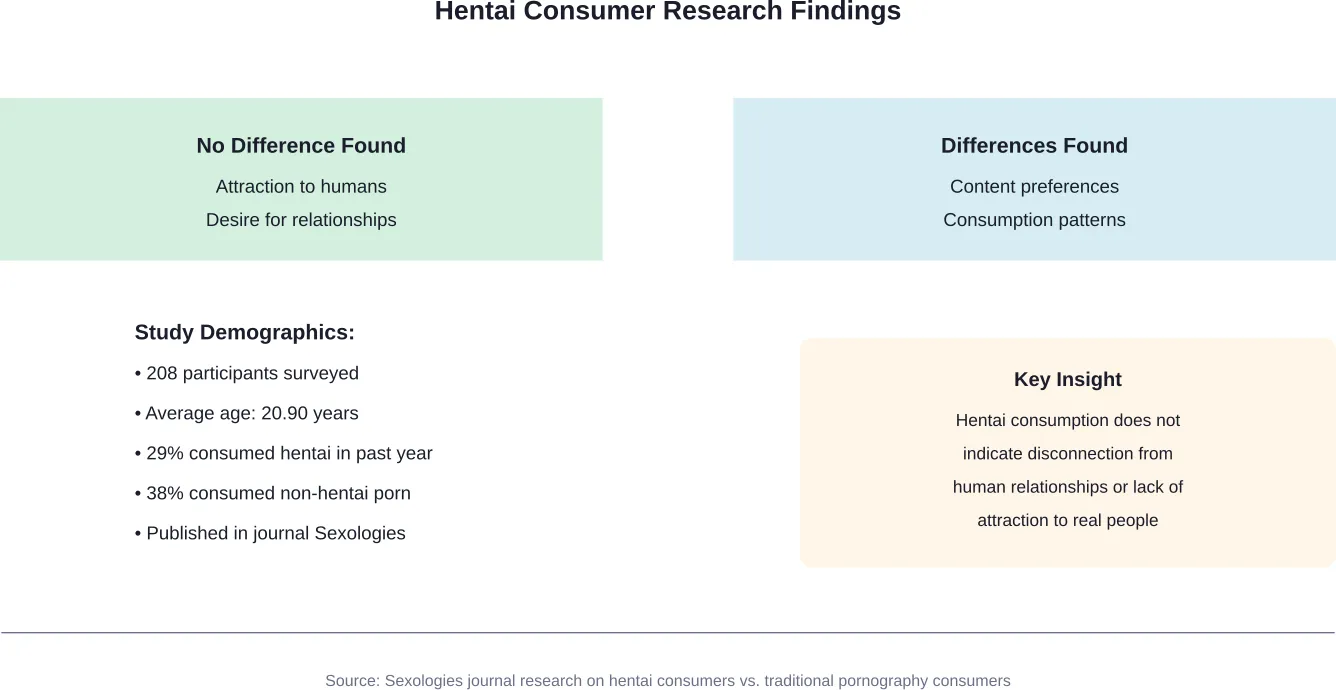
Psychologists have started examining how hentai consumers differ from those who view other types of pornography. According to research published in the journal Sexologies, the findings challenge many assumptions.
The study was based on survey responses from 208 participants who were 20.90 years old on average. Approximately 29% had consumed hentai in the past year, while 38% had consumed non-hentai pornography.
The key finding? People who consume hentai do not appear to differ from others in regard to their attraction towards humans or their desire for a human relationship. This directly contradicts the stereotype that hentai consumers are disconnected from real-world relationships or lack interest in actual human interaction.
However, hentai consumers did show differences on several other characteristics compared to those viewing traditional pornography. The research suggests these differences relate more to content preferences and consumption patterns than to fundamental relationship desires.
The Millennial and Gen Z Connection to Anime Culture
Anime and hentai pornography represents a growing trend among young adults (according to sources discussing parental awareness). This isn’t happening in isolation—it’s connected to broader anime culture popularity.
Millennials and Gen Z grew up with anime as mainstream entertainment. Shows like Pokemon, Naruto, and Dragon Ball Z were childhood staples, not niche interests. This normalization of Japanese animation created familiarity with the art style and storytelling conventions.
When people already consume anime for entertainment, the transition to adult-oriented anime content feels less jarring. The art style is familiar, comfortable even. There’s no cognitive dissonance between their entertainment preferences and their sexual content choices.
Research on anime genre preferences shows that anime fans engage with multiple genres across the medium. Someone who watches action anime might also watch romance anime, comedy anime, and yes—adult anime. It’s all part of the same cultural ecosystem.
Young adults spend significant time consuming media. Research indicates that American children and adolescents spend approximately four hours watching television and nearly eight hours consuming media daily, with emerging adults aged 18-25 reported to spend around 12 hours per day using media (Rideout, Foehr, & Roberts, 2010; Coyne, Padilla-Walker, & Howard, 2013).
With this level of media saturation, people seek variety in their content. Hentai offers a different experience from traditional pornography while still fitting within familiar visual and narrative frameworks for anime fans.
Artistic Expression and Visual Appeal
Not everyone who consumes hentai does so purely for sexual gratification. The artistic elements attract many viewers who appreciate animation, character design, and visual storytelling.
Japanese animation employs distinct aesthetic principles that differ from Western animation. The attention to detail, color palettes, and character expressiveness create visual experiences that some find more appealing than live-action pornography.
Animation allows for creative scenarios and settings impossible to film practically. Fantasy worlds, science fiction environments, and supernatural elements blend seamlessly with sexual content in ways live-action struggles to achieve convincingly.
Some consumers report that the artistic distance makes the content feel less exploitative. Since no real performers are involved, there are no concerns about consent, working conditions, or exploitation that plague the traditional pornography industry.
This ethical consideration matters to many modern consumers who are increasingly aware of problems within live-action adult entertainment. Animated content sidesteps these issues entirely.
Privacy, Control, and Consumption Patterns
The way people consume hentai differs from traditional pornography in several practical ways that enhance its appeal.
Manga—Japanese comics—provides a significant portion of hentai content. Reading offers more control than video. Consumers can pause, skip, or linger on specific panels. This level of control over pacing and content engagement appeals to many.
The variety within hentai is extensive. From romantic and plot-driven narratives to specific fetish content, the range covers virtually any interest. This variety means people can find highly specific content that matches their preferences rather than settling for close approximations.
Community discussions on forums reveal that many people appreciate hentai for its lack of real-world baggage. There’s no wondering about the performers’ wellbeing, no concerns about trafficking or coercion, and no guilt about supporting potentially harmful industries.
Privacy is another factor. Animated content feels more private to consume than videos of real people. Some describe it as less “voyeuristic” since they’re not watching actual humans in intimate situations.
The Role of Imagination and Mental Engagement
Hentai often includes plot, character development, and narrative elements more elaborate than typical pornography. This engages viewers mentally as well as physically.
Many works within the genre tell actual stories. Characters have motivations, relationships develop, and contexts matter. This narrative structure creates different psychological engagement than purely visual sexual content.
The imaginative element is stronger with animation. Viewers must mentally “fill in” aspects that live-action makes explicit. This cognitive participation creates a different type of arousal—one that’s more cerebral and imaginative.
For some consumers, this mental engagement is precisely the appeal. It’s not passive consumption but active imagination working with visual prompts.
Research examining adolescents’ media seeking shows that 92% reported getting information about AIDS from media (defined as television, magazines, or radio), with 59% using media for STI information and 78% for condom information. The way young people learn about and explore sexuality through media has fundamentally changed, and anime pornography represents one aspect of this shift.
Cultural Factors and Normalization
Japan’s different cultural approach to sexuality and censorship has shaped hentai’s development. Japanese law requires censorship of genitalia in pornography, which led to creative workarounds and stylistic choices that became genre conventions.
These conventions—the use of creative camera angles, strategic obscuring, and focus on expressions and reactions—created a distinct visual language. Many find this approach more suggestive and therefore more arousing than explicit depiction.
The term “hentai” itself has evolved. In Japan, it carries stronger negative connotations, while Western audiences use it as a neutral genre descriptor. This linguistic shift reflects cultural adaptation and normalization outside Japan.
As anime has become globally mainstream, so too has acceptance of adult anime content. What was once niche is now discussed openly in online communities. This normalization reduces stigma and makes consumption feel like a personal choice rather than a shameful secret.
Addressing Common Misconceptions
Several myths about hentai consumers persist despite research evidence to the contrary.
The biggest misconception is that people who watch hentai lack interest in real relationships or real people. As the Sexologies research demonstrated, this simply isn’t true. Hentai consumers show the same levels of attraction to humans and desire for relationships as anyone else.
Another myth suggests hentai consumption indicates social dysfunction or inability to form connections. Community discussions reveal that many consumers maintain active social lives, romantic relationships, and normal functioning. It’s simply a content preference, not a lifestyle indicator.
Some worry that animated pornography desensitizes people to real intimacy. However, no current research supports this concern specifically for hentai consumers compared to consumers of other pornography types.
The stereotype of the isolated, antisocial hentai fan is largely unfounded. Many consumers engage with online communities, attend anime conventions, and maintain diverse media consumption habits that include but aren’t limited to adult content.
Comparative Analysis: Hentai vs Traditional Pornography
| Aspect | Hentai | Traditional Pornography |
|---|---|---|
| Content Creation | Animated, illustrated, or computer-generated | Filmed with human performers |
| Fantasy Range | Unlimited by physical reality | Constrained by what’s physically possible |
| Ethical Concerns | No real performers involved | Performer welfare, consent, industry practices |
| Art Style | Japanese anime aesthetic conventions | Realistic cinematography |
| Narrative Elements | Often includes plot and character development | Typically minimal narrative |
| Consumption Control | Easy to pause, skip, control pacing (especially manga) | Video format with less granular control |
| Cultural Context | Rooted in Japanese animation traditions | Western film production conventions |
| Privacy Perception | Feels less voyeuristic to many consumers | Watching real people in intimate situations |
The Psychology of Anonymity and Safety
Psychological safety plays a significant role in hentai’s appeal. Consuming animated content provides layers of emotional and psychological distance that some people need to explore sexuality comfortably.
There’s no eye contact with real people, no sense of invading someone’s privacy, and no concerns about how performers were treated. This emotional buffer allows for exploration without the complex feelings that might accompany watching real humans.
For people with social anxiety or those who struggle with intimacy, animated content provides a non-threatening way to engage with sexual material. The characters aren’t real, which paradoxically makes the experience feel safer.
Anonymity extends to consumption patterns too. Hentai communities online allow for discussion and sharing without revealing identity. People can explore interests, ask questions, and engage with others who share their preferences without social risk.
This sense of safe space is particularly important for people exploring aspects of their sexuality they might not feel comfortable discussing in other contexts.
The Neurological Response to Animated Sexual Content
The brain doesn’t necessarily distinguish between animated and real sexual stimuli in terms of arousal response. Neural pathways associated with sexual excitement activate regardless of whether the stimulus is photographed or drawn.
What changes is the cognitive processing around that arousal. The frontal cortex—responsible for judgment and social awareness—processes animated content differently than recorded human activity. There’s less moral evaluation, less empathy activation, and less social cognition involved.
This creates a unique psychological state where arousal occurs without the full suite of social and emotional responses tied to watching real people. For some, this dissociation is precisely the appeal.
The supernormal stimulus effect compounds this. Exaggerated features trigger stronger responses in the brain’s reward centers than realistic proportions. It’s not that people prefer cartoons to real humans—it’s that the exaggerated stimulus creates a more intense initial response.
Concerns and Considerations
Despite research showing hentai consumers don’t differ in their attraction to real people, legitimate concerns exist around animated pornography, particularly regarding certain content types.
Some hentai depicts scenarios that would be illegal if they involved real people. The ethical questions around such content remain complex. While no real people are harmed in production, questions persist about whether such material normalizes harmful attitudes or behaviors.
Current research hasn’t conclusively demonstrated that animated pornography leads to real-world harmful behavior. However, the potential for problematic content to influence attitudes remains a concern for researchers and parents alike.
The growing trend of anime and hentai pornography among young adults is something parents need awareness of. Open communication about media consumption and healthy sexuality remains important regardless of the specific content type.
Excessive consumption of any pornography type can potentially interfere with real relationships, work, or daily functioning. Hentai isn’t uniquely problematic in this regard, but like any media, moderation matters.
The Social Aspect: Community and Shared Interest
Hentai consumption isn’t always solitary. Online communities dedicated to anime and manga—including adult content—create social spaces around shared interests.
These communities serve multiple functions. They provide recommendations, facilitate discussions about art and storytelling, and create spaces where people feel their interests are understood and accepted.
For many young adults, these online communities become important social outlets. Research on shared enthusiasm and anime fandom shows that social cohesion within these communities contributes to their appeal and longevity.
The community aspect normalizes consumption and reduces feelings of shame or isolation. When thousands of others openly discuss and share interest in hentai, it feels less like a deviant interest and more like a subcultural preference.
Conventions, online forums, and social media groups dedicated to anime culture often include discussions of adult content alongside mainstream anime. This integration reflects how consumers view hentai as one genre among many within the broader anime ecosystem.
Demographics and Consumption Patterns
Understanding who consumes hentai provides context for its popularity. While comprehensive demographic data remains limited, available research and community surveys reveal patterns.
The average age of consumers tends younger, with significant representation among individuals aged 18-30. This aligns with the generational exposure to anime during formative years.
Gender distribution challenges assumptions. While male consumers dominate raw numbers, significant female participation exists—particularly in certain subgenres and manga consumption. Women create and consume substantial amounts of hentai content, though their preferences often differ from male consumers.
Geographic distribution has shifted dramatically. What began as a Japanese medium now has global consumption, with significant markets in North America, Europe, and throughout Asia. Cultural adaptation has created region-specific preferences and subgenres.
Consumption frequency varies widely. Some people engage occasionally out of curiosity, while others make it their primary pornography type. The Sexologies study found 29% of participants had consumed hentai in the past year, suggesting it’s a common but not necessarily primary choice for many.
Frequently Asked Questions
Is watching hentai normal?
Yes, hentai consumption is common, particularly among young adults familiar with anime culture. Research shows approximately 29% of surveyed participants had consumed hentai in the past year. It represents one preference among many types of sexual content, and consumers don’t differ from others in their attraction to real people or desire for relationships.
Does watching hentai affect real-world relationships?
Current research shows that hentai consumers display the same levels of attraction toward humans and desire for human relationships as non-consumers. The content preference doesn’t indicate disconnection from real-world intimacy. However, like any media consumption, excessive use that interferes with daily life or relationships may indicate broader issues requiring attention.
Why is hentai more appealing than regular pornography to some people?
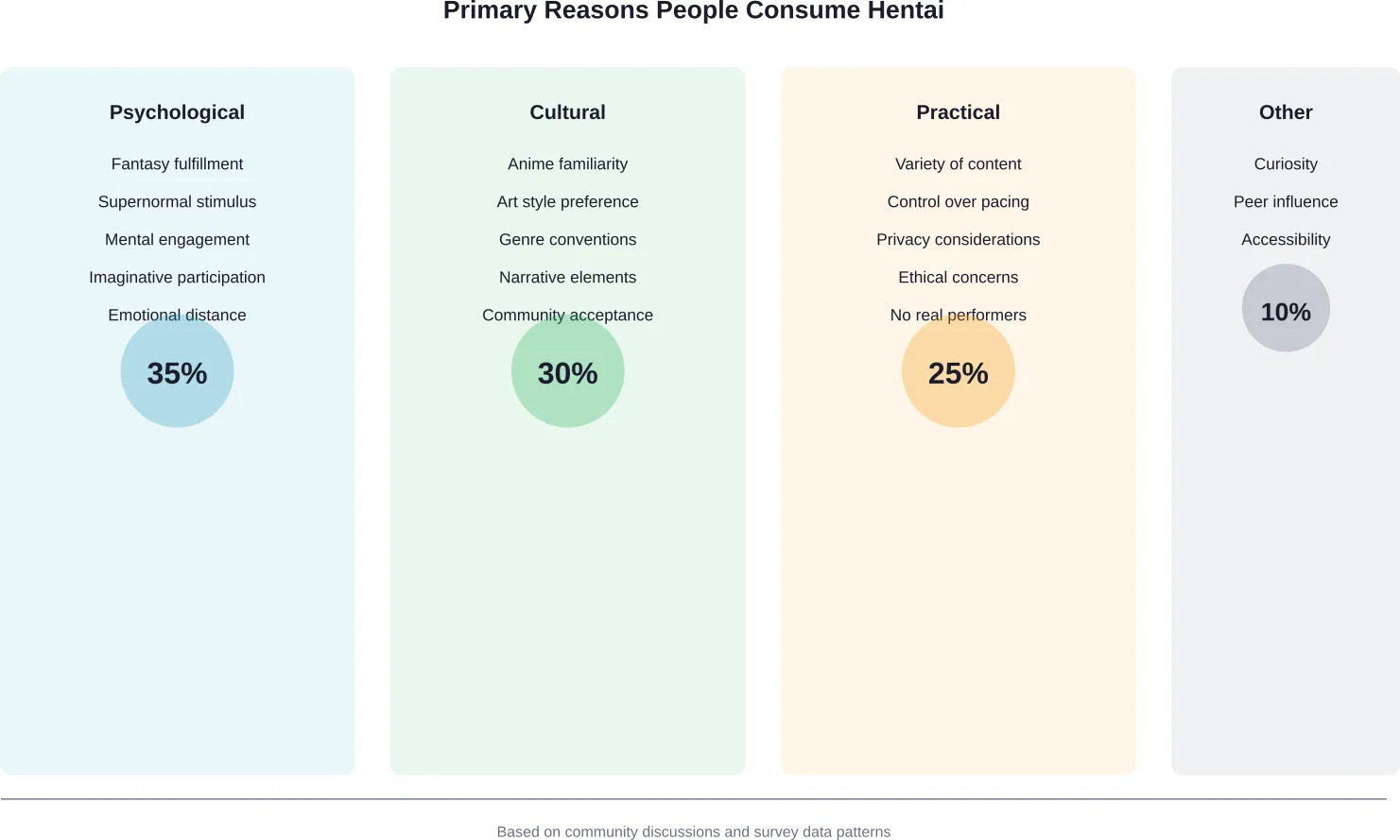
Several factors contribute: the supernormal stimulus effect creates exaggerated features that trigger stronger arousal responses; the fantasy element allows impossible scenarios; there are no ethical concerns about real performers; the artistic style appeals to anime fans; and the emotional distance feels safer or less invasive to many consumers. The appeal is psychological, cultural, and practical.
Is hentai harmful?
Research hasn’t demonstrated that hentai consumption itself causes harm to consumers or affects their real-world relationships negatively. However, concerns exist about specific content types and the potential for any pornography—including hentai—to become problematic when consumed excessively. Moderation and self-awareness about consumption patterns are important regardless of content type.
Why do people who watch anime often watch hentai too?
Familiarity with the art style and storytelling conventions makes the transition natural. For people who already consume anime entertainment, adult anime content uses familiar visual language and narrative structures. It’s not a separate, foreign medium but rather an adult-oriented genre within an already-enjoyed format. The cultural ecosystem of anime includes multiple genres, and adult content is simply one of them.
What does research say about hentai consumers?
The most significant research finding, published in the journal Sexologies, showed that hentai consumers don’t differ from others in their attraction to humans or desire for relationships. They do show differences in content preferences and consumption patterns compared to traditional pornography consumers, but these differences don’t indicate social dysfunction or disconnection from reality.
Can hentai be considered art?
Many consumers and creators view hentai as artistic expression within the broader anime medium. It involves illustration, character design, storytelling, and visual composition—all elements of artistic creation. While the sexual content is explicit, the production requires the same artistic skills as any animation or illustration. Whether individual works qualify as “art” depends on execution, just as with any creative medium.
Conclusion: Understanding Complex Motivations
The appeal of hentai stems from a complex intersection of evolutionary psychology, cultural familiarity, artistic preferences, and practical considerations. The supernormal stimulus effect explains why exaggerated animated features trigger strong arousal responses, while cultural exposure to anime creates comfort with the art style.
Research challenges common stereotypes, demonstrating that hentai consumers maintain normal attraction to real people and desire for actual relationships. The content preference doesn’t indicate social dysfunction but rather represents one option within diverse media consumption patterns.
Fantasy fulfillment without real-world constraints, ethical considerations about performer welfare, and the psychological safety of emotional distance all contribute to hentai’s appeal. For anime fans, it’s a natural extension of familiar entertainment into adult content.
Understanding why people like hentai requires moving beyond judgment to examine the legitimate psychological, cultural, and practical factors at play. As anime culture continues growing globally and media consumption evolves, hentai will likely remain a significant—if sometimes controversial—aspect of sexual content consumption.
What matters most is approaching the topic with nuance, respecting research findings over stereotypes, and maintaining open conversations about healthy media consumption across all content types.